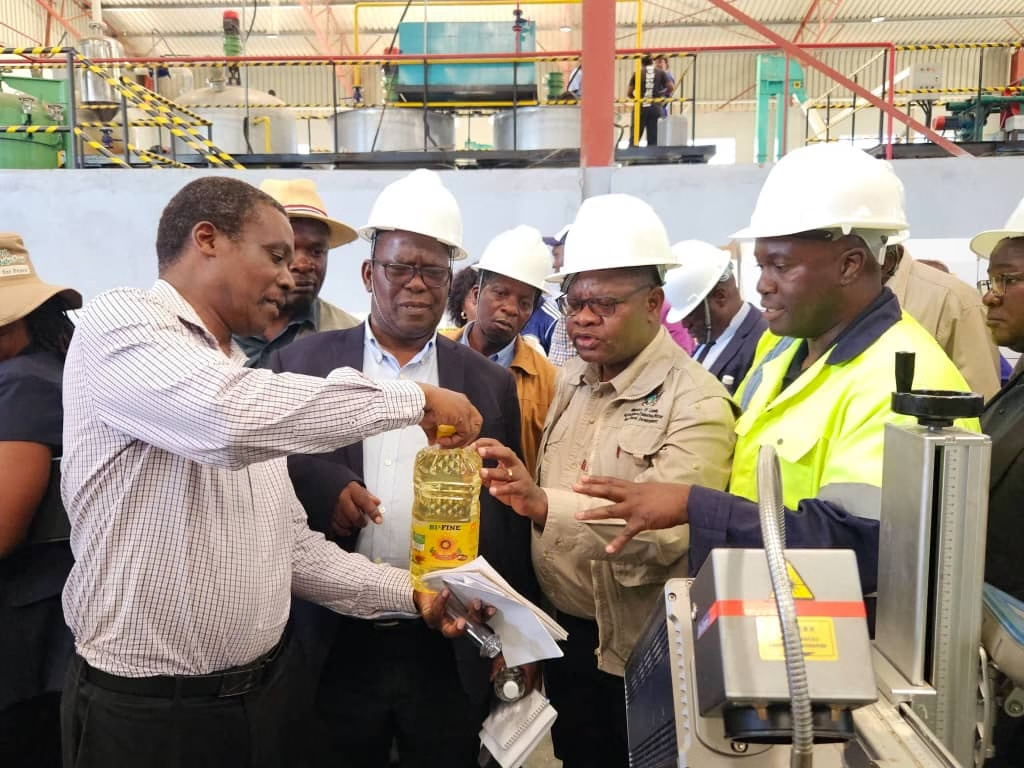
Mutoko – The Finealt bioeconomy plant in Mutoko is fast positioning itself as a strategic pillar in Zimbabwe’s rural industrialisation drive, demonstrating how local resources can be transformed into high-value products while stimulating inclusive economic growth.
Spearheaded within the broader framework of the National Development Strategy 2 (NDS2), the plant focuses on converting locally grown crops such as sunflower and soya into cooking oil, soap and biodiesel. This model directly addresses one of Zimbabwe’s long-standing economic gaps, the export of raw agricultural produce with limited local value addition.
What sets the Finealt plant apart is its integrated approach. Rather than operating as an isolated industrial project, it functions as a convergence point for agriculture, innovation and manufacturing. Farmers in Mutoko and surrounding districts are not just producers, but active participants in a value chain that guarantees a market for their crops while improving incomes and productivity.
Obert Jiri has underscored the significance of the initiative, describing it as a practical example of how government institutions can coordinate to deliver tangible economic transformation at community level. The plant reflects a “whole-of-government” approach, where policy, technical expertise and implementation are aligned toward a common developmental goal.
Similarly, Fanuel Tagwira has highlighted the scientific and innovation dimension of the project, noting that bioeconomy models such as Finealt are critical in transitioning Zimbabwe from a resource-based economy to a knowledge-driven one. By leveraging research and local knowledge systems, the plant demonstrates how science can be applied to solve real economic challenges.
At its core, the Finealt initiative speaks to value addition and beneficiation, key pillars of Zimbabwe’s industrialisation agenda. Instead of exporting raw oilseeds, the country is now producing finished goods that can compete in both domestic and regional markets. This not only improves trade balances but also reduces dependency on imports of basic commodities like cooking oil and soap.
The biodiesel component of the plant further introduces an energy dimension, aligning with global trends toward renewable energy and sustainability. By producing alternative fuel sources locally, the initiative contributes to energy security while creating new economic opportunities within rural communities.
Beyond production, the plant is also a catalyst for skills development and employment creation. Youths and local residents are gaining exposure to agro-processing technologies, manufacturing processes and business operations, building a workforce that is equipped for a modernising economy.
The ripple effects extend into financial inclusion and rural development. With structured value chains, farmers are better positioned to access financing, inputs and extension services. This strengthens agricultural productivity while ensuring that rural communities are not left behind in the national development trajectory.
However, for the Finealt model to achieve its full potential, scalability and consistency will be key. Expanding such initiatives to other provinces, strengthening supply chains and ensuring stable input production will determine long-term sustainability. Equally important is maintaining quality standards that allow locally produced goods to compete regionally and internationally.
The Mutoko plant ultimately represents more than a processing facility, it is a blueprint for how Zimbabwe can industrialise from the ground up. By linking agriculture, innovation and manufacturing, it demonstrates that rural areas can become centres of production, not just sources of raw materials.
As Zimbabwe advances toward Vision 2030, projects like Finealt provide a clear indication of the path forward, one where local resources are harnessed, communities are empowered and economic growth is both inclusive and sustainable.