By Aldridge Dzvene
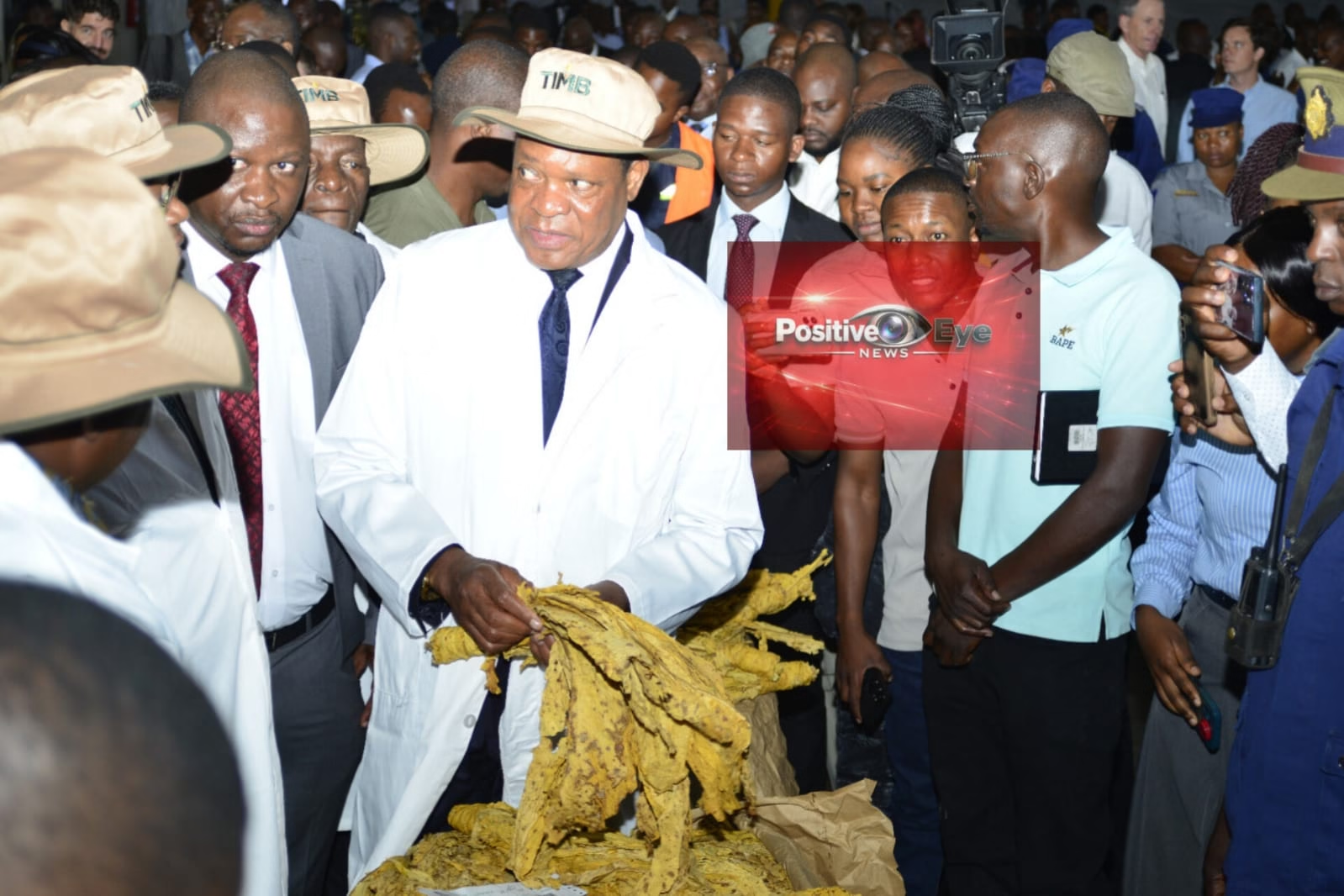
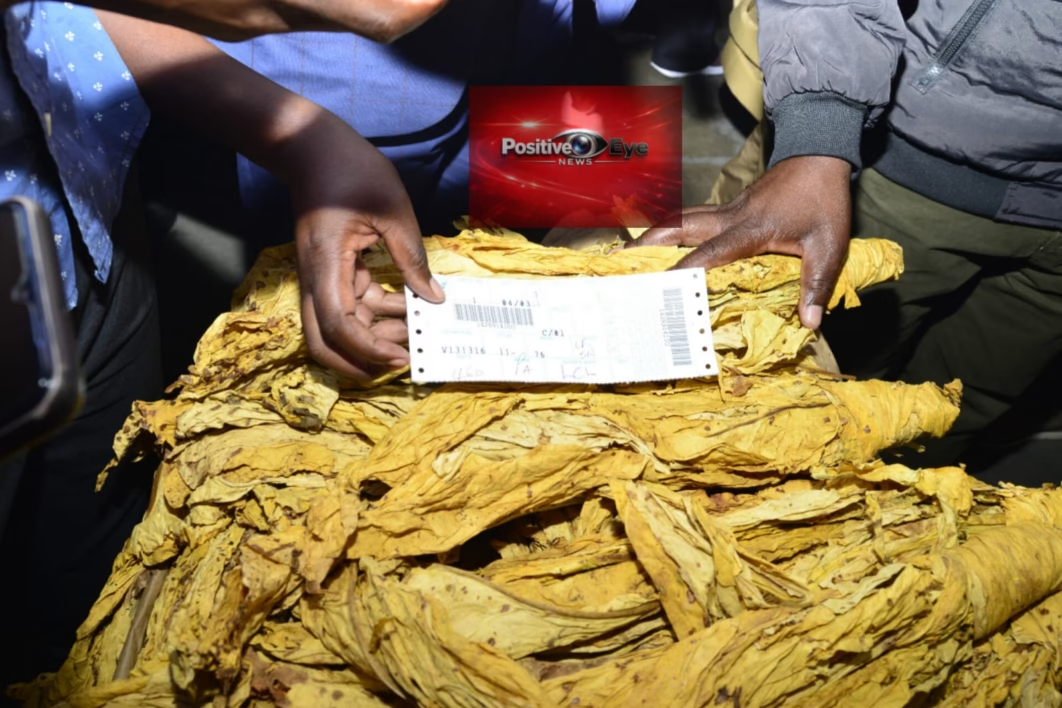
The 2026 Tobacco Marketing Season has officially opened at the Tobacco Sales Floor in Willowvale, Harare, with the first bale going under the hammer at US$4.60 per kilogramme, setting an early tone of cautious optimism in a year defined by record ambitions and structural reform. The opening coincided with the launch of the Tobacco Value Chain Transformation Plan II, a five-year blueprint that aims to grow the industry into a US$7 billion enterprise by 2030.
Government officials and industry leaders framed the season not merely as a marketing exercise but as a consolidation phase for a sector that has become one of Zimbabwe’s most strategic economic pillars. Tobacco production reached 355 million kilogrammes in 2025, an 88 percent increase from 189 million kilogrammes in 2017. Farmer earnings crossed the US$1 billion threshold for the first time in history, reaching US$1.2 billion and supporting more than 135,000 households. Average earnings per grower rose significantly, reinforcing tobacco’s central role in rural income transformation.
Yet the significance of the US$4.60/kg opening price extends beyond symbolism. In seasons of anticipated high output, with projections hovering around 400 million kilogrammes for 2026, price sustainability becomes the ultimate test of market depth and quality differentiation. Policymakers and merchants alike are aware that global oversupply conditions, shifting consumption patterns and increasing regulatory scrutiny demand a more sophisticated industry response.
Under the Tobacco Value Chain Transformation Plan II, the strategic focus shifts from volume dominance to value optimisation. While production is targeted to increase from 355 million kilogrammes to 500 million kilogrammes by 2030, the more transformative ambition lies in raising value addition from the current 11 percent to 30 percent. This entails expanding local processing of cut rag and finished tobacco products, deepening beneficiation and retaining more export value within Zimbabwe.
Processing capacity has already expanded significantly over the past decade. From three green-leaf processing machines with a capacity of 200 million kilogrammes in 2017, the country now operates four machines with a combined capacity of 380 million kilogrammes. The commissioning of a high-capacity cut rag processing plant in Harare in late 2025 further strengthens beneficiation prospects, signaling a decisive move up the value chain.
Institutional reform also features prominently. The Tobacco Industry and Marketing Board has licensed 48 contractors for the 2026 season, alongside 47 Class A buyers. Three auction floors, Tobacco Sales Floor, Premier Tobacco Auction Floors, and the new entrant Ethical Sales Floor, are operating this season, complemented by five decentralised selling centres aimed at reducing logistical burdens on farmers and aligning with the devolution agenda.
Payment structures remain consistent with previous seasons, with growers receiving 70 percent of proceeds in United States dollars and 30 percent in local currency. This hybrid framework reflects an attempt to balance foreign currency retention for farmers with broader macroeconomic stabilisation objectives.
However, structural risks persist. Industry leaders have raised alarm over the proliferation of illegal and counterfeit tobacco seed, describing it as a direct threat to productivity, traceability and Zimbabwe’s premium market reputation. Enforcement measures and farmer awareness campaigns are being intensified in collaboration with research institutions and law enforcement agencies. In a market increasingly driven by sustainability metrics and traceability compliance, compromised seed integrity could undermine long-term competitiveness.
At the same time, Zimbabwe is positioning itself to remain relevant amid global consumption shifts. With smoking volumes declining in traditional markets and demand rising for next-generation heated tobacco products, diversification into specialised leaf types is emerging as a strategic hedge. Export earnings, already at US$399.8 million by mid-February 2026, will depend not only on tonnage but on responsiveness to evolving product standards and market preferences across the Far East, Europe, Africa and the Middle East.
The broader macroeconomic calculus is clear. Tobacco remains one of Zimbabwe’s largest single sources of foreign currency inflows, rural employment and downstream industrial activity. Approximately 85 percent of production is driven by smallholder farmers, embedding the crop deeply into the social and economic fabric of rural communities. In Matabeleland North and South, for example, Naturally Cured Virginia production has expanded sharply, reflecting both geographic diversification and resilience.
The US$4.60/kg opening price, while only the first indicator in a long marketing cycle, captures the intersection of aspiration and reality. The industry stands at a pivotal juncture: production capacity is expanding, value addition infrastructure is strengthening, and policy alignment with Vision 2030 is tightening. Yet global headwinds, sustainability compliance pressures and quality expectations will ultimately determine whether the US$7 billion target becomes a milestone achieved or merely a benchmark declared.
As the 2026 marketing season unfolds, Zimbabwe’s tobacco sector is no longer simply chasing volume records. It is navigating a structural transition from a high-output exporter of raw leaf to a competitive, value-driven agro-industrial ecosystem. The opening auction at US$4.60 per kilogramme may well be remembered not just as the first sale of the season, but as the starting signal for the next phase of transformation.
Pictures by George Nyamukubva