Story by Aldridge Dzvene
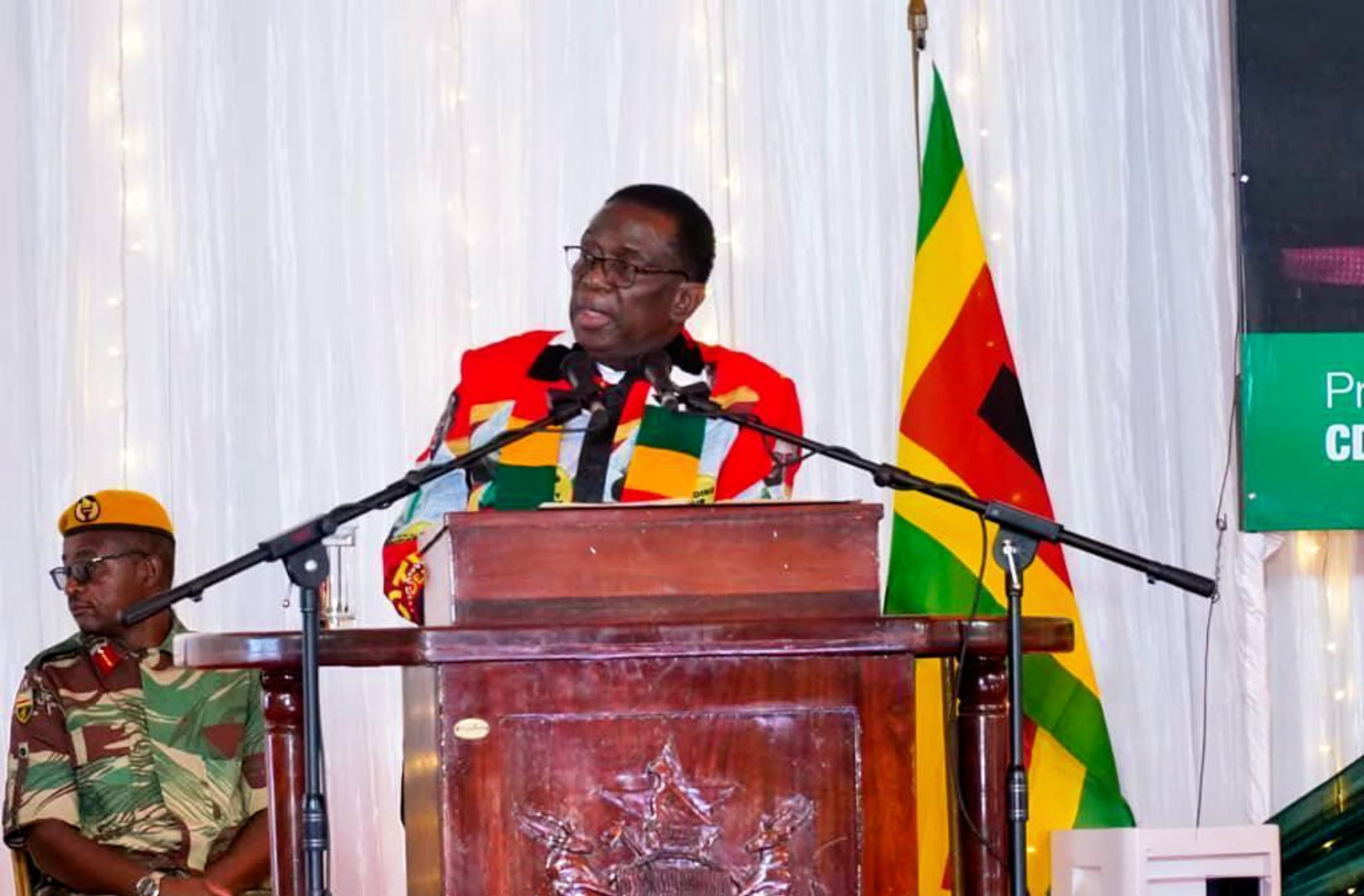
The First Secretary and President of ZANU PF and President of the Republic of Zimbabwe used the Central Committee Strategic Seminar in Gweru not merely as an internal party platform but as a governance and development signal point, setting out a structured doctrine that blends ideological discipline, institutional accountability and economic transformation under Vision 2030. The address reads less like routine party rhetoric and more like a systems level recalibration of how political leadership must function within a modernising state facing shifting global economic, technological and security realities.
At the core of the President’s message is the repositioning of political leadership from symbolic authority to operational responsibility. The Central Committee was framed not simply as a supervisory organ between Party Congresses but as a constitutional engine expected to translate resolutions into measurable governance outcomes. By repeatedly grounding authority in constitutional literacy, discipline and collective responsibility, the President elevated institutional compliance above personality driven leadership, reinforcing predictability and continuity as foundations for development delivery.
This emphasis on constitutional alignment between Party and State structures is economically significant. In development economics, policy credibility and institutional consistency are critical variables in attracting long term capital, sustaining reform momentum and reducing governance risk. The President’s insistence that Party and National constitutional frameworks are complementary legal instruments signals an attempt to harmonise political authority with administrative execution. Such alignment reduces policy contradiction risk and strengthens implementation coherence across ministries, provinces and agencies.
The President’s intervention also places leadership capacity development at the center of national transformation. Rather than assuming political experience alone is sufficient, the address stresses analytical competence, ideological clarity and technical understanding of economic frameworks. This reflects recognition that modern governance increasingly requires leaders who can interpret economic data, technological shifts and global market movements, not merely mobilise political support. It suggests an evolution toward evidence informed leadership within political structures, which is often a missing link in emerging economy reform trajectories.
From a macroeconomic governance perspective, the directive that Party leadership must better understand economic transformation frameworks is strategically timed. Zimbabwe is operating in an environment of currency reform, fiscal consolidation, mineral value chain expansion and re engagement efforts with international financial institutions. Political actors who lack economic literacy can unintentionally disrupt reform consistency. By urging deeper economic comprehension within the Central Committee, the President is effectively building a political risk buffer around reform programs.
The address also integrates technological disruption and security into political leadership responsibilities. By referencing artificial intelligence, hybrid warfare, media plurality and digital influence, the President acknowledges that governance vulnerability has shifted beyond traditional political and military threats into information and technology domains. This is consistent with global governance trends where digital infrastructure, data control and narrative influence are now elements of national security and economic competitiveness. Embedding this awareness into party leadership training suggests a forward looking risk management posture.
Another critical analytical dimension is the President’s positioning of corruption, inefficiency and complacency as development threats rather than merely ethical failures. This reframing matters. When corruption is treated as a macroeconomic constraint, it becomes a growth variable, not just a moral issue. Leakages, procurement distortions and bureaucratic delay directly reduce development multiplier effects. The call for active exposure of inefficiencies within both Party and Government structures signals an attempt to internalise accountability enforcement rather than outsourcing it solely to oversight agencies.
The development philosophy outlined in the address is also people centered but execution driven. The President repeatedly links leadership conduct to poverty reduction, quality of life improvement and Vision 2030 delivery. Importantly, development is not presented as an abstract target but as a leadership obligation with ripple effects. This language suggests a governance model where political structures are evaluated by delivery performance, not ideological loyalty alone. In development administration theory, this marks a shift from patronage centered systems toward performance legitimacy models.
International relations doctrine was also carefully integrated into the development framework. By reaffirming that Zimbabwe is a friend to all and an enemy to none, while also declaring that the country is open for business but not for sale, the President balanced investment openness with sovereignty protection. Economically, this is a dual signal to global capital and domestic constituencies. It communicates investment receptiveness while maintaining policy space over strategic resources. Such positioning is typical of states seeking diversified partnerships without dependency capture.
The repeated stress on unity, discipline and ideological consistency inside the Party also has an economic governance interpretation. Fragmented political leadership often produces policy reversals, regulatory uncertainty and reform paralysis. By tightening ideological and structural discipline, the President is indirectly reinforcing policy stability signals to markets and investors. Political coherence reduces reform volatility premiums that are often priced into frontier market risk assessments.
Equally notable is the President’s directive to modernise mobilisation strategies through new media and digital platforms. This is not only a communication adjustment but an institutional adaptation to demographic and technological change. Younger populations consume political and economic information differently, and governance legitimacy increasingly depends on digital engagement capacity. Integrating new media into leadership responsibility indicates awareness that development narratives must compete in real time information environments.
Taken analytically, the address represents a layered governance blueprint rather than a ceremonial speech. It links party discipline to state performance, constitutional literacy to policy credibility, leadership capacity to economic transformation, technology awareness to national security, and anti corruption enforcement to development efficiency. The Central Committee is being repositioned as a strategic governance interface rather than a procedural structure.
In development terms, the message is clear, political leadership must evolve into a disciplined, analytically equipped, constitutionally grounded and economically literate force capable of executing long horizon national transformation goals. Whether this institutional recalibration translates into measurable delivery outcomes will depend on implementation depth, enforcement consistency and leadership behavior alignment. But as a strategic signal, the address sets a high governance bar anchored on systems, discipline and development execution.