Story by Aldridge Dzvene
Zimbabwe’s foreign policy doctrine of being a friend to all and an enemy to none is no longer just a diplomatic phrase, it is increasingly becoming a structured economic strategy under President Emmerson Dambudzo Mnangagwa, who has consistently positioned international engagement as a central pillar of national development and investment attraction.
President Mnangagwa has, over successive international platforms and bilateral engagements, advanced a diplomacy that is deliberately economic in character, reform aware in tone, and partnership driven in execution. His approach reframes foreign relations from symbolic cooperation to outcome based engagement, where meetings translate into memoranda, and memoranda are expected to mature into projects, capital flows, technology transfer and market access.
At the core of President Mnangagwa’s international relations posture is diversification. Rather than anchoring Zimbabwe’s future to one geopolitical axis, his administration has expanded cooperation channels across the Middle East, Europe, Asia and within Africa. This wide spectrum engagement model reduces dependency risk and increases opportunity exposure, allowing Zimbabwe to negotiate from a position of flexibility and strategic balance.
Under President Mnangagwa, the Open for Business doctrine has been elevated from a campaign message into a governing framework. It now connects diplomacy, regulatory reform, ease of doing business measures, and institutional alignment. The President’s repeated emphasis on policy consistency, property rights dialogue, investment protection, and sector modernization is designed to send market signals that Zimbabwe is not only inviting capital, but preparing systems to receive it.
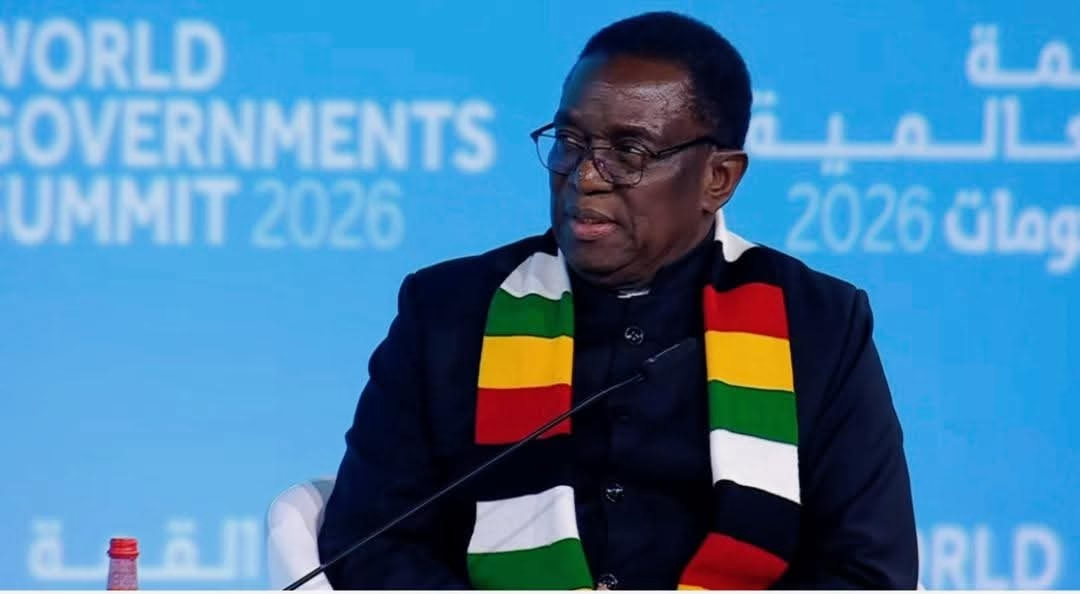
International summits attended by President Mnangagwa have increasingly become economic corridors rather than ceremonial appearances. These platforms are being used to pitch Zimbabwe as an investment destination in mining value addition, agriculture modernization, tourism expansion, digital transformation and energy development. His engagements with government leaders, sovereign funds and private investors reflect a pattern of targeted economic diplomacy rather than protocol driven travel.
President Mnangagwa’s emphasis on innovation and technology partnerships is also reshaping the diplomatic agenda. Cooperation around digital government systems, artificial intelligence frameworks, skills development and innovation ecosystems shows a forward looking dimension to Zimbabwe’s global outreach. This signals that the country is not only selling resources, but also seeking relevance in future industries.
Tourism and cultural diplomacy, reinforced by high level receptions of international business delegations, also fit within President Mnangagwa’s broader engagement matrix. By linking heritage, investment and trade access, his approach converts soft power into commercial pathways. Visitors are treated not only as guests, but as potential partners and connectors into global enterprise networks.
The friend to all, enemy to none philosophy, as driven by President Mnangagwa, lowers negotiation friction and widens cooperation space. Neutral accessibility increases dialogue opportunities and accelerates partnership formation. In a fragmented global environment, predictability and openness become diplomatic assets.
What is becoming visible is a presidency that treats diplomacy as an economic tool, engagement as infrastructure, and international relations as a growth engine. The success of President Mnangagwa’s model will ultimately be measured by funded projects, operational industries, expanded exports and sustained investor confidence, but the architecture of that strategy is now clearly in motion.
Zimbabwe’s global re engagement under President Mnangagwa is therefore not accidental, it is structured, persistent and economically intentional, positioning the country as open, available and competitively engaged with the world.