What was meant to signal a long-awaited rebirth of the Movement for Democratic Change has instead laid bare the extent of institutional decay gripping Zimbabwe’s once-dominant opposition, as fresh resistance from party leader Douglas Mwonzora threatens to derail a court-mandated reset before it even begins.
At the centre of the latest turmoil is the Draft MDC Agreement for Reconciliation and Party Restructuring, crafted by the Joint Monitoring and Implementation Committee (JOMIC) as a corrective response to a High Court judgment that nullified the party’s controversial 2023 congress. Rather than unifying the party, the agreement has exposed a deeper crisis, one rooted not only in factionalism, but in a fundamental clash between personal power retention and constitutional rebuilding.

Rainbow Hotels — Experience Luxury Across Zimbabwe
Rainbow Hotels continues to redefine hospitality standards in Zimbabwe, offering world-class accommodation, fine dining, and modern conference facilities in Harare, Bulawayo, and Victoria Falls.
Whether for business or leisure, Rainbow Hotels delivers unmatched comfort, exceptional service, and a truly premium guest experience tailored to modern travellers.
Book NowPressure has intensified on Mwonzora, who has refused to endorse the JOMIC blueprint unless he is first recognised as the legitimate MDC president and allowed to return to Harvest House under that authority. The demand effectively seeks to pre-empt the very restructuring process ordered by the court, converting reconciliation into a conditional political surrender. In doing so, it transforms what was meant to be a neutral, healing framework into a fresh battlefield.
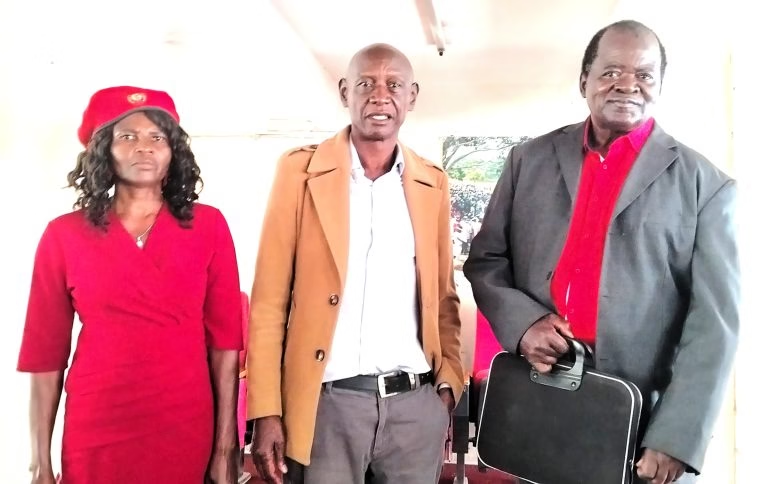
JOMIC chairperson Gift Chimanikire has confirmed Mwonzora’s refusal to sign the agreement, describing it as a direct contradiction of the negotiated process. The committee, whose principals represent both the applicants led by Eng. Elias Mudzuri and the respondents led by Mwonzora, was deliberately structured to bridge rival camps and guide the party back to constitutional order. Its work now hangs in the balance.
The standoff underscores a recurring pattern that has haunted the MDC since its fragmentation: the elevation of leadership claims above institutional legitimacy. By insisting on recognition before process, Mwonzora positions himself against the logic of the High Court ruling, which called for restructuring precisely because existing authority claims were legally and procedurally compromised. In effect, the dispute is no longer about unity, but about whether rules still matter inside the opposition.
The agreement itself, while couched in the language of renewal, already hinted at a party struggling to govern itself. Its call for blanket amnesty, nullification of a previous congress, and establishment of multiple interim structures revealed an organisation attempting to reset without fully confronting accountability for past failures. Mwonzora’s resistance now sharpens that contradiction, exposing how fragile even negotiated consensus has become.
Tensions were further illustrated at Harvest House this week when a much-anticipated press briefing by JOMIC was abruptly cancelled, officially due to unspecified security concerns. Instead, Eng. Mudzuri addressed the media, urging calm and discipline within a party that increasingly appears to be fighting its own shadow. His remarks, calling for order at party headquarters, sounded less like routine leadership messaging and more like an appeal to salvage a fading institutional culture.
Mudzuri revealed that post-judgment engagements had at least produced agreement on a pathway toward congress, including the formation of a steering committee that was meant to be announced at the aborted briefing. Yet the very need to cancel the event reinforced a troubling reality: even basic communication within the MDC has become hostage to internal mistrust and power struggles.
More broadly, Mudzuri acknowledged what many observers have long argued, that Zimbabwe’s opposition landscape is currently too fragmented, too structurally weak and too inward-looking to mount a credible challenge to ZANU PF. His warning against splinter projects was a tacit admission that the MDC brand, once synonymous with opposition strength, is now fighting for political survival.
Recent court skirmishes over control of Harvest House, including the failed attempt by Mwonzora to remove Morgan Komichi ally Mr. Mukoyi, have only deepened the sense of drift. That a party founded on democratic contestation must repeatedly rely on litigation to determine who controls its own offices illustrates how far it has strayed from mass politics into procedural paralysis.
In this context, the JOMIC pact does not read as a bold renewal strategy but as a damage-control instrument for a party in managed decline. Mwonzora’s refusal to sign it merely strips away the remaining pretence of unity, revealing an opposition still negotiating itself while the electorate moves on.
Unless the MDC resolves whether it is rebuilding an institution or protecting individual ambitions, the promised extraordinary congress risks becoming another symbolic exercise, one that rearranges leadership claims without restoring public trust. What is unfolding is not renewal, but a stark reminder that opposition decay, once entrenched, cannot be reversed by agreements alone.