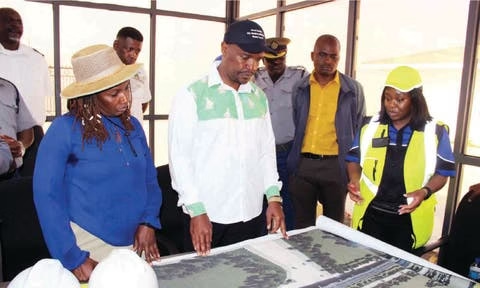
The launch of the Mabvuku Interchange marks more than a new road project, it is a defining moment in Harare’s struggle with urban mobility, economic competitiveness, and modern infrastructure planning.
For decades, the Harare–Mutare Highway stretch feeding into Mabvuku and Tafara has been synonymous with gridlock, bottlenecks, and accidents. The start of construction, with traffic officially diverted onto detours this September, represents the state’s most direct attempt yet to solve a structural weakness that has choked movement and commerce.
Unlike routine road rehabilitation, an interchange alters traffic flows permanently, opening the possibility of smoother regional connections between Harare, Ruwa, Mutoko, and the airport. It is no coincidence that this corridor is one of Zimbabwe’s most economically sensitive arteries. With commuters, cargo, and regional traffic converging daily, efficiency here translates into broader competitiveness for the capital.
But the Mabvuku project must be understood as part of a larger policy blueprint. Under the Second Republic, interchanges are not simply engineering feats; they are symbols of a modernising state that wants to keep pace with regional peers. Already, the successful Trabablas Interchange has set expectations for quality and delivery timelines. Mabvuku, scheduled for completion by mid-2026, will be judged against this standard.
At a social level, the project also speaks to inclusion. Mabvuku and Tafara, long associated with infrastructural neglect, now stand at the centre of a national development agenda. For residents who have endured unreliable public services, the interchange offers hope of economic spill-overs, from easier commuting to renewed business prospects along revitalised routes.
The analytical question, however, is whether these benefits will outlast the construction buzz. Large-scale infrastructure requires not only successful completion but sustainable maintenance. Zimbabwe’s experience with past projects shows that without proper upkeep, new roads can deteriorate rapidly, undermining gains.
For now, the interchange stands as both a promise and a test: a promise of smoother mobility and economic efficiency, and a test of Zimbabwe’s ability to deliver transformative infrastructure on schedule and at scale. The detours of today may inconvenience motorists, but the stakes of this project reach far beyond temporary traffic disruptions, they cut to the heart of how Harare prepares for its urban future.