
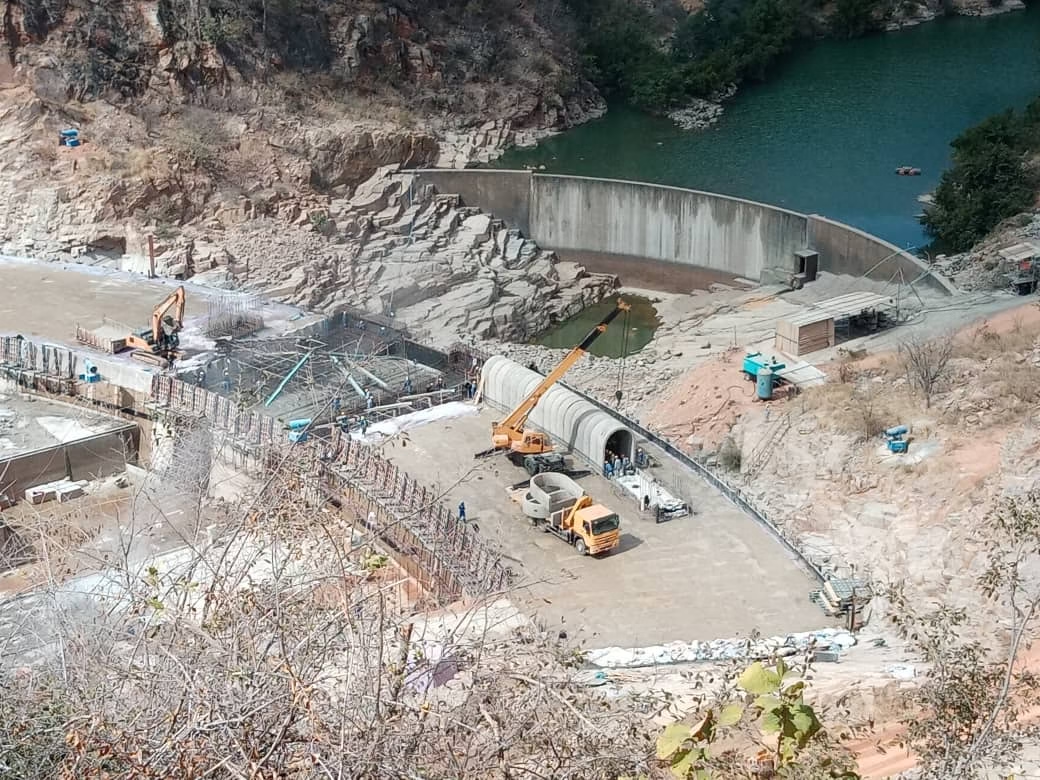
Seventy-two percent. A figure that now carries the weight of a century’s worth of promises, struggles, and deferred hope. The Gwayi-Shangani Dam, once a distant dream and often dismissed as impossible, is finally shifting into the realm of reality, bringing with it the prospect of rewriting the socio-economic story of Matabeleland.
For decades, Bulawayo’s water crisis has been both a humanitarian concern and a brake on industrial growth. The city, Zimbabwe’s second-largest, has lived through routine shortages, rationing, and recurring fears of running dry. The completion of Gwayi-Shangani Dam, now visibly within reach, signals a future where water insecurity no longer defines the region. At 72 percent complete, with Treasury’s consistent monthly injections of US$5 million, construction is running 24 hours a day, evidence of renewed political will under the Second Republic.
This is not just a reservoir in the making; it is a strategic engine of transformation. When complete, Gwayi-Shangani will be Zimbabwe’s third-largest inland water body, anchoring the National Matabeleland Zambezi Water Project. Its impact will ripple across sectors: supplying Bulawayo with reliable water, powering a mini-hydropower station, irrigating thousands of hectares of arid land, and unlocking opportunities in tourism, fisheries, and rural industries. Each element is designed not in isolation, but as part of an interconnected blueprint for resilience and growth.
The dam is already creating jobs for hundreds of locals in Mabale, Lupane, and Lubimbi. Beyond employment, it is fostering a sense of pride and ownership in communities long excluded from major development projects. For villagers, workers, and traders, the construction site is no longer just a distant Government promise, it is daily proof that something transformative is taking shape.
Symbolically, the Gwayi-Shangani Dam represents more than engineering progress. First proposed in 1912, the project languished for decades, trapped between funding gaps and shifting political priorities. Its revival under the Second Republic demonstrates not only persistence but a recalibration of development priorities, turning a once elusive dream into a practical cornerstone of regional integration.
The significance extends to national policy. With climate change tightening its grip and water scarcity threatening agriculture and urban survival alike, Zimbabwe’s capacity to harness and manage its water resources is central to achieving Vision 2030. The dam’s irrigation potential aligns directly with food security strategies, while its energy generation capacity dovetails with the national push for diversified renewable power. In this sense, Gwayi-Shangani is not only a Matabeleland story, it is a Zimbabwean story, tying local needs to the national development agenda.
Challenges remain. Timelines have been revised before, and the final stages of construction will demand both technical precision and unwavering financial discipline. Yet the momentum appears stronger than ever. With visible progress, growing public confidence, and high-level oversight, the path to completion feels more assured than at any other time in the dam’s history.
At 72 percent, Gwayi-Shangani is already more than numbers. It is persistence poured into concrete. It is policy translated into progress. It is the shaping of a new narrative where water no longer limits possibility, but instead fuels industry, agriculture, and human development. And for Matabeleland, long defined by scarcity, it is nothing less than the promise of transformation finally coming to life.