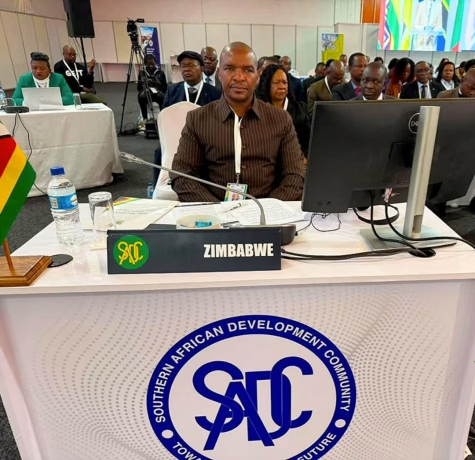
A wave of urgency is sweeping across Southern Africa as health experts and government officials converge in Harare, reaffirming their commitment to establishing and strengthening National Public Health Institutes (NPHIs).
These institutions are increasingly viewed as the backbone of health security, anchoring nations in the face of future pandemics and public health emergencies. This momentum was evident during the fourth Annual Regional Meeting of National Public Health Institutes, hosted in Zimbabwe’s capital.

Rainbow Hotels — Experience Luxury Across Zimbabwe
Rainbow Hotels continues to redefine hospitality standards in Zimbabwe, offering world-class accommodation, fine dining, and modern conference facilities in Harare, Bulawayo, and Victoria Falls.
Whether for business or leisure, Rainbow Hotels delivers unmatched comfort, exceptional service, and a truly premium guest experience tailored to modern travellers.
Book NowThe forum brought together leading minds in health policy, research, disease control and governance. Delegates from across the region rallied behind a united call, to fortify the region’s public health infrastructure by operationalizing NPHIs that are technically equipped, locally led and community-focused.
Delivering the keynote address, Zimbabwe’s Minister of Health and Child Care, Dr Douglas Mombeshora, emphasized the indispensable role that NPHIs must play in shaping strong, evidence-based responses to emerging threats. He highlighted the function of these institutions in coordinating disease surveillance, providing specialized diagnostics, advancing research, and building a skilled health workforce.
“Today, we do not merely meet as representatives of our countries, but as a regional force committed to strengthening the architecture of public health. A robust and functional NPHI is not a luxury, it is a necessity. It is a foundation for national resilience, a tool for swift and science-led action when our people are under threat,” said Dr Mombeshora.
From the continental level, Africa Centres for Disease Control and Prevention (Africa CDC) Regional Director, Dr Lul Riek, set the tone for strategic reform. He laid out five bold pillars to elevate Africa’s public health capacity, the establishment of NPHIs, the expansion of local pharmaceutical and equipment manufacturing, the growth of a skilled health workforce, increased domestic financing, and the forging of purposeful partnerships.
“These gaps must be closed with urgency. Africa’s health future cannot be outsourced or imported. It must be built on our own soil, with our own solutions. That work begins here in Harare and must stretch across the continent,” Dr Riek declared, his message resonating with African pride and pragmatism.
Representing the World Health Organisation (WHO), Dr Desta Tiruneh brought a global perspective, urging governments to embed public health principles within broader national development goals. He stressed the importance of multisectoral collaboration and equity, noting that building resilient health systems requires integrating prevention, data use, and public engagement.
“Strengthening public health services is not just about preparing for pandemics, it’s about creating healthier societies every day. The tools exist, the frameworks are in place, but what is needed now is political will and national ownership,” said Dr Tiruneh.
On the operational side, Dr Talkmore Maruta from the African Society for Laboratory Medicine (ASLM) spotlighted the critical role of diagnostics and biosafety. He argued that laboratories are often the first responders in a health emergency, and must therefore be prioritised for investment and development.
“A laboratory is not just a place where tests are conducted. It is the epicentre of health intelligence. Without it, we are flying blind. NPHIs must be built with diagnostics as a central pillar, ensuring rapid response and informed decision-making,” Dr Maruta added.
The forum in Harare comes at a pivotal time. Africa is recalibrating its approach to public health after the devastating lessons of COVID-19. The pandemic exposed both the fragility and potential of Africa’s health systems. Now, the continent is moving away from reactionary crisis management and toward a model of anticipation, prevention and preparedness.
Zimbabwe’s role as host is significant. As one of six African countries selected by Africa CDC to pilot a roadmap for NPHI readiness, Zimbabwe is emerging as a leader in regional health governance. With its recent national AI and health systems assessments, the country is positioning itself to harness both technology and policy innovation in the quest for health resilience.
The discussions held in Harare are not just about reports and strategies. They are about rewriting Africa’s public health narrative , one where African nations lead from the front, build lasting institutions, and protect their citizens through unity, innovation, and political will.
As public health experts and policymakers leave the conference rooms of Harare, one truth stands tall: Africa’s health security depends not on promises made, but on structures built, capacities strengthened and collaborations that stand the test of time.