A powerful current of Pan-African ideology, economic reflection, and international solidarity surged through the Rainbow Towers Hotel as the International Youth Summit on Land and Economic Freedom (IYSOLEF 2025) roared to life. Hosted by the Africa Youth Congress, the event brought together young leaders from across the continent and beyond to interrogate one of the most pressing issues of our time: how land and economic sovereignty form the foundation of Africa’s sustainable development. What began as a dialogue on land quickly evolved into a spirited call for self-determination, with Africa’s youth challenged to reclaim their role as architects of their nations’ futures, and global allies, notably China, pledging to stand with them in the journey.
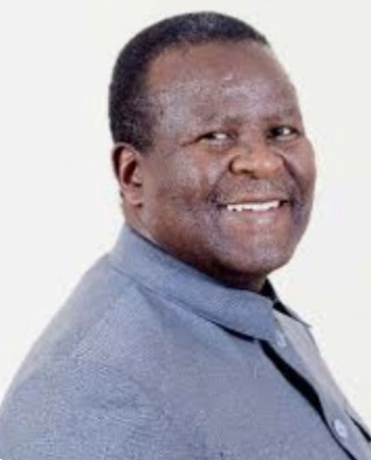
Delivering the keynote address, Minister of State for Provincial Affairs and Devolution for Harare Metropolitan Province, Hon. Senator Charles Tawengwa, gave an emotionally charged and intellectually rooted analysis of land as more than property. In Africa, he said, land is the very essence of identity, freedom, and survival. “The history of our liberation struggles, the backbone of our economic justice, and the pulse of our national pride begins and ends with land,” he said. His message echoed through the hall, this was not just a youth summit, but an ideological renaissance. He emphasized that Zimbabwe’s land reform programme was not a political event, but a moral act of reclaiming justice, and despite global sanctions, the nation has stood proud with land now in the hands of the indigenous majority.
Tawengwa praised President Emmerson Mnangagwa for his inclusive governance and commitment to youth empowerment, describing Zimbabwe as a nation where young people now shape public policy, innovation ecosystems, and local development. He lauded Harare as a beacon of economic potential, contributing over 23% to the national GDP and offering strategic opportunities in manufacturing, energy, health, tourism, and infrastructure. The summit, he said, must not only revisit Africa’s past but reimagine its future, where African youth do not simply consume global ideas but generate indigenous solutions, rooted in unity and cultural clarity.
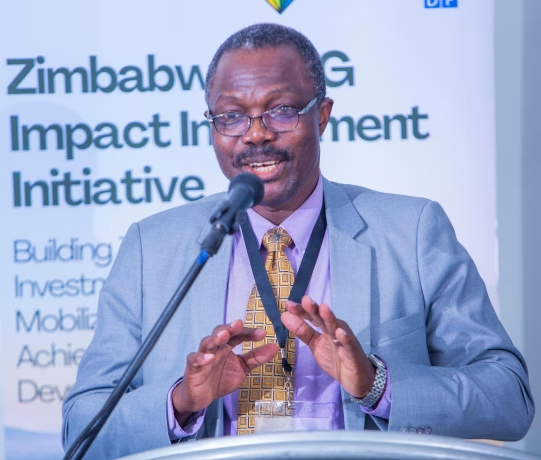
The energy of African renewal met global partnership in the powerful address by Chinese Ambassador to Zimbabwe, His Excellency Zhou Ding, who framed China as a steadfast ally in the pursuit of Africa’s dream. Speaking on the occasion of Africa Day, Ambassador Zhou described Africa’s youth as its “greatest asset” and promised that China’s commitment to Zimbabwe, and to Africa, is not temporary aid, but a long-term partnership for transformative development. “With half of its population younger than 19, Africa Day reminds us that the continent’s future lies in its youth,” he said.
Ambassador Zhou detailed China’s deepening engagement with Zimbabwe, citing multi-sectoral investments in infrastructure, education, technology, and agriculture. “From the airports in Harare and Victoria Falls that connect Zimbabwe to global markets, to the boreholes that bring clean water to rural villages, the China-Zimbabwe partnership proves that true development is not transactional, but transformational,” he said. In 2024 alone, trade between Zimbabwe and China soared to US$3.8 billion, a 23.9% increase. More than 3,000 Zimbabwean students have pursued studies in China since 2018, and about 500 professionals participate in Chinese-led training programmes each year.
Crucially, the ambassador spotlighted the success of Agricultural Demonstration Villages in Mashonaland West and Central, where China is exporting its technology-driven farming systems. These projects, he said, are boosting productivity, income, and dignity in rural areas, especially among young people and women. In total, over US$100 million has been invested by Chinese companies in 70+ community initiatives that promote youth skills, tech transfer, and grassroots empowerment.
As the summit continued with workshops, cultural performances, and panel discussions, what emerged was a new diplomatic rhythm, where African history, youth energy, and international partnerships were not separate stories, but intertwined threads in a greater continental narrative. In this narrative, land is power. Youth are destiny. And partners like China are not spectators but co-creators of a shared developmental future.
Minister Tawengwa’s call for ideological clarity was met with the ambassador’s call for deeper cooperation. Both men left the youth with a challenge,
to think boldly, act collectively, and build a legacy beyond borders. “Your energy, ideas, and courage will drive the social and economic development of your great nation,” Zhou concluded. And in that spirit, Harare did not simply host a summit. It ignited a movement.