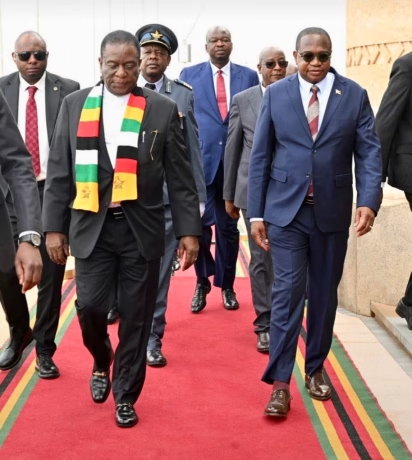
The state banquet hosted by President Emmerson Mnangagwa in honour of Mozambican President Daniel Chapo during the 65th Zimbabwe International Trade Fair (ZITF) became more than a ceremonial gesture—it signaled a renewed regional ambition driven by two nations ready to lead Southern Africa into a new phase of shared prosperity and infrastructure-led development.
President Mnangagwa’s address celebrated not only the fraternal history between Zimbabwe and Mozambique but also a decisive shift toward strategic collaboration, where economic diplomacy, connectivity, and multilateral cooperation take centre stage.
The centerpiece of the bilateral outlook is the Ponta Techobanine Project, a transformative logistics corridor linking Zimbabwe to the Indian Ocean. Once implemented, the corridor is expected to unlock immense economic value, providing Zimbabwe with direct maritime access while enhancing Mozambique’s role as a regional gateway.
President Mnangagwa stressed, “The importance of shared cross-border infrastructure towards accelerating multi-pronged industrialisation, modernisation and overall development cannot be over-emphasised.” His words underscored a collective determination to reduce landlocked limitations and increase intra-African trade through long-term infrastructure investments.
Another notable feature of this evolving partnership is the increasing involvement of the private sector. The strong presence of Mozambican companies on the ZITF exhibition floor and their participation in business roundtables is a reflection of growing investor confidence. This cross-border engagement demonstrates a deliberate shift from political goodwill to concrete economic action.
The ZITF platform has become a catalyst for real economic dialogue, and the 2025 edition has successfully elevated regional cooperation to a business-centered, future-focused agenda.
President Mnangagwa also emphasized the ideological foundation of this partnership, grounded in liberation history. Yet, his message was forward-looking: sustainable development, environmental resilience, and collective sovereignty are the new battlegrounds of the modern era.
“Zimbabwe will always work closely with Mozambique at regional, continental and multilateral fora to advance common interests,” he affirmed, highlighting not only bilateral trust but also shared responsibility in shaping Africa’s future.
As the leaders toasted to peace, prosperity, and enduring friendship, it became clear that Zimbabwe and Mozambique are setting a new tone for regional collaboration—one that blends historical unity with economic urgency. With projects like Ponta Techobanine on the horizon and business communities rallying around shared goals, this partnership is poised to become a model of productive, people-centered integration in Southern Africa.