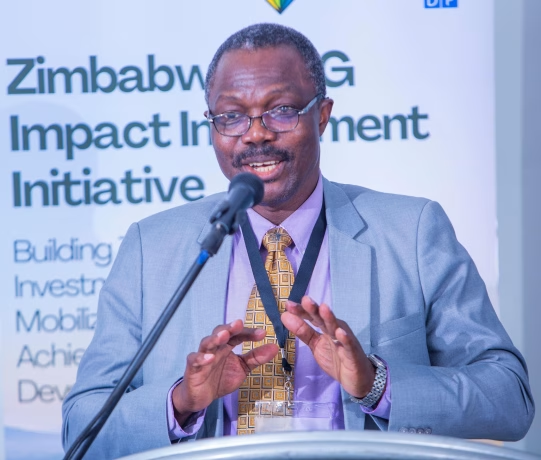
The inaugural International Business, Governance, and Accounting Conference (IBGAC) held at Tamarind Resort in Kariba from July 26-28, 2024, brought together leading experts and stakeholders to explore the transformative potential of Artificial Intelligence (AI) under the theme ‘Advancing Cross-Industry Transformation through Artificial Intelligence (CiTai)’. The conference aimed to share insights on AI applications, foster collaboration on AI-related projects, and showcase innovative AI solutions poised to revolutionize various industries.
AI is at the forefront of technological innovation, offering unparalleled opportunities to enhance business processes and promote sustainable development. Its applications in robotics, machine learning, natural language processing, and rule-based systems are revolutionizing how industries operate. For instance, robotics can automate repetitive tasks, machine learning can optimize business workflows, natural language processing can facilitate language translation and sentiment analysis, and rule-based systems can streamline decision-making processes.
Zimbabwe stands to gain significantly from the adoption of AI, particularly in sectors such as mining, agriculture, and manufacturing, which are crucial to the country’s economy. AI-powered predictive maintenance can minimize equipment downtime in mining, while AI-driven precision farming techniques can optimize resource use and increase agricultural productivity. These technologies not only boost efficiency but also drive sustainable practices.
Moreover, AI offers solutions to pressing environmental challenges. As the world grapples with climate change, AI can assist in carbon sequestration and the production of hydrogen from industrial emissions, contributing to a greener economy. Zimbabwe has already increased its efforts to reduce greenhouse gas emissions and expand mitigation targets, including methane, hydrofluorocarbons, black carbon, and particulate matter. Universities are encouraged to spearhead innovations in clean energy through AI-driven research.
Governments globally are leveraging AI for predictive analytics, automated decision-making, streamlined processes, enhanced citizen engagement, and reinforced security. These capabilities enhance efficiency, transparency, and service delivery, benefiting citizens and stakeholders alike. Zimbabwe’s Parliament, too, can enhance its legislative, oversight, and representative functions with AI applications.
Embracing AI is essential for Zimbabwe’s vision of becoming an empowered upper middle-income economy by 2030. Countries like China, the United States, and Germany are already setting benchmarks by integrating AI into their smart city initiatives, healthcare, and manufacturing sectors. By learning from these pioneering efforts, Zimbabwe can harness AI’s capabilities to foster technological advancement and economic growth, positioning itself as a leader in AI-driven sustainable development.
In conclusion, the IBGAC highlighted the immense potential of AI to drive cross-industry transformation in Zimbabwe. With strategic investments and collaborations, AI can propel the nation towards a future of innovation, efficiency, and sustainable development, ensuring prosperity for all.