By Aldridge Dzvene
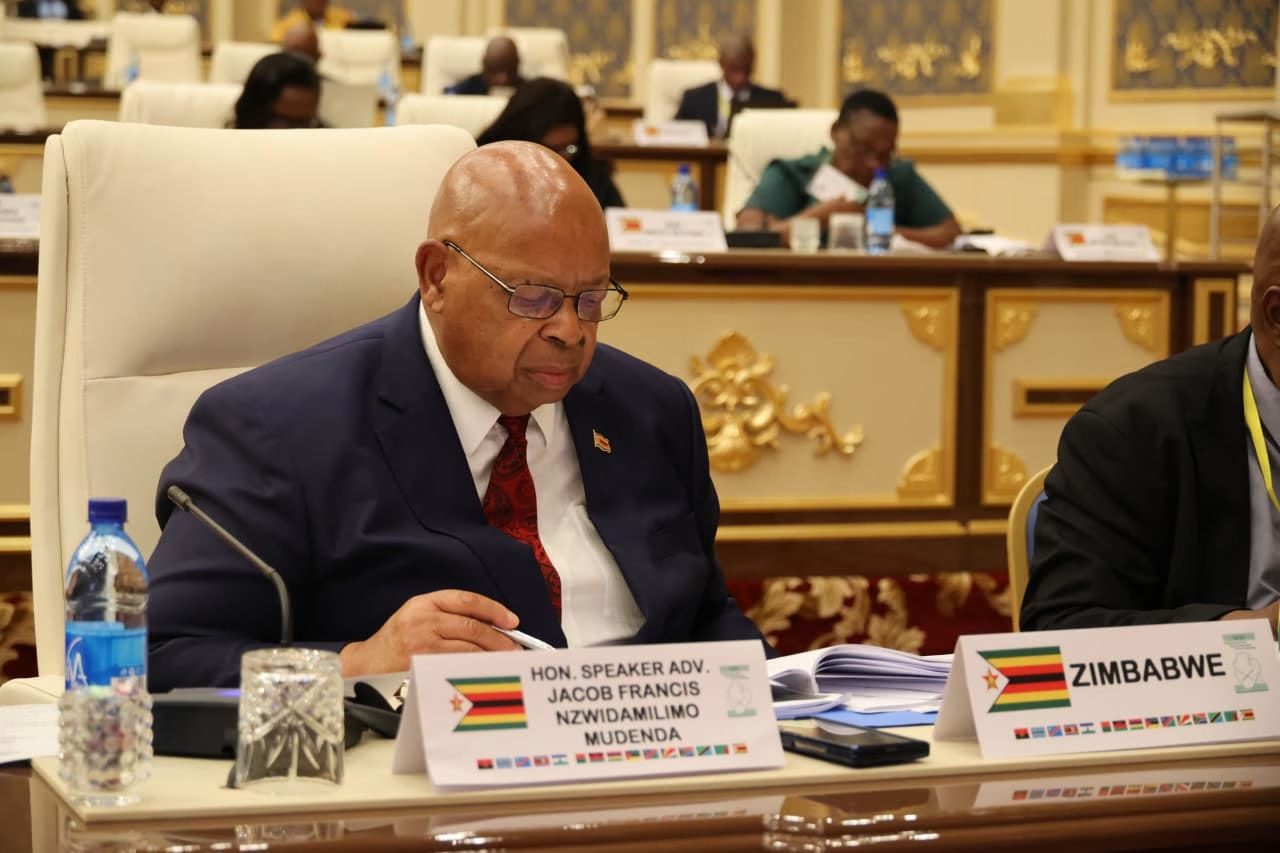
Zimbabwe’s Speaker of Parliament, Hon. Advocate Jacob Francis Nzwidamilimo Mudenda, has called for urgent engagement between the Southern African Development Community Parliamentary Forum (SADC PF) and the SADC Secretariat to accelerate the draft Protocol establishing a regional Parliament, as the decade-long institutional transformation moves towards its final approval stages.
Addressing the Forum’s 59th Plenary Assembly in Ezulwini, Kingdom of Eswatini, on November 25, 2026, Speaker Mudenda urged the Strategic Lobby Team of Speakers, which he chairs, to expedite outstanding processes ahead of the 48th SADC Summit.
His call places the immediate focus on securing the Protocol’s legal clearance and approval, followed by its signature and ratification by Member States.
The intervention signals a shift in the transformation agenda from securing political endorsement to completing the legal instruments and institutional arrangements necessary to establish the proposed SADC Parliament. While the Agreement Amending the SADC Treaty has provided the legal foundation for the transformation, the Protocol will determine how the regional legislature is constituted and operates.
The draft Protocol has incorporated comments from 13 Member States and has been referred to SADC Ministers of Justice and Attorneys General for legal clearance. It is expected to proceed to the Council of Ministers before consideration by the SADC Summit. Once approved, it will be circulated for signature and ratification, with entry into force requiring instruments of ratification from 11 of the region’s 16 Member States, followed by a 30-day period.
This threshold makes the coming diplomatic and legal engagements particularly consequential. The transformation will depend not only on approval at regional level, but also on Member States completing their domestic ratification processes to bring the new institution into force. Institutional preparations are meanwhile advancing, with the transition envisaged by 2027.
Speaker Mudenda has chaired the Strategic Lobby Team since November 2013, leading parliamentary diplomacy aimed at building support among regional leaders and national legislatures. A major milestone was reached on August 17, 2025, when Madagascar and Mauritius signed the Agreement Amending the SADC Treaty during the 45th SADC Summit in Antananarivo, bringing the number of signatory Member States to 15.
With the treaty amendment process having advanced, Speaker Mudenda is now urging the Executive Committee to begin developing appropriate Standing Orders for the envisaged Parliament. This is a significant parallel process because the establishment of a regional legislature will require rules governing its proceedings, internal organisation and parliamentary business, rather than relying solely on the legal instrument establishing it.
The institutional transition also comes with questions of financial sustainability. In its report to the Plenary Assembly, the outgoing Executive Committee, presented by Vice-President Hon. Sylvia Elizabeth Lucas-Izaks of South Africa, called on national Parliaments to scrutinise fuel procurement and pricing, strengthen domestic food production and address barriers to regional trade amid rising freight and energy costs.
The financial report presented by outgoing Treasurer Hon. Dr Pinkie Rosemary Manamolela further distinguished between the once-off costs of establishing the SADC Parliament and the recurring expenditure required to sustain the Forum’s operations. While existing reserves could meet establishment costs, the report underscored the need for predictable Member State contributions and disciplined expenditure to maintain institutional continuity.
These considerations highlight a central test for the proposed Parliament: its long-term effectiveness will depend not only on the political will to establish it, but also on whether Member States provide the resources and operational framework required for it to function consistently.
Beyond the transformation agenda, the Plenary Assembly considered regional correctional oversight, gender equality, youth development, democratic governance, trade and food security. Speaker Mudenda drew on Zimbabwe’s correctional reform experience, citing Connemara Male Open Prison in Gweru and Marondera Female Open Prison as examples of rehabilitation approaches that combine vocational training, family reintegration and preparation for release.
He also placed these initiatives within Zimbabwe’s legislative framework, including the Prisons and Correctional Service Act [Chapter 7:21] of 2023, the constitutional mandate of the Zimbabwe Human Rights Commission to inspect places of detention, and the Death Penalty Abolition Act of 2024.
Zimbabwe’s delegation also brought sector-specific priorities into the regional discussions. Hon. Senator Maybe Mbohwa called for stronger economic empowerment of women through affordable credit, market access and skills development, while Hon. Lynette Karenyi emphasised measurable outcomes in girls’ education, youth employment and funding for health and child protection services.
Hon. Tendai Nyabani called for adequate financing of election observation and parliamentary follow-up on recommendations, while Hon. Mercy Mugomo highlighted domestic value addition and the upgraded Beitbridge Border Post as an example of infrastructure supporting regional trade. Hon. Senator Chinhenza Chigwadzara, also known as Chief Matsiwo, urged stronger investment in drought preparedness and regional cooperation on food and electricity security.
The Assembly also received the Regional Women’s Parliamentary Caucus report and considered the implementation of the SADC Model Law on Eradicating Child Marriage and Protecting Children Already in Marriage, whose regional monitoring dashboard was recently launched, ten years after the Model Law’s adoption in Eswatini.
Taken together, the deliberations reflect the breadth of responsibilities expected of a more structured regional parliamentary institution, from legislative harmonisation and public expenditure oversight to social protection, democratic accountability and economic integration.
For Speaker Mudenda, the immediate priority is to ensure that the political commitment secured over years of parliamentary diplomacy is translated into an approved Protocol, ratification by Member States and functioning institutional rules. The proposed 2027 transition will therefore be measured not simply by the creation of a new regional body, but by the legal certainty, financial capacity and parliamentary authority with which it begins its work.