By Aldridge Dzvene
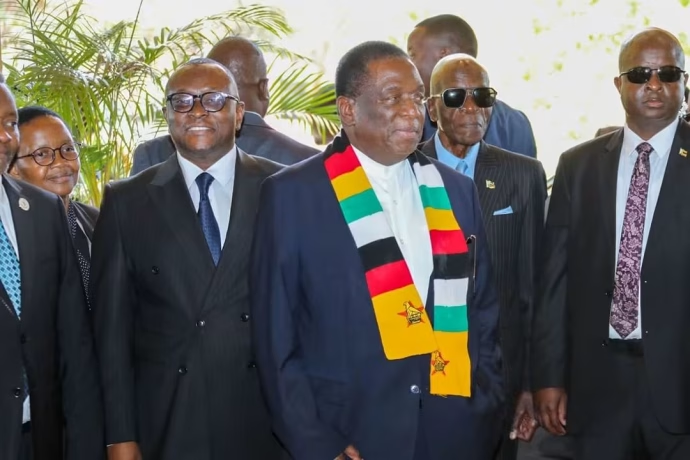
HARARE, October 12, 2026. His Excellency Dr Emmerson Dambudzo Mnangagwa, President of the Republic of Zimbabwe, has sworn in Senator Dr Kudakwashe Regimond Tagwirei as Minister of Economic Development and Investment Promotion at State House in Harare, formally placing one of the country’s most prominent business figures at the centre of the Government’s drive to attract investment, expand productive capacity and accelerate economic transformation.
The swearing-in marks the operational beginning of a significant restructuring of Zimbabwe’s economic management architecture, following the separation of the former Ministry of Finance, Economic Development and Investment Promotion into two distinct portfolios. Professor Mthuli Ncube has been reassigned to head the Ministry of Finance, while Dr Tagwirei assumes responsibility for economic development and investment promotion. The changes establish a more distinct administrative division between the management of public finances and the mobilisation of investment for national development.
Beyond the formalities of Cabinet appointments, however, the significance of the development lies in the economic responsibilities now assigned to the new minister. Zimbabwe is attempting to move from the consolidation of macroeconomic stability towards a more investment-intensive phase of development, in which capital must translate into factories, processing plants, energy infrastructure, agricultural value chains, export capacity and sustainable employment.
The central question is whether the reconfigured ministry will provide the institutional coordination, investor confidence and implementation capacity required to turn the country’s investment ambitions into measurable economic outcomes.
President Mnangagwa’s decision creates an opportunity for Treasury to concentrate on revenue collection, expenditure discipline, public debt and fiscal stability, while the economic development ministry focuses on capital formation, investment facilitation, productive-sector expansion and the implementation of development priorities.
Such a division of responsibilities can improve focus, but it does not automatically guarantee better performance. The success of the arrangement will depend on whether the two ministries develop a coordinated operating framework, supported by clear institutional responsibilities, shared economic priorities and measurable delivery targets.
Investment decisions are inseparable from fiscal policy. Investors consider the stability of the currency, taxation, access to foreign currency, the cost of borrowing, infrastructure reliability and the predictability of regulations before committing capital. Consequently, Dr Tagwirei’s investment mandate and Professor Ncube’s Treasury responsibilities will remain closely interconnected, notwithstanding their administrative separation.
If the investment ministry promotes projects without adequate coordination with Treasury and other implementing institutions, Zimbabwe could experience a gap between announced opportunities and the financial and regulatory conditions necessary to realise them. Conversely, if the two ministries operate as complementary components of one economic strategy, the restructuring could help establish a clearer pathway from investment mobilisation to production and economic growth.
The stakes are considerable because Zimbabwe’s development challenge is no longer simply about attracting interest from prospective investors. It is about converting that interest into capital actually deployed, productive assets commissioned, businesses expanded, exports increased and jobs created.
The distinction between investment announcements and realised investment is fundamental. A project may attract considerable publicity, secure an expression of interest or receive an investment licence without immediately generating new production or employment. The economic value emerges when financing is secured, land and permits are obtained, infrastructure is available, construction is completed and operations begin.
This is where the new minister’s performance will ultimately be measured. His office will need to demonstrate not merely an ability to identify investment opportunities, but also the capacity to remove administrative obstacles, coordinate public institutions and follow projects through to completion.
Zimbabwe’s investment pipeline provides an important starting point. The country has continued to pursue opportunities across manufacturing, mining, agriculture, energy and infrastructure, sectors capable of strengthening domestic production and expanding export earnings. However, the full economic significance of investment approvals depends on what happens after the paperwork is completed.
How much of the proposed investment has been financed? How much has reached implementation? What proportion represents new productive capacity rather than expansion, replacement or changes in ownership? How many jobs have been created, and how much additional output and export revenue can be attributed to these projects?
A credible investment performance framework should answer these questions through regular public reporting. Licence approvals, signed agreements, financial closures, construction milestones, commissioned projects and actual production should be distinguished rather than grouped together as a single investment achievement.
For Zimbabwe, that distinction is especially important in mining and manufacturing, where investment can have a multiplier effect across transport, construction, energy, logistics, professional services and local supply chains. A mine that exports unprocessed minerals may generate revenue, but a project that incorporates local processing, engineering, component manufacturing and downstream industries has the potential to deepen domestic economic participation.
The strategic objective, therefore, should be to maximise the productive value retained within the national economy. Investment promotion must become an instrument for industrialisation, not merely a competition to secure large headline commitments.
Dr Tagwirei’s private-sector experience may provide familiarity with capital-intensive businesses, commercial negotiations and investment decisions. His background in sectors associated with energy, mining, agriculture and infrastructure is relevant to an economy whose development ambitions depend heavily on expanding production and addressing infrastructure constraints.
Nevertheless, public administration operates under a different set of obligations from private enterprise. A business leader can prioritise the commercial interests of an individual enterprise, whereas a minister must ensure that public policy serves the wider national interest, operates within the law and provides fair, transparent and predictable conditions for businesses across the economy.
The new portfolio will therefore require a careful balance between commercial pragmatism and institutional accountability. Investors need efficient decision-making, but they also need confidence that opportunities are allocated through transparent processes, regulations are applied consistently and competing businesses can access the market without undue favour.
This consideration is particularly important when a minister’s private-sector profile intersects with industries affected by government policy, public procurement, licensing, energy allocation or state-linked investment. The appropriate response is not to presume wrongdoing, but to ensure that robust conflict-of-interest safeguards, disclosure requirements and transparent decision-making procedures protect the integrity of public office.
For an investment minister, credibility is itself an economic asset. Investors assess not only the commercial potential of a market, but also the reliability of its institutions and the fairness of its regulatory environment. Strong governance can therefore reinforce investment promotion, while uncertainty about the application of rules can undermine it.
The international dimension presents another important test. Dr Tagwirei has been reported as subject to United States and British sanctions, a factor that has attracted scrutiny following his appointment.
The implications for investment promotion require careful, evidence-based assessment. The existence of sanctions does not, by itself, establish that every transaction involving an individual is prohibited in every jurisdiction. The applicable restrictions, the parties involved, the nature of a proposed transaction and the relevant jurisdiction all matter. Equally, it would be unwise to dismiss the issue as immaterial when international banks, financiers, insurers and multinational companies conduct compliance checks before entering transactions.
Zimbabwe’s new minister will consequently need to demonstrate that the country remains capable of engaging a broad range of international investors while maintaining transparent, lawful and commercially credible arrangements. Clear communication, appropriate legal guidance and reliable compliance procedures will be important in preventing uncertainty from obstructing otherwise viable projects.
This is not simply a question of international perception. It concerns whether financing can be arranged, whether counterparties are willing to participate, whether transactions can be processed and whether projects can access the technology, insurance and financial services required for implementation.
The same practical approach must extend to Zimbabwe’s domestic investment environment. Policy consistency, reliable electricity, efficient transport networks, access to financing, transparent taxation and predictable licensing remain central to the decisions businesses make. A ministry can promote Zimbabwe aggressively abroad, but promotional campaigns cannot permanently compensate for obstacles that investors encounter when attempting to establish or expand operations.
The country’s development ambitions also demand a stronger connection between investment promotion and domestic enterprise. Large projects can create employment and infrastructure, but the benefits are greater when local companies participate as suppliers, contractors, processors and service providers. Small and medium-sized enterprises should be able to connect to investment opportunities through accessible procurement systems, financing arrangements and clearly communicated supply-chain requirements.
Agriculture offers a particularly important example. Investment in irrigation, storage, mechanisation, fertiliser production, cold-chain facilities and agro-processing can strengthen food security while creating opportunities for manufacturing and exports. The value of such investment should be assessed not only through the amount of capital committed, but also through productivity gains, reduced post-harvest losses, expanded processing capacity and the incomes of farmers and rural communities.
In mining, the challenge is to expand value addition and beneficiation so that the country captures more economic value from its mineral resources. In energy, investment must improve the reliability and affordability of electricity for households and productive businesses. In manufacturing, the priority should be to expand local production, improve competitiveness and reduce unnecessary dependence on imported finished goods. Across these sectors, the ministry must ensure that investment policy is connected to the practical requirements of production.
The separation of the two ministries also raises questions about institutional authority. Investment promotion cuts across several government departments and agencies responsible for taxation, land, environmental approvals, infrastructure, trade and sector-specific regulation. Without a clear coordination mechanism, the new ministry could find itself responsible for promoting projects while lacking the authority to resolve the constraints delaying them.
A dedicated investment portfolio will therefore need more than a mandate to attract capital. It will require a functioning mechanism for resolving investor bottlenecks, assigning responsibility for delayed decisions and monitoring projects from initial approval to operation. The effectiveness of that mechanism should be reflected in shorter processing times, fewer stalled projects and stronger implementation rates.
The broader development framework makes this responsibility particularly urgent. Zimbabwe’s National Development Strategy 2 provides the economic and development objectives against which government implementation must be assessed. Dr Tagwirei’s task will be to align investment mobilisation with the national development agenda, ensuring that capital supports clearly defined priorities rather than remaining detached from the country’s wider economic objectives.
That means investment promotion must be connected to industrialisation, infrastructure expansion, agricultural modernisation, export development, technological advancement and employment creation. The new ministry must also establish how its work will complement Treasury’s fiscal responsibilities and the mandates of institutions overseeing individual economic sectors.
With Vision 2030 approaching, the Government’s ability to translate policy into implementation will become increasingly important. The remaining development period requires investment that expands productive capacity, strengthens infrastructure, improves competitiveness and creates opportunities for citizens to participate in economic growth.
The ministry’s contribution should consequently be judged against a defined set of outcomes, including realised investment, project completion rates, new productive capacity, export growth, employment creation, domestic supplier participation and the geographical distribution of investment. These indicators would help distinguish between administrative activity and tangible economic transformation.
They would also make it easier to identify projects that are delayed, determine why implementation has stalled and direct government intervention towards the most consequential obstacles. Regular reporting would provide businesses, workers and citizens with a clearer understanding of how investment policy is translating into economic results.
Ultimately, the swearing-in at State House is the formal beginning of a demanding public responsibility. President Mnangagwa has separated the management of public finances from the economic development and investment promotion function, creating an opportunity for a more focused approach to capital mobilisation and productive transformation.
That opportunity will only be realised if institutional responsibilities are clear, the investment environment is credible, private interests are appropriately separated from public decision-making and the Government can demonstrate that investment approvals are becoming operational projects.
For Dr Tagwirei, the central test is whether his commercial experience can be translated into effective public administration and measurable national economic gains. For Professor Ncube, the corresponding responsibility is to ensure that fiscal management supports stability and sustainable development. The two portfolios will need to operate in concert if Zimbabwe is to convert investment opportunities into lasting productive capacity.
The defining measure of this restructuring will not be the prominence of the appointments or the number of investment announcements made in the coming months. It will be the extent to which capital reaches productive sectors, industries expand, businesses become more competitive, employment opportunities grow and economic benefits reach communities across Zimbabwe.
As the new minister assumes office, the policy direction has been established. The decisive phase now begins with implementation, transparency and results.