WestProp Holdings Limited’s half-year results show a property group continuing to expand its asset base and development pipeline, but the financial picture is more mixed than the headline growth figures suggest. Revenue increased strongly, underlying operating activity remained resilient and assets expanded, yet comprehensive income declined substantially from the prior year as property revaluation gains normalised. The results therefore point to a company in an investment and expansion phase, with future performance increasingly dependent on converting its growing portfolio into sustainable operating and recurring income.
Revenue rose 18.7 percent to US$14.91 million in the six months to June 2026, compared with US$12.62 million in the corresponding period. Millennium Heights and Pomona City remained the largest contributors, generating US$5.19 million and US$4.99 million respectively. Gross profit increased by 9.5 percent to US$7.48 million, while profit from operations was US$4.37 million. The revenue increase is encouraging, but the slower growth in gross profit indicates that expansion is also bringing additional costs and that higher turnover is not translating into an equivalent increase in margins.
The movement in comprehensive income requires even greater caution. Total comprehensive income fell to US$2.48 million from US$13.11 million in the prior period. However, the comparison is heavily affected by fair value movements: the previous period included a US$9.6 million gain on investment property, compared with US$0.88 million in the current period. This means the decline should not automatically be interpreted as a collapse in the underlying business, but neither should it be dismissed. It demonstrates the extent to which reported profitability can fluctuate when property valuations make a significant contribution to earnings.
Headline earnings provide a somewhat different picture, increasing to 10 cents per share from five cents. That improvement suggests stronger underlying performance after adjusting for some of the effects that can distort reported property-company earnings. At the same time, investors will need to distinguish between accounting profitability and the cash actually being generated by developments, particularly as WestProp continues to commit capital to new projects.
The balance sheet provides evidence of significant expansion. Total assets increased 9.1 percent to US$261.78 million from US$239.72 million at the end of 2025, with investment property reaching US$188.39 million. The consolidation of Sunshine Developments added a 1,071-hectare land bank along Harare-Mazowe Road and strengthened the group’s future development pipeline. From a strategic perspective, this gives WestProp considerable optionality, but land and development assets also require substantial capital before they can be converted into completed, income-producing properties.
That distinction is central to assessing the group’s next phase. A larger asset base provides the foundation for future growth, but asset growth alone does not guarantee higher returns. The challenge will be to develop the land at commercially viable rates, manage construction and financing costs and ultimately generate sufficient sales, rental or hospitality income to justify the capital committed.
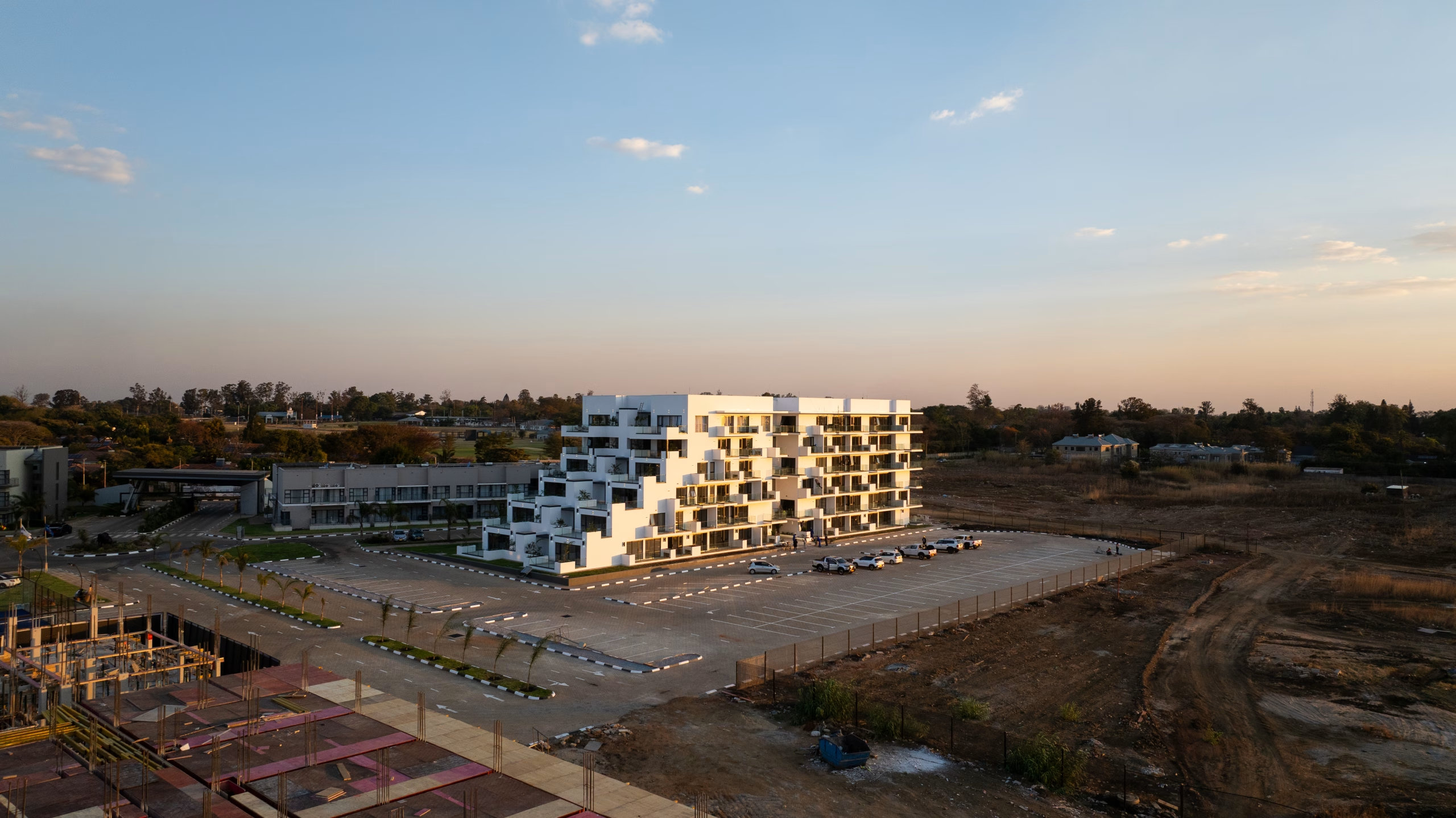
The development portfolio nevertheless provides several potential routes towards diversification. At Millennium Heights, completed and advancing residential blocks are being combined with the planned Radisson Serviced Apartment development and other lifestyle facilities. The serviced apartment component is particularly relevant because it could provide recurring income beyond the initial sale of residential units. At The Hills and Pokugara, completed or advancing recreational and community facilities similarly create opportunities to derive revenue from membership, hospitality and related services.
Chivhu EcoCity represents a larger and longer-term proposition. The 5,000-hectare mixed-use development, designed to accommodate up to 80,000 residents, expands WestProp’s footprint beyond Harare and potentially gives the group exposure to a new urban development market. Its scale, however, means that the project should be viewed as a long-duration investment rather than an immediate earnings driver. Its eventual contribution will depend on infrastructure delivery, demand, financing and the pace at which individual components are developed and occupied.
The proposed corporate restructuring also reflects the increasing complexity of the portfolio. Separating the Pomona City land bank into Aloha Holdings Africa while consolidating developing entities under WestProp Holdings is intended to improve transparency and capital allocation. If implemented effectively, the structure could make it easier for shareholders to assess the performance of development operations separately from underlying land holdings and completed income-producing assets.
The US$1.81 million interim dividend indicates that the board remains willing to return capital to shareholders while funding an ambitious expansion programme. However, the sustainability of shareholder distributions will ultimately depend on operating cash flows, development requirements and the financing structure supporting future projects. The dividend is therefore positive from a shareholder-return perspective, but it must be considered alongside the group’s continuing capital demands.
The extension of the Exit Offer to 9 October also places the restructuring in a broader shareholder context. Minority shareholders are being given additional time to consider the offer while the group moves towards a reorganised corporate structure. The subsequent 100-for-1 share split is intended to improve trading accessibility and liquidity on the VFEX, although the split itself does not alter the underlying economic value of shareholders’ holdings.
WestProp’s financial position therefore presents both opportunity and risk. Revenue growth, improving headline earnings and a larger asset base point to an expanding business, while the decline in comprehensive income, higher operating costs and the capital-intensive nature of the development pipeline highlight the need for disciplined execution. The company’s future investment case will increasingly depend not on the size of its property portfolio alone, but on how efficiently that portfolio is converted into cash-generating assets.
The strategic direction is nevertheless clear. WestProp is seeking to evolve from a developer reliant on individual property sales into a more diversified real estate platform encompassing residential developments, commercial assets, hospitality, lifestyle facilities and large-scale mixed-use communities. The success of that transition will be measured by whether the growing asset base ultimately produces stronger and more predictable recurring earnings, while maintaining sufficient financial flexibility to fund the next stage of expansion.