Story by Godfrey M. Bonda
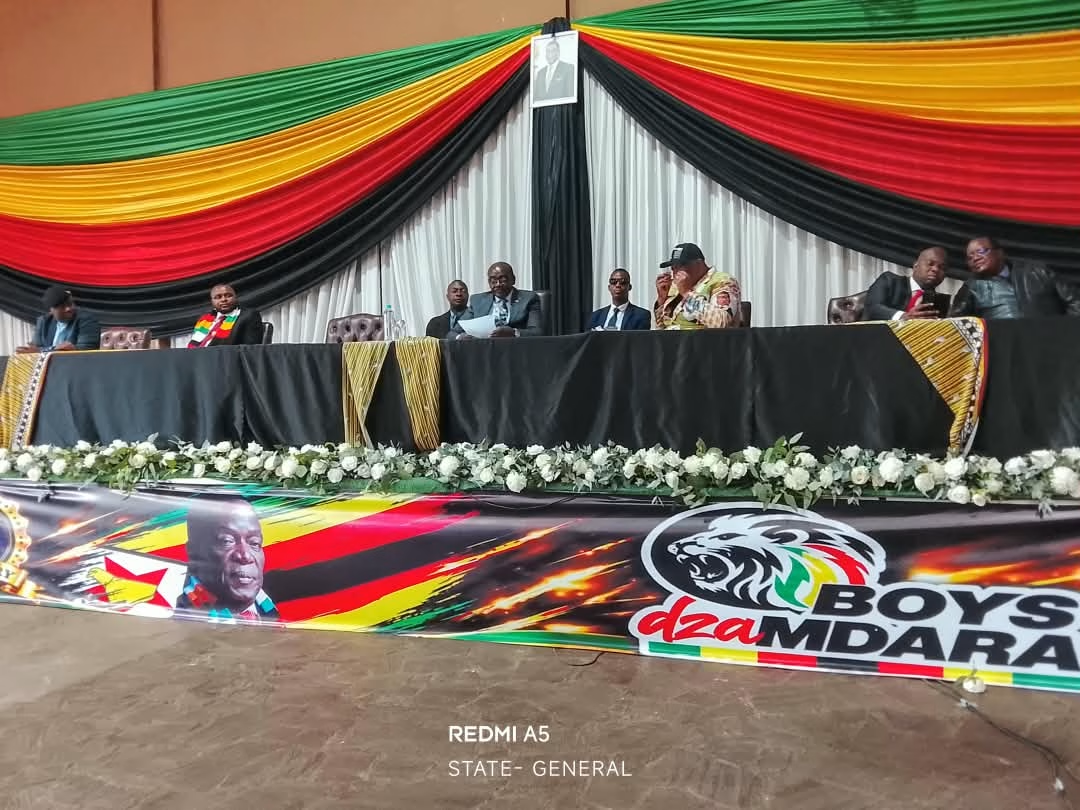
HARARE — Boyz DzaMudhara has marked its fourth anniversary with a renewed call for youth empowerment, skills development, entrepreneurship, and active participation in national development, as Vice President Dr Colonel (Rtd) Kembo Mohadi challenged young people to turn Government-created opportunities into tangible economic results.
Addressing the anniversary celebrations in Harare, Vice President Dr Colonel (Rtd) Kembo Mohadi said the organisation had evolved from an idea into a platform through which young people could find their voice, develop skills and contribute to the country’s development agenda. He said the unity demonstrated by the organisation’s members was significant as Zimbabwe works towards Vision 2030.
Vice President Dr Colonel (Rtd) Kembo Mohadi said political and economic empowerment were inseparable from the country’s broader development ambitions, warning that young people without meaningful opportunities remained vulnerable to social and economic challenges. He urged beneficiaries of Government empowerment programmes to move beyond simply receiving assistance and instead use available opportunities productively to create sustainable livelihoods.
The Vice President also commended Boyz DzaMudhara for its interventions in skills development, sport and the fight against drug and substance abuse, saying the organisation’s work demonstrated how youth-led initiatives could complement national programmes. He challenged young people to create opportunities for themselves, stressing that leadership was built through courage, discipline and responsibility.
Vice President Dr Colonel (Rtd) Kembo Mohadi said the Government’s philosophy of leaving no one and no place behind required young people to become active participants rather than passive beneficiaries of national development. He further encouraged Boyz DzaMudhara to continue complementing Government programmes and supporting young people to translate their talents into productive ventures.
ZANU PF National Political Commissar Cde Munyaradzi Machacha said affiliates remained important in extending the reach of the ruling party, but stressed that their role should be guided by discipline, humility and responsibility.
He said affiliates had a responsibility to transform supporters into active members while contributing to the party’s broader organisational objectives. Cde Machacha also urged affiliates to counter misinformation with facts and avoid speaking on behalf of the party outside their mandate.
Minister of State for Harare Metropolitan Province Cde Charles Tawengwa saluted the young people drawn from Zimbabwe’s provinces and the diaspora, urging them to reject drug and substance abuse and remain focused on productive activities that contribute to the country’s Vision 2030 trajectory.
Minister of Youth Empowerment, Development and Vocational Training Cde Tino Machakaire said Zimbabwe’s young people were ambitious and ready to work, urging them to use their talents and skills to build rather than undermine national development.
Reflecting on the organisation’s four-year journey, Minister Machakaire said Boyz DzaMudhara had developed from an idea into an organised youth platform whose programmes complement the structures of ZANU PF. He called for a disciplined and patriotic youth that could contribute positively to Zimbabwe’s development.
Representing the national leadership of Boyz DzaMudhara, the Vice National Chairperson said the organisation had expanded beyond Zimbabwe, with structures established in countries including Russia and South Africa. He said the organisation had largely relied on its own resources to finance its programmes, reflecting its commitment to turning its ideas into practical interventions.
The organisation’s programmes include entrepreneurship initiatives, skills development and educational support, including assistance towards school fees for students in higher learning institutions. The organisation has also supported students affiliated to the Zimbabwe Congress of Students’ Unions, aligning its interventions with broader national development priorities.
The anniversary therefore comes at a point when youth empowerment is increasingly being positioned as an economic rather than merely social intervention. For Boyz DzaMudhara, the challenge ahead is to convert the momentum generated over its first four years into larger-scale entrepreneurship, employment creation, skills development and measurable community impact.
The celebrations ultimately reinforced a central message from the leadership: youth empowerment must be experienced through actual businesses, skills, jobs and opportunities. As Zimbabwe pursues Vision 2030, organisations such as Boyz DzaMudhara face the task of ensuring that youthful energy is translated into productive economic activity rather than remaining confined to political or ceremonial participation.