RTG Mountain Valley Marathon turns sport, music and wellness into a destination-development strategy
By Aldridge Dzvene
NYANGA is preparing for an experiment in destination tourism that could prove bigger than the race itself, as Rainbow Tourism Group turns the inaugural Mountain Valley Marathon and Music Festival into a platform for connecting sport, wellness, entertainment, hospitality and the natural economy of Zimbabwe’s Eastern Highlands.
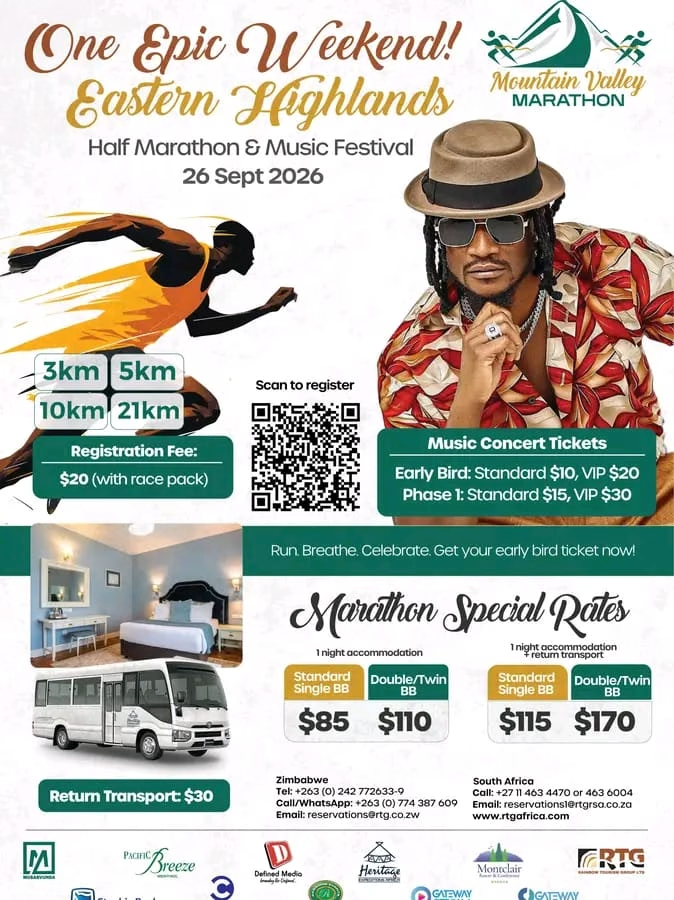
The event, scheduled for September 26 under the theme “Run. Breathe. Celebrate.”, is being positioned not simply as another item on Zimbabwe’s sporting calendar, but as a tourism product designed to give people a reason to travel to Nyanga, stay in the destination, experience its landscape and participate in an entertainment programme that culminates in a performance by Jah Prayzah. The concept is significant because it moves the conversation away from the number of people who will run and towards what happens economically when those people arrive, where they sleep, what they eat, what they see, what they experience and whether they return.
At the press conference, RTG Chief Commercial Officer Shupai Marware placed the event within that wider tourism strategy, saying the company wants the marathon to help position the Eastern Highlands as a major destination in its own right and as a complementary tourism proposition to Victoria Falls. “This marathon will position the Eastern Highlands as a leading destination,” Marware said, adding that RTG was “putting the Eastern Highlands on the map as a strong complementary alternative to Victoria Falls.”
That is perhaps the most important statement surrounding the event because it identifies the real product being marketed. RTG is not creating Nyanga’s mountains, scenery or tourism attractions. Those assets already exist. What the company is attempting to create is a recurring reason for people to consume those assets, and the marathon provides that reason by combining an organised sporting challenge with accommodation, leisure and entertainment. In tourism economics, the distinction matters because a destination becomes commercially stronger when attractions are packaged into experiences that encourage visitors to spend more time within the destination rather than making a short visit and leaving.
Marware also linked the initiative to the broader potential of sports tourism, noting that sports tourism contributes significantly to global tourism activity. RTG’s interest is therefore not limited to the inaugural weekend. The group intends to establish the Mountain Valley Marathon as an annual fixture and has indicated ambitions to eventually expand the race to a full 42-kilometre marathon, potentially giving Nyanga a larger place within the regional endurance-sport calendar.
The strategy is taking place alongside investment in the tourism infrastructure that would be required to accommodate increased visitor activity. RTG completed a US$2 million refurbishment of Montclair Resort and Conference Hotel, with the work increasing the property’s room stock from 85 to 110. That investment gives the marathon a physical tourism base, but more importantly demonstrates the connection between events and destination infrastructure, because attracting visitors only creates lasting economic value if the destination has the accommodation, hospitality and supporting services required to receive them.
Marware said RTG was also looking at the traditionally quieter periods in the tourism cycle, meaning the marathon is being used as part of an attempt to create demand when visitor numbers would otherwise be weaker. The significance is therefore not merely the economic activity generated on September 26, but whether a recurring event can help distribute tourism demand more evenly across the year.
The participation story itself has grown considerably during the preparation of the event. Musabvunda Chief Executive Officer Kudzai Lister Pasipanodya said the original expectation was much smaller, explaining that organisers initially discussed 300 participants before the projections moved to 500, then 1,000 and eventually about 1,500. “When we started discussing the marathon last year, the first figure we had was 300 people, then it went to 500, then 1,000. Now we are talking about 1,500 people,” Pasipanodya said.
That progression is important not simply as a statistic but as an indication of the event’s developing market. A sporting event that initially begins with a relatively narrow running audience can become a broader destination proposition once families, leisure travellers, music audiences, sponsors and tourists begin to see it as a weekend experience. The race therefore becomes the entry point into a much larger tourism ecosystem.
Pasipanodya also acknowledged the involvement of the National Athletics Association of Zimbabwe, the Manicaland Athletics Board, the Zimbabwe Republic Police and the Ministry of Sport in preparations for the event. The institutional support is important because a destination event of this nature requires more than commercial sponsorship. It depends on route management, safety, sporting administration, participant services and coordination between the private sector and public institutions.
The decision to combine the marathon with music is equally strategic. Gateway Stream Media Manager Elton Kurima said the entertainment component was deliberately introduced to expand the audience beyond people who would ordinarily travel for a running event. “The idea was to build a complete weekend experience where sport and entertainment complement each other,” Kurima said. He explained that for runners the concert provides an opportunity to celebrate after the race, while for people who are not interested in running, the music festival creates another reason to travel to Nyanga.
That model gives the destination two different but connected markets. The first consists of runners and their supporters, who travel because of the sporting programme. The second consists of music and leisure audiences, who may travel because of the entertainment programme but can subsequently consume the same tourism infrastructure. Jah Prayzah’s headline performance therefore becomes more than an after-race concert. Within the tourism model being developed, it becomes an additional demand generator capable of bringing people into the Eastern Highlands who might not otherwise have considered travelling for an athletics event.
RTG Corporate Affairs and Quality Manager Pride Khumbula similarly described the initiative as an experience built around the intersection of sport, wellness, music and tourism. “The Nyanga Mountain Valley Marathon and Music Festival is about creating an experience that brings people together through sport, wellness, music and tourism,” Khumbula said, stressing that participants should not only challenge themselves against Nyanga’s terrain but also slow down, enjoy the destination and experience what the wider Eastern Highlands offers.
That emphasis on experience is central to the development proposition. Nyanga’s mountains and landscapes are already natural tourism assets, but an event gives those assets a narrative. A runner experiences the terrain physically. A family accompanying the runner experiences the destination socially. A music fan experiences it culturally. A hotel guest experiences it commercially. The same landscape therefore begins generating different forms of tourism value for different categories of visitor.
Pacific Breeze, the event’s title sponsor, has approached the partnership from the wellness and community angle. Pacific Marketing Manager Kudakwashe Chiutsi said the company was proud to join RTG on what she described as a wellness campaign and expressed the ambition of making the event an experience of national significance. “We are very proud to join RTG on this wellness campaign. We want this to be the ultimate experience,” Chiutsi said. She added that the partnership was about bringing wellness into the community and supporting activities in which communities participate.
Chiutsi also directly addressed the obvious question surrounding a tobacco company’s sponsorship of a wellness-oriented event, saying the company supports community activities across different sporting disciplines. “People will ask why we are joining a marathon as a cigarette brand. It is because we believe in supporting spaces where our communities thrive,” she said, adding that the company supports soccer, basketball and other community activities because “our people are our greatest asset.”
The partnership therefore illustrates another layer of the event economy, corporate brands are not simply attaching their names to a race but are using sport and entertainment platforms to connect with communities and consumers. For RTG, the benefit is additional commercial and promotional support. For sponsors, the benefit is association with a high-visibility national event. For Nyanga, the broader benefit can be increased traffic into the destination if the event continues to grow.
The sporting programme itself has been designed to accommodate different levels of participation, with 3km, 5km, 10km and 21km categories. The structure allows serious runners to pursue the longer-distance challenge while families, casual participants and people entering the sport for the first time can participate at shorter distances. The 21km category carries the principal competitive prizes, but the wider event is clearly being constructed around participation rather than elite athletics alone.
The more interesting tourism question, however, begins after the finish line.
If a visitor comes to Nyanga for the marathon, spends a night in a hotel, eats in local establishments, uses local transport, visits attractions and attends the concert, the economic value of that visitor extends well beyond the registration fee. The event can therefore feed into accommodation, restaurants, transport operators, tour companies, retailers, entertainment businesses and other services. If those visitors return later in the year, the initial event has effectively become a marketing mechanism for the destination itself.
This is why the marathon should be understood as a potential tourism value chain, rather than merely a sporting competition.
The sequence is straightforward: an event creates a reason to travel; travel creates demand for accommodation; accommodation creates demand for hospitality services; visitors seek experiences; experiences create spending; positive experiences create the possibility of repeat visitation.
The challenge for Nyanga will be converting that possibility into a sustained tourism pattern.
A successful inaugural event will generate attention, but the long-term development value will depend on whether the marathon becomes an annual fixture, whether visitors remain longer, whether surrounding attractions are packaged effectively and whether tourism businesses beyond the event’s immediate organisers benefit from the additional traffic.
RTG’s own investment gives the strategy a commercial foundation. The refurbishment of Montclair means that the company is simultaneously developing accommodation capacity and creating an event capable of generating demand for that capacity. Its wider tourism operations can also connect accommodation with excursions and destination experiences, creating the possibility of a more integrated Eastern Highlands tourism product.
The proposed evolution towards a full 42km marathon could take that concept further. A longer-distance race could attract a more specialised running audience, while the annual music and tourism components could continue to serve the broader visitor market. RTG has indicated an ambition for the event eventually to develop towards major international marathon standards, although that remains a longer-term objective rather than an established outcome.
For Zimbabwe’s tourism sector, the wider lesson is that destinations do not necessarily have to compete by offering identical attractions. Victoria Falls has built an internationally recognised identity around one of the world’s great natural wonders. Nyanga has a different proposition, mountains, highland scenery, outdoor recreation, cooler climate, wellness, hospitality and the cultural experience of the Eastern Highlands.
The Mountain Valley Marathon is an attempt to turn those attributes into a recurring event-based tourism product.
The immediate spectacle will be the runners moving through Nyanga’s mountain terrain and Jah Prayzah taking the stage after the races.
But the development story is what happens around them.
If the event succeeds in attracting visitors who stay longer, spend across the local economy, discover the Eastern Highlands and return outside the marathon weekend, then the race will have achieved something considerably larger than producing winners and losers.
It will have helped create a new reason to visit Nyanga.
And that is ultimately the test of the Mountain Valley Marathon, not how many people cross the finish line on September 26, but whether the finish line becomes the beginning of a longer tourism journey for Zimbabwe’s Eastern Highlands.