By Aldridge Dzvene
HARARE — Zimbabwe has taken a significant step towards converting one of its most closely watched platinum prospects into a long-term productive asset, with the signing of a 25-year Special Mining Lease Agreement for the Karo Platinum Project exposing a broader strategy to turn mineral endowment into sustained industrial capacity, investment and employment.
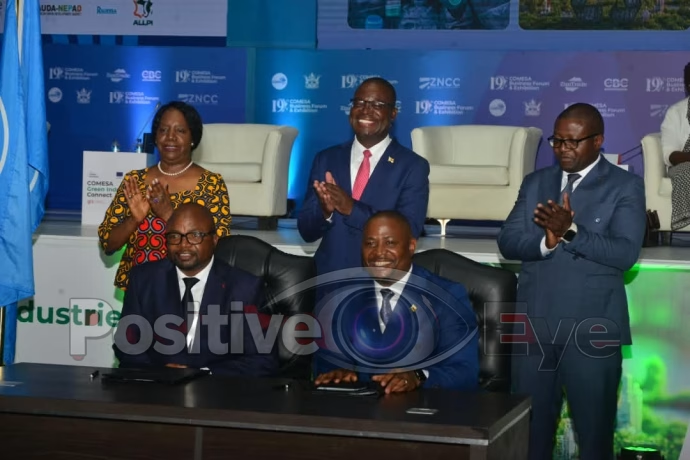
Witnessed by President Emmerson Mnangagwa at State House on 24 August, the agreement between the Government and Karo Platinum, a subsidiary of Tharisa Plc, secures tenure over 23,903 hectares on the Great Dyke and establishes the fiscal and operational framework under which the project can advance towards first production. The agreement was signed by Mines and Mining Development Minister Dr Eng. Polite Kambamura and Finance, Economic Development and Investment Promotion Minister Prof Mthuli Ncube on behalf of Government.
On the surface, the development is a conventional mining-sector milestone. Viewed more closely, however, it represents something considerably more important: the reduction of one of the biggest risks surrounding large-scale mining projects, namely uncertainty over tenure and the commercial framework required to justify billions of dollars in long-term capital.
That distinction matters because mining investment is fundamentally different from short-cycle business. A platinum mine is built around decades rather than months. Investors must commit capital to exploration, mine development, processing infrastructure, power, water, roads and equipment before the first ounce of metal is sold. The 25-year lease therefore provides more than permission to mine. It creates the legal and fiscal visibility necessary for Karo to make the next level of capital commitments.
Tharisa’s own disclosures describe the agreement as providing the security of tenure and fiscal certainty required to advance Karo towards first production. The company says Karo Platinum is 85 percent owned by Karo Mining Holdings, while the Government holds a 15 percent interest through Generation Minerals on an unencumbered free-carried basis.
This structure is important from a strategic perspective because Zimbabwe is not simply granting access to a mineral deposit and walking away. The State retains an economic interest in the project while seeking to attract the private capital, technical capability and operational expertise required to develop it.
The significance becomes clearer when the history of Karo is examined.
The project traces its formal investment framework to March 2018, when Karo Holdings entered into an investment agreement with Zimbabwe to establish an integrated platinum group metals complex. The original concept was considerably broader than simply extracting ore. It envisaged mining, concentrators, smelters, a base-metal and precious-metal refinery and power-generation capacity, including potential surplus electricity for the national grid.
Eight years later, the signing of the Special Mining Lease provides a new reference point in that trajectory.
More than US$240 million has already been invested in the project, according to Government and company statements, including expenditure on plant establishment, mining fleets, water and power infrastructure and community development. Phase One is expected to require investment approaching US$1 billion, according to Prof Ncube, meaning the capital already deployed is better understood as the foundation of a much larger investment cycle rather than the completion of the project.
That is where the agreement becomes strategically consequential.
The first phase is expected to produce as much as 226,000 ounces of platinum group metals annually and employ more than 1,000 people, with first production targeted for the second half of 2027. The project has an open-pit mineral reserve of about 2.1 million ounces on a 4E basis and a mineral resource of 11.2 million ounces, while potential underground mining could support a mine life exceeding 50 years.
For Zimbabwe, therefore, the issue is not simply how many jobs Karo will create during Phase One. The larger question is whether the project can become an anchor around which an extended mining and industrial ecosystem develops.
Platinum group metals sit at the centre of a global industrial economy spanning automotive catalysts, chemical applications, electronics, jewellery and emerging energy technologies. Zimbabwe possesses an unusually strong geological position in this market. The Great Dyke is recognised as the world’s second-largest PGM resource after South Africa’s Bushveld Complex, giving Zimbabwe a resource base capable of supporting a much larger role in the international platinum industry.
The strategic challenge has never been simply geological availability. Zimbabwe has known for decades that it possesses significant mineral wealth. The harder task has been translating that geological advantage into sustained production, beneficiation, export earnings, industrial linkages and broader economic value.
That is why Karo’s progression should be watched beyond the headline investment figure.
A mine that produces metal but remains isolated from the domestic economy can generate substantial export revenue without necessarily creating the industrial transformation that policymakers seek. The more consequential test will be whether Karo develops local supply chains, technical skills, infrastructure, downstream processing and business opportunities around the operation.
The Government’s emphasis on fiscal certainty is also revealing.
Prof Ncube said fiscal incentives had been extended to enable Karo to raise additional capital and maintain the viability of the investment. This demonstrates the delicate balance at the centre of large-scale mining policy: Zimbabwe needs to secure a meaningful national return from its mineral resources while offering investors sufficiently predictable conditions to commit capital over decades.
For investors, predictability can be as important as the geology itself.
The Great Dyke may contain enormous mineral wealth, but mineral resources do not automatically become mines. Between discovery and production sits a chain of financial, regulatory, infrastructural and operational decisions. By defining tenure and the fiscal framework for a project of national significance, the Special Mining Lease reduces some of the uncertainty that can delay those decisions.
From a strategic-risk perspective, this is perhaps the strongest signal emerging from the agreement.
Zimbabwe is attempting to position itself not merely as a country with minerals, but as a jurisdiction capable of accommodating long-duration capital. That distinction will ultimately be judged by what happens after the signing ceremony: whether construction advances on schedule, whether capital continues flowing, whether production begins as projected and whether the promised economic benefits reach communities and the wider economy.
There is also a broader message for Zimbabwe’s platinum industry.
The Great Dyke already hosts major operations, but additional large-scale investment expands the country’s production base and strengthens its ability to participate in a global PGM market where Zimbabwe remains a relatively important resource holder. Karo’s planned output of 226,000 ounces a year would make it a significant contributor to national production.
The project’s potential mine life is equally important. A 25-year initial lease, against a potential resource life of more than 50 years when underground mining is considered, creates the possibility of a multigenerational industrial asset rather than a short-lived extraction project.
That possibility, however, places a greater responsibility on both Government and the investor.
The real measure of success will not be the signing of the agreement. It will be whether the agreement becomes the platform for a mine that produces consistently, employs Zimbabweans, creates local procurement opportunities, contributes fiscally, supports host communities and progressively increases the value captured inside Zimbabwe.
President Mnangagwa’s description of Karo as part of the vision launched in 2018 therefore carries significance beyond political messaging. The project has moved through the stages of investment framework, mineral rights, development expenditure and infrastructure preparation. The latest agreement attempts to establish the certainty needed for the next stage: production.
The strategic picture is consequently becoming clearer.
Zimbabwe’s mineral policy is increasingly being tested not by the size of its underground deposits, but by its ability to attract patient capital, protect investment certainty while safeguarding national interests, and ensure that extraction feeds into a wider programme of industrialisation.
Karo now sits directly within that test.
The 23,903-hectare concession is valuable because of what lies beneath it. But its greater national value will ultimately be determined by what Zimbabwe builds around what lies beneath it.
The signing at State House is therefore best understood not as the conclusion of the Karo story, but as the point at which the project enters its most consequential phase. The capital has been committed, the tenure has been secured and the framework has been established. The next question is execution.
And for Zimbabwe, execution is where mineral wealth finally has to become economic wealth.