By Aldridge Dzvene
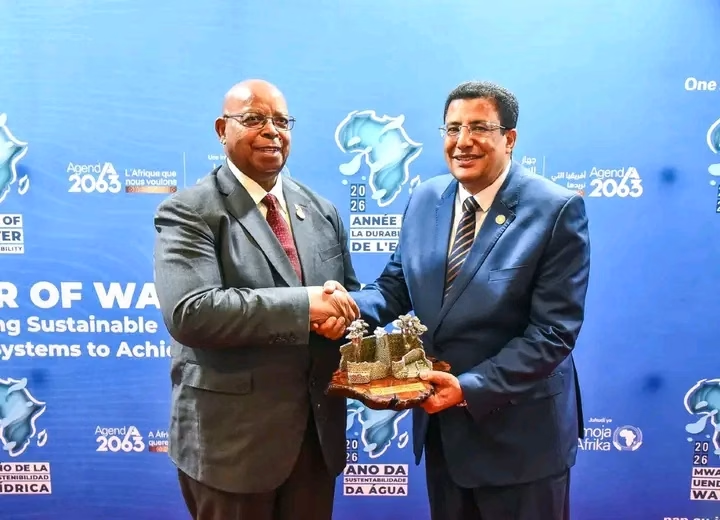
MIDRAND, SOUTH AFRICA – Speaker of Parliament, Honourable Advocate Jacob Francis Nzwidamilimo Mudenda, has called for a shift from policy commitments to measurable implementation after presiding over the 2026 Pan-African Parliament Annual Conference of Speakers, which adopted the Johannesburg Declaration and an Action Plan to accelerate the African Union’s Agenda 2063.
Honourable Mudenda, who was unanimously elected President of the Bureau of the Conference, chaired two days of high-level deliberations attended by Speakers of national and regional parliaments from across Africa, culminating in resolutions aimed at strengthening parliamentary diplomacy, legislative harmonisation and continental integration.
The conference signals a growing recognition that Africa’s development aspirations will depend less on the adoption of new policy frameworks and more on the effective implementation of existing continental commitments. By placing Parliament at the centre of Agenda 2063 implementation, African legislatures are increasingly positioning themselves as institutions responsible for translating continental ambitions into enforceable national laws and accountable governance.
Addressing delegates during the closing session, Speaker Mudenda said Africa’s greatest challenge is no longer the absence of development blueprints but ensuring that agreed policies produce tangible improvements in people’s lives.
“We have, as a continent, produced admirable frameworks, visionary blueprints and eloquent declarations. However, our greatest challenge has often been the implementation deficit. The Johannesburg Declaration must become a living and actionable instrument whose success will be measured by the positive transformation it brings to the lives of the African people,” he said.
His remarks reflect an emerging governance philosophy that places implementation at the heart of development. Across the continent, legislatures are increasingly expected not only to enact laws but also to strengthen oversight, monitor policy execution and ensure public resources deliver measurable socio-economic outcomes.
The adoption of the Johannesburg Declaration therefore represents more than a political commitment. It establishes a legislative framework through which African parliaments will align domestic laws with Agenda 2063, domesticate Pan-African Parliament Model Laws and submit annual implementation reports, creating stronger accountability mechanisms for continental development.
The unveiling of Model Laws on Gender Equality, Labour Migration and Sustainable Soil Management further demonstrates Parliament’s evolving role in promoting legal harmonisation across Africa. Common legislative standards are expected to facilitate labour mobility, strengthen environmental sustainability and promote inclusive development while advancing regional integration.
Speaker Mudenda also renewed calls for the ratification of the Malabo Protocol, arguing that a stronger Pan-African Parliament would enhance the continent’s institutional capacity to coordinate development, promote democratic governance and deepen economic integration. His proposal for biannual Conferences of Speakers similarly seeks to establish continuous monitoring of implementation rather than relying on periodic declarations.
Invoking the African philosophy of Ubuntu and Hunhu, Speaker Mudenda reminded delegates that Africa’s future depends on collective responsibility and sustained cooperation.
“Our fortunes as African nations are interconnected. We must return to our countries as custodians of the commitments we have made here and ensure that the Johannesburg Declaration is implemented for the benefit of all Africans. One Africa. One Voice,” he said.
For Zimbabwe, Speaker Mudenda’s leadership of the conference reinforces the country’s growing influence in continental parliamentary diplomacy while aligning with the Second Republic’s commitment to regional integration, economic cooperation and African-led development solutions. The Midrand conference therefore marks a strategic shift from continental policy formulation towards implementation-driven governance, recognising that Africa’s transformation under Agenda 2063 will ultimately be measured by tangible improvements in the livelihoods of its citizens.