For decades, Zimbabwe’s mining industry has been measured by the abundance of its mineral wealth. From lithium and platinum to gold, chrome and diamonds, the country’s underground resources have positioned it among Africa’s most strategically endowed nations. Yet, in today’s rapidly evolving global economy, mineral abundance alone is no longer enough. Competitive advantage is increasingly determined by technology, innovation and the ability to transform raw minerals into high value industrial products.
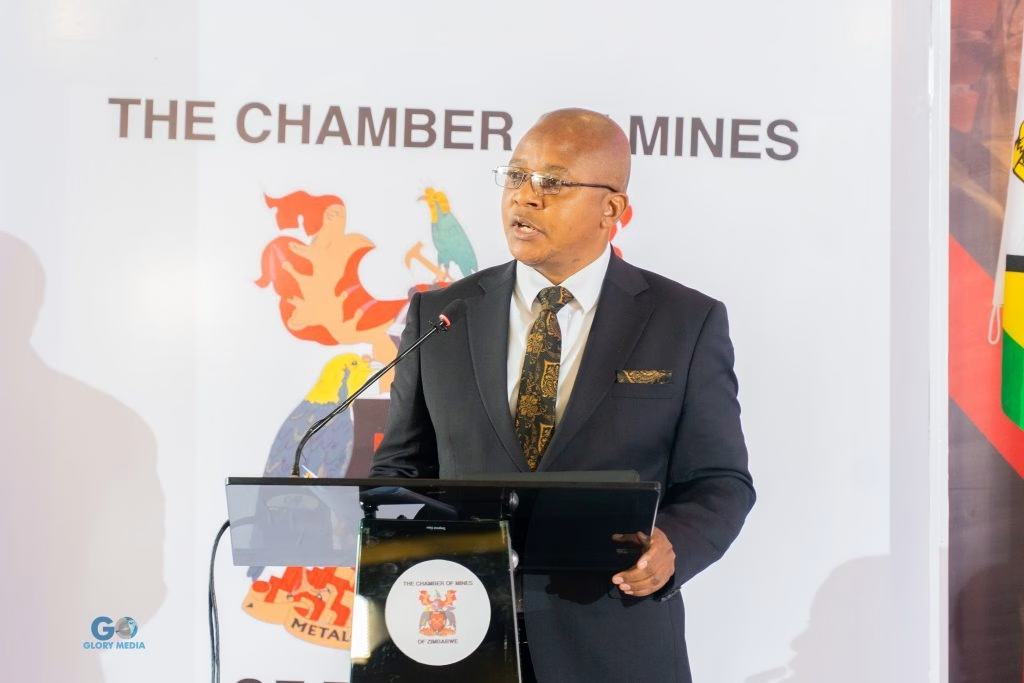
This emerging reality was captured by Mines and Mining Development Minister Dr. Polite Kambamura during the Zimbabwe, China Investment Symposium in Harare, where he declared that Zimbabwe’s future competitiveness will depend less on what lies beneath the ground and more on the intelligence applied above it. Artificial intelligence, automation, robotics, predictive analytics and advanced mineral processing, he argued, are becoming the defining pillars of modern mining.
The Minister’s remarks signal a significant shift in Zimbabwe’s mining philosophy. For many years, African economies have exported raw minerals while importing expensive finished products manufactured from those same resources. This model generated export earnings but limited industrial growth, technology development and high quality employment.
The Zimbabwe, China partnership seeks to reverse that trend. Zimbabwe contributes critical minerals that are indispensable to the global green energy transition, while China brings technological expertise, industrial experience, capital and manufacturing capacity. Together, the two countries are attempting to build an integrated mining value chain in which extraction is only the starting point rather than the final destination.
The timing of this strategic cooperation is particularly significant. Around the world, mining companies are confronting declining ore grades, deeper and more technically demanding mines, higher production costs and stricter environmental standards. Simultaneously, artificial intelligence is revolutionising geological exploration, enabling companies to identify mineral deposits more accurately, reduce exploration risks and optimise mine planning before excavation even begins. Automation is reducing operational costs while improving worker safety through autonomous drilling systems, remotely operated equipment and predictive maintenance technologies that minimise downtime.
Zimbabwe recognises that remaining competitive in this new environment requires far more than opening additional mines. It requires building digital mines capable of operating efficiently, sustainably and profitably in an increasingly technology driven global economy. This ambition aligns with the country’s National Artificial Intelligence Strategy, which identifies mining as one of the priority sectors for AI driven transformation.
The partnership also reinforces Zimbabwe’s long standing beneficiation and value addition agenda. Government policy has consistently sought to discourage the export of unprocessed minerals in favour of domestic processing. This strategy is already beginning to yield tangible results.
Chinese investment has helped establish major processing facilities, including the Dinson Iron and Steel Plant in Manhize and lithium sulphate plants developed by Chinese investors. These projects demonstrate a transition from exporting raw ore to producing higher value industrial materials required in battery manufacturing and electric vehicle supply chains. The export of Africa’s first shipment of lithium sulphate earlier this year represents more than a commercial milestone, it signals Zimbabwe’s gradual integration into advanced global manufacturing value chains.
Equally important is the emphasis on human capital development. Technology transfer cannot succeed without skilled engineers, metallurgists, geologists, software developers and technicians capable of operating and improving sophisticated mining systems. Agreements between Zimbabwean polytechnics, Chinese universities and mining companies therefore represent investments not only in education but also in Zimbabwe’s long term industrial competitiveness. Building local expertise ensures that technological advancement becomes sustainable rather than permanently dependent on imported skills.
Nevertheless, the success of this ambitious vision will depend on addressing several structural constraints. Reliable electricity remains fundamental for energy intensive mineral processing. Efficient transport infrastructure is required to move minerals and finished products competitively. Stable policy frameworks are equally essential, as long term mining investments demand predictability in taxation, licensing and regulatory systems.
The broader geopolitical context further enhances Zimbabwe’s strategic importance. As the global transition toward electric vehicles, renewable energy and battery storage accelerates, demand for lithium, nickel, graphite and other critical minerals continues to rise. Nations possessing these resources are becoming increasingly influential within global industrial supply chains. Zimbabwe’s challenge is therefore not merely to produce more minerals, but to capture greater value from every tonne extracted through local processing, technological innovation and manufacturing.
If successfully implemented, the Zimbabwe, China technology alliance could become a model for resource rich African economies seeking to escape the historical resource curse. Instead of remaining exporters of raw commodities, countries can leverage international partnerships to industrialise, create skilled employment, develop technological capacity and participate more meaningfully in the Fourth Industrial Revolution.
Ultimately, Dr. Kambamura’s vision extends beyond mining. It presents a blueprint for transforming Zimbabwe from a nation known primarily for mineral abundance into one recognised for technological capability, industrial innovation and value creation. In an era where data, artificial intelligence and advanced manufacturing increasingly determine economic competitiveness, the future of Zimbabwe’s mining sector will not be defined solely by the minerals beneath its soil, but by the knowledge, technology and innovation applied to unlock their full value.