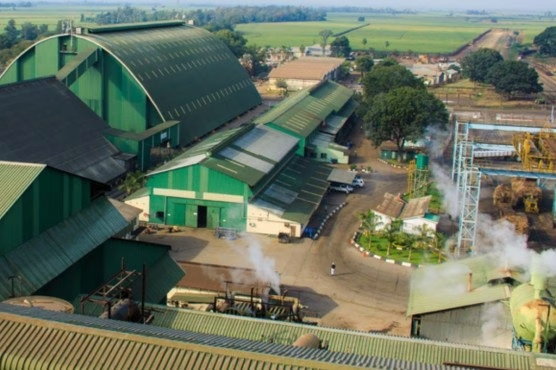
Padenga Holdings recorded a significant rise in gold production during the first quarter of 2026, with output increasing 13 percent to 696.7 kilogrammes, reinforcing the mining sector’s growing role as a strategic pillar within Zimbabwe’s economic transformation and industrialisation agenda under Vision 2030 and the National Development Strategy 2.
The production increase, equivalent to approximately 22 400 ounces of gold, comes at a time when international bullion prices continue trading at historic highs, creating a highly favourable operating environment for gold producers. With average global prices estimated around US$4 875 per ounce during the quarter, the company’s gold division is projected to have generated substantial revenues, further strengthening mining’s contribution to Zimbabwe’s export earnings and foreign currency inflows.
Analytically, Padenga’s latest performance reflects a broader structural transformation within Zimbabwe’s mining economy, where resource extraction is increasingly becoming integrated with industrial efficiency, technological optimisation, and energy sustainability. The company’s strategic evolution from its traditional crocodile farming operations toward mining dominance through full ownership of Dallaglio Investments illustrates how capital is progressively shifting toward high growth sectors capable of generating export driven revenues.
The latest production figures also highlight the growing significance of gold within Zimbabwe’s macroeconomic framework. Gold remains one of the country’s most critical foreign currency earners, underpinning monetary stability, industrial financing, and broader economic resilience amid fluctuating global economic conditions. Increased production from major players such as Padenga therefore carries implications extending beyond corporate profitability into national fiscal and economic stability.
A key component of Padenga’s operational strategy lies in infrastructure modernisation and recovery optimisation. The upcoming gravity circuit upgrade at the Eureka Mine represents a calculated technical intervention aimed at improving gold recovery efficiencies while reducing processing costs. By enhancing the capture of free milling gold earlier within the processing cycle, the company is expected to increase plant recovery rates while simultaneously reducing chemical and reagent consumption.
This reflects a wider trend within modern mining operations where profitability increasingly depends not solely on production volumes, but also on operational efficiency, technological innovation, and cost management. In an environment where commodity markets remain volatile despite strong pricing conditions, efficiency improvements provide critical long term sustainability advantages.
Equally significant is Padenga’s aggressive investment into renewable energy infrastructure. The rollout of a 5 megawatt solar power plant at Pickstone Peerless, alongside the larger 7 megawatt installation at Eureka Mine, signals a strategic shift toward energy self sufficiency and operational resilience.
Energy remains one of the largest operational costs within mining, often accounting for a substantial share of production expenses due to electricity shortages, diesel dependency, and power instability. The integration of hybrid solar systems therefore positions Padenga to stabilise operational costs, reduce reliance on imported fuel, and maintain uninterrupted milling capacity during daylight operations.
From a developmental perspective, this renewable energy investment aligns with Zimbabwe’s broader energy transition and industrial sustainability goals under NDS2. Mining companies are increasingly expected not only to extract resources, but also to contribute toward environmental sustainability, energy efficiency, and infrastructure resilience.
The company’s continued resource drilling at Pickstone Peerless further underscores confidence in Zimbabwe’s long term mining prospects. Resource expansion programmes are essential in extending mine life, attracting investment confidence, and sustaining future production growth within the sector.
Analysts note that Padenga’s current positioning reflects a convergence of favourable global commodity prices, operational optimisation, and strategic infrastructure investment. This combination places the company in a strong position to consolidate growth throughout 2026 while contributing to Zimbabwe’s broader mining led economic expansion agenda.
More broadly, the company’s performance highlights how Zimbabwe’s mining sector is gradually evolving beyond raw extraction toward integrated industrial operations characterised by technological upgrading, renewable energy integration, and value chain efficiency. This evolution remains central to Government’s long term objective of transforming mining into a catalyst for industrialisation, export growth, employment creation, and sustainable economic development.