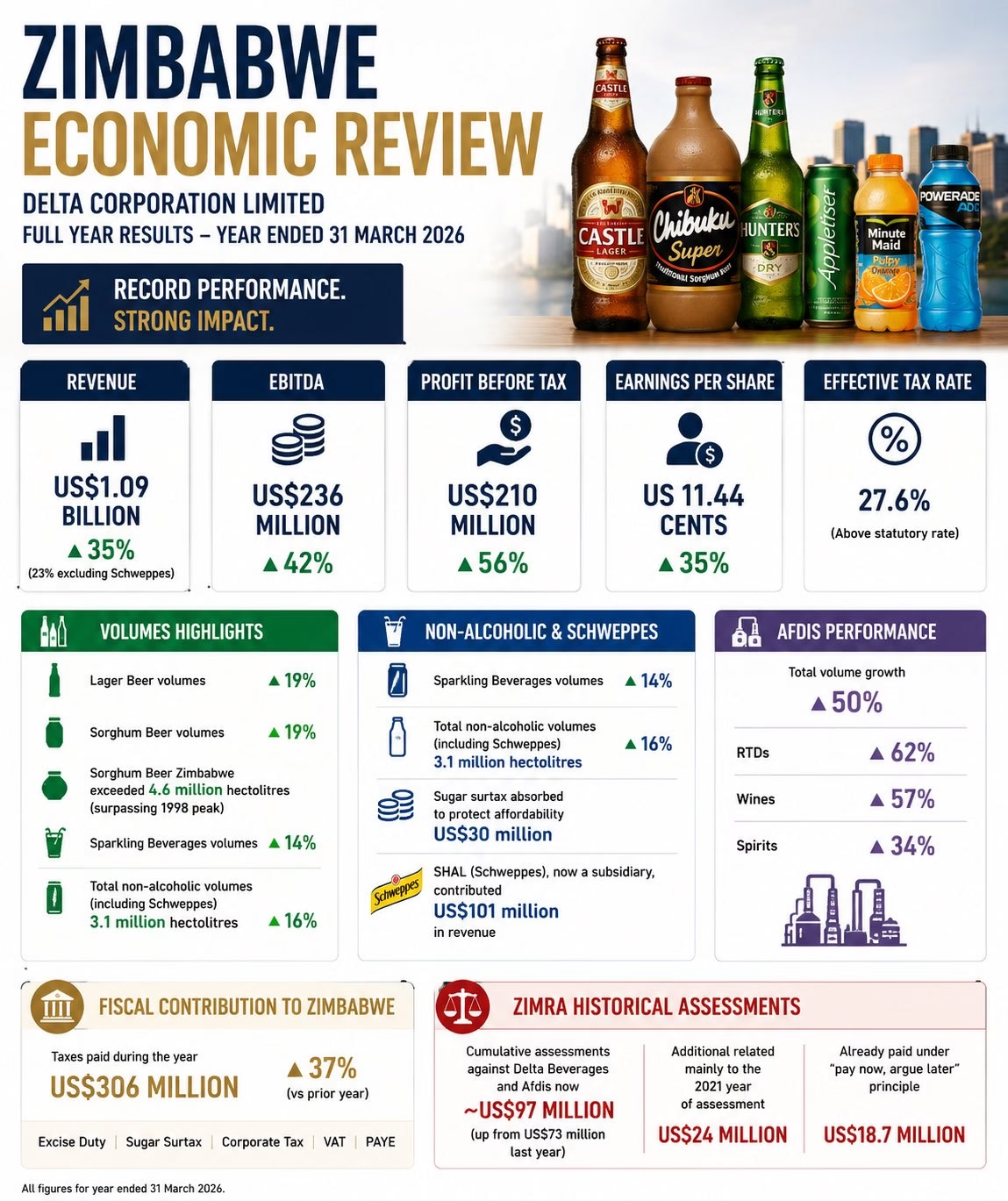
Delta Corporation has delivered one of the strongest corporate performances in Zimbabwe’s recent economic history, surpassing the US$1 billion revenue threshold for the first time as rising consumer demand, pricing resilience, and expanding beverage volumes drove significant growth across its operations.
The beverages giant recorded revenue of US$1.09 billion for the financial year ending 2026, representing a 35% increase, while revenue growth excluding Schweppes stood at 23%. The milestone is not merely symbolic for Delta itself, but reflects the broader role large corporates continue to play as economic stabilisers within Zimbabwe’s volatile operating environment.
What stands out in the results is the extent to which volume growth, rather than pricing alone, underpinned performance. Lager Beer and Sorghum Beer volumes both expanded by 19%, with Sorghum Beer Zimbabwe surpassing 4.6 million hectolitres, exceeding the previous peak last achieved in 1998.
This resurgence in sorghum beer consumption reveals more than changing consumer preference. It reflects the growing importance of affordable beverages within an economy where disposable incomes remain under pressure. Sorghum beer has increasingly become a volume driven resilience product, sustaining mass market demand while insulating Delta from slower premium consumption growth.
The company’s non alcoholic beverages segment also demonstrated strong recovery momentum. Sparkling beverages grew 14%, while total non alcoholic volumes, including Schweppes Holdings Africa Limited, rose 16% to 3.1 million hectolitres.
Importantly, Delta disclosed that it absorbed approximately US$30 million in sugar surtax related costs to preserve product affordability. This decision highlights the delicate balancing act facing large manufacturers, protecting margins while preventing excessive retail price escalation that could weaken consumer demand.
The consolidation of Schweppes Holdings Africa Limited as a subsidiary added US$101 million in revenue, further strengthening Delta’s diversification strategy beyond traditional alcoholic beverages.
Meanwhile, African Distillers emerged as one of the group’s fastest growing segments, posting 50% volume growth. Ready to Drink beverages surged 62%, wines increased 57%, and spirits rose 34%, signalling an aggressive expansion within lifestyle and premium consumption categories.
At profitability level, Delta’s performance reflects not just scale, but operational efficiency. EBITDA climbed 42% to US$236 million, while profit before tax surged 56% to US$210 million. Earnings per share rose 35% to US11.44 cents, underscoring the company’s capacity to generate shareholder value despite persistent macroeconomic uncertainty.
However, the results also expose the growing fiscal burden placed on large corporates in Zimbabwe. Delta paid more than US$306 million in taxes during the year, a 37% increase from the previous period, covering excise duty, VAT, corporate tax, PAYE, and the sugar surtax.
This effectively positions Delta as not only a private sector giant, but one of the country’s largest fiscal contributors. In many ways, the company’s performance now mirrors the broader relationship between the Zimbabwean state and large corporates, where a relatively small number of formal businesses carry a disproportionately large share of national tax mobilisation.
At the same time, Delta revealed that cumulative tax assessments by Zimbabwe Revenue Authority against Delta Beverages and Afdis have risen to approximately US$97 million, up from US$73 million last year.
The dispute highlights a deeper structural tension increasingly visible in Zimbabwe’s economic environment, the push by authorities to maximise revenue collection against the need for policy predictability and investor confidence.
Although Delta has already paid US$18.7 million under the “pay now, argue later” principle while contesting the assessments, the growing scale of tax disputes raises broader concerns around regulatory certainty for major investors and corporates operating within the country.
Strategically, Delta’s FY2026 performance demonstrates the resilience of consumer driven sectors even within constrained economic conditions. The results suggest that Zimbabwe’s formal consumer economy remains active, though increasingly segmented between affordability driven demand and emerging premium markets.
More importantly, the company’s expansion trajectory reflects how scale, diversification, and operational flexibility are becoming critical survival tools in Zimbabwe’s evolving economic landscape.
In essence, Delta’s record performance is not just a corporate success story. It is a reflection of an economy where consumption remains resilient, taxation is intensifying, and large corporates are increasingly functioning as anchors of both fiscal stability and industrial continuity.