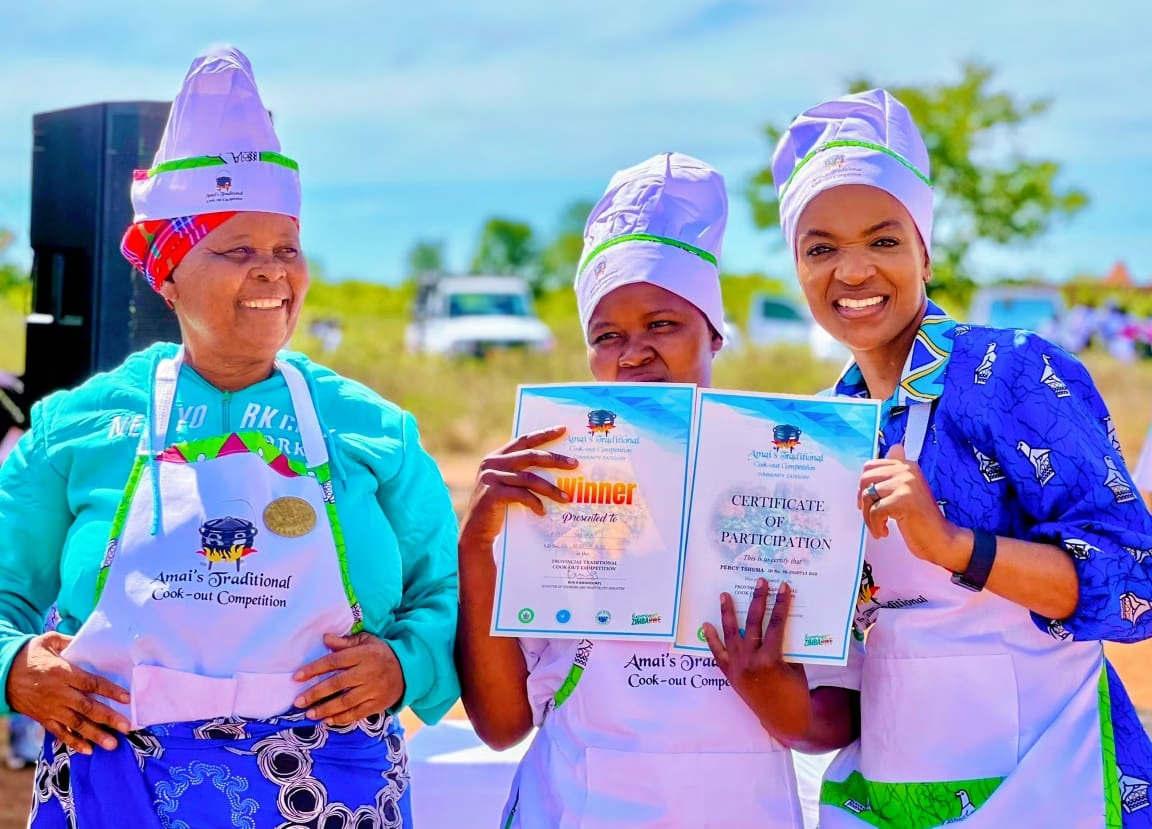
Deep in Makhulela Village in Matabeleland South, the 2026 edition of the Amai’s Traditional Cookout Competition unfolded as more than a culinary showcase, it became a strategic cultural statement on how heritage, identity, and tourism are increasingly being positioned as economic assets within Zimbabwe’s development agenda.
Hosted within the San community, the event brought together 22 participants drawn from the local community, youths, and persons with disabilities, reflecting a deliberate effort to align cultural preservation with inclusive development under Vision 2030.
Driven by the vision of Auxilia Mnangagwa, the Amai’s Traditional Cookout initiative continues to evolve beyond a food competition into a broader rural transformation platform, where gastronomy tourism is being used as a vehicle for community empowerment, cultural preservation, and economic participation.
What distinguished the Makhulela gathering was the authenticity of the San community’s cultural expression. Traditional dishes such as isthwala lezembwe, yoghurt yomukomba, zambana, mbambaira okudhala, amabele, inyama yenkomo, and the renowned inyama yendlovu were not merely presented as meals, but as living archives of identity, memory, and indigenous knowledge systems.
In many ways, the competition reflected a growing policy recognition that culture itself possesses economic value. For decades, rural communities have often been viewed through the lens of vulnerability and subsistence. However, initiatives such as the traditional cookout are gradually repositioning heritage as a productive sector capable of generating tourism flows, local enterprise opportunities, and community visibility.
Officiating at the event, Barbara Rwodzi commended the San community for safeguarding Zimbabwe’s cultural heritage through cuisine, dance, and hospitality. She described Makhulela as an emerging rural and cultural tourism destination with potential to contribute meaningfully to the country’s tourism diversification strategy.
Her remarks underscored a broader transition taking place within Zimbabwe’s tourism model. Rather than relying exclusively on traditional attractions such as wildlife and Victoria Falls, the country is increasingly investing in experiential tourism rooted in culture, heritage, and local community participation.
The Minister also reaffirmed government’s commitment to elevating local delicacies, including madora, onto international tourism platforms, in line with the First Lady’s broader campaign to promote Zimbabwean cuisine globally. This reflects an expanding understanding within the tourism sector that gastronomy is no longer peripheral to tourism, but central to destination branding and visitor experience.
Equally significant was the emphasis on inclusion. The participation of women, youths, and persons with disabilities reinforced the idea that heritage preservation and tourism development must translate into tangible livelihoods across communities.
From an economic perspective, the cookout competitions are gradually creating micro enterprise ecosystems around food preparation, crafts, performances, and hospitality services. In rural areas where formal employment opportunities remain limited, such cultural platforms are becoming alternative channels for income generation and local economic circulation.
The Makhulela event also highlighted the strategic role of indigenous knowledge within sustainable development conversations. Traditional food systems, often overlooked in mainstream economic discourse, carry nutritional, environmental, and cultural significance that aligns with broader conversations around food security and climate resilience.
Beyond the festivities, the cookout reflected an emerging national narrative, that preserving heritage is no longer solely about protecting the past, but about monetising identity in ways that empower communities while strengthening national pride.
As Zimbabwe advances toward Vision 2030, initiatives such as Amai’s Traditional Cookout Competition are increasingly demonstrating that culture, when strategically positioned, can function not only as heritage, but as infrastructure for rural industrialisation, tourism growth, and inclusive economic transformation.