Zimbabwe’s agricultural transformation agenda under National Development Strategy 2 is increasingly pivoting from a narrow focus on production volumes to a more sophisticated model centred on efficiency, preservation, and market readiness. The latest rollout of mechanisation equipment for smallholder and communal farmers signals a deliberate attempt to close one of the sector’s most persistent structural gaps, post-harvest losses.
For years, Zimbabwe’s agricultural economy has been constrained not only by how much is produced, but by how much is lost before reaching the market. With estimates suggesting that up to 30% of harvests are lost post-harvest, the intervention effectively targets what has quietly been one of the largest “invisible drains” on national food security.
The distribution of over 2,100 metal silos introduces a decentralised storage solution that fundamentally alters the grain retention model at household and community level. By providing airtight, pest-resistant storage, the silos reduce reliance on chemical preservation while extending the lifespan of harvested crops. This represents a shift from reactive to preventive agriculture, where losses are managed at source rather than compensated through imports.
Complementing storage are 70 multi-crop threshers, which directly address labour inefficiencies in the transition from field to storage. In traditional systems, delays in threshing often expose crops to weather damage and spoilage. Mechanisation compresses this timeline, preserving both quantity and quality, which in turn enhances market value.
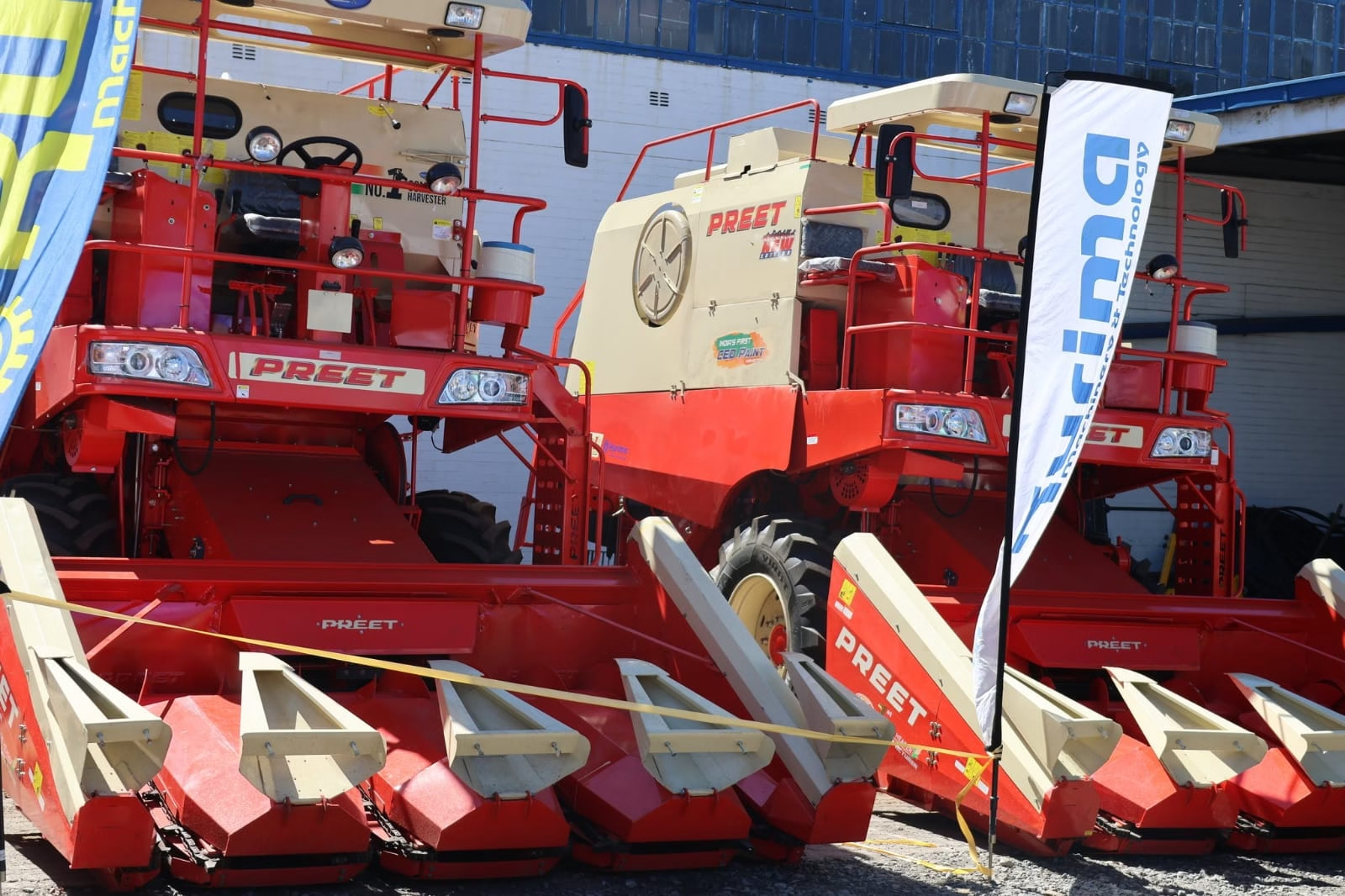
The introduction of combine harvesters, though limited in number, signals a gradual expansion of mechanised harvesting into communal and A1 farming sectors. This is particularly significant in ensuring crops are harvested at optimal maturity, reducing quality degradation and aligning smallholder output with commercial standards.
Backed by African Development Bank and Food and Agriculture Organization, the initiative reflects a layered approach to agricultural reform, where infrastructure, financing, and technical expertise converge. However, the deeper implication lies in how this support redefines productivity itself, from hectares planted to value retained.
Economically, the intervention has the potential to ease pressure on public finances. By preserving more of what is already produced, the country reduces its exposure to costly food imports, particularly in deficit years. This creates fiscal space that can be redirected toward long-term investments such as irrigation, transport logistics, and rural industrialisation.
Socially, the move enhances resilience at household level. Smallholder farmers, who form the backbone of Zimbabwe’s agricultural sector, are often the most vulnerable to post-harvest losses. By securing their yields, the programme strengthens income stability, food availability, and overall rural livelihoods.
Yet, the success of this mechanisation drive will depend less on distribution and more on utilisation. Historically, agricultural equipment schemes have faced challenges related to maintenance, access, and ownership models. Without structured training, cooperative usage systems, and clear accountability frameworks, there is a risk that some of the equipment could remain underutilised.
This is where the emphasis on technical support becomes critical. Skills transfer, maintenance training, and community-based management models will determine whether the intervention evolves into a sustainable system or remains a short-term boost.
Strategically, Zimbabwe now stands at a transition point. Having moved from “growing more” to “saving more,” the next phase must focus on “earning more.” This raises a policy crossroads between expanding irrigation infrastructure or accelerating digital market access.
Irrigation would stabilise production and ensure consistency in supply, particularly under climate variability. However, without efficient market systems, increased output risks saturating local markets and depressing prices. On the other hand, digital market access can unlock better price discovery, link farmers to wider markets, and integrate them into value chains, but it depends on consistent production volumes to be effective.
In reality, the two are not competing priorities but sequential layers of the same transformation. Preservation without market access limits income potential, while production without preservation sustains losses. The current intervention addresses the middle of this chain, but its long-term impact will depend on how effectively Zimbabwe integrates irrigation, logistics, and digital platforms into a unified agricultural ecosystem.
What is emerging is a more strategic understanding of agriculture, not merely as food production, but as a value system where efficiency at every stage determines national prosperity.