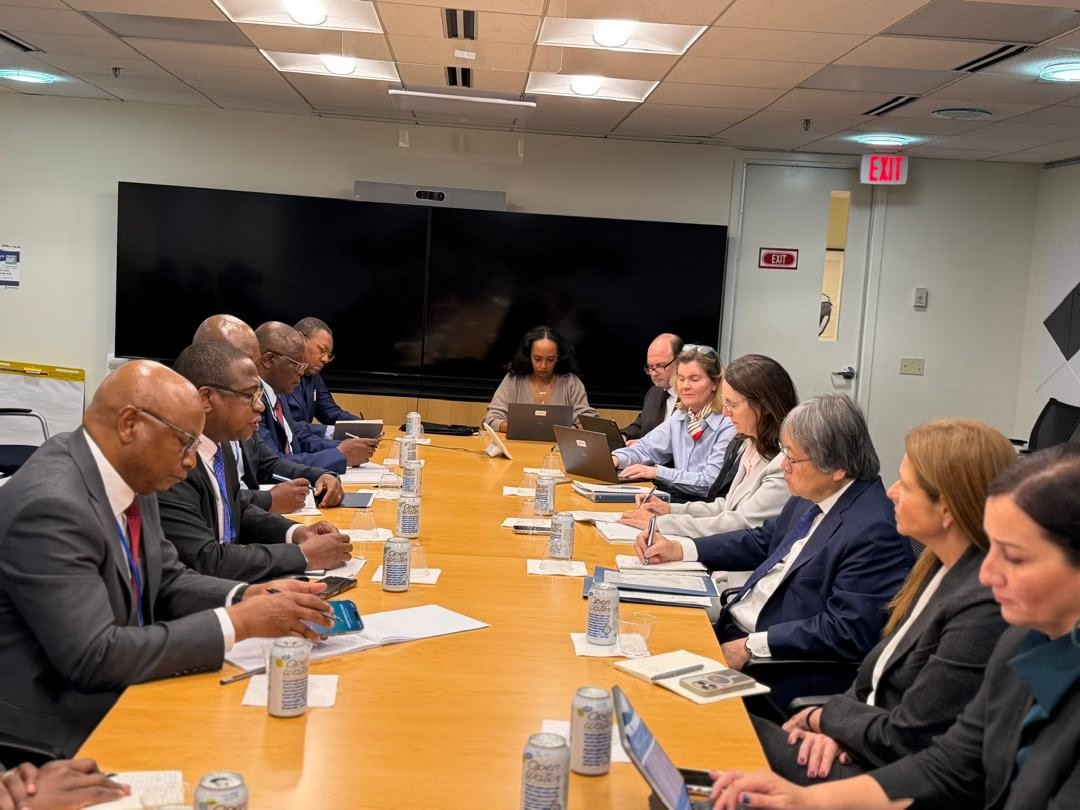
Zimbabwe’s engagements at the IMF World Bank Spring Meetings mark more than routine diplomatic interaction, they reflect a calculated effort to reposition the country within the global financial architecture, anchored on reform credibility, arrears resolution, and investment mobilisation.
At the centre of this re-engagement is Zimbabwe’s interaction with the World Bank, which signals a cautious but notable shift in tone. The acknowledgement of progress under the Staff-Monitored Programme is significant, not merely as a technical endorsement, but as a confidence signal to the broader international financial community.
Macroeconomic stabilisation remains the foundation of this engagement. The attainment of single-digit inflation and a sustained current account surplus over seven years suggests a degree of fiscal and external balance discipline that has historically been elusive. These indicators point to a government attempting to rebuild macroeconomic credibility, an essential prerequisite for re-entry into concessional financing and capital markets.
However, stabilisation alone is not sufficient. The real test lies in transitioning from macroeconomic control to sustained economic expansion. This is where Zimbabwe’s strategy becomes more layered. The push for a pre-arrears clearance framework under the Debt and Arrears Clearance Strategy reflects an understanding that without resolving legacy debt, access to long-term, affordable financing will remain constrained.
The search for an advocacy partner and a bridge-loan champion is particularly strategic. It signals recognition that arrears clearance is not just a technical process, but a political and financial negotiation requiring alignment among shareholders, development partners, and creditors. Success in this area would unlock not only funding, but also investor confidence, which is often more responsive to signals of risk reduction than to policy statements alone.
Domestically, the reform narrative is being reinforced through fiscal consolidation, improved revenue performance, and expenditure rationalisation. A 12% increase in revenue collections in the first quarter suggests strengthening administrative capacity, while the halting of domestic debt accumulation indicates a shift away from inflationary financing practices.
Yet, these gains must be viewed within a broader socio-economic context. The allocation of nearly half of the national budget to social sectors reflects an attempt to cushion vulnerable populations while maintaining reform momentum. This balancing act, between austerity and social protection, is a defining feature of reforming economies and will ultimately determine the political sustainability of these policies.
Structural reforms, particularly the move towards a market-determined exchange rate, represent another critical dimension. Exchange rate liberalisation, while necessary for correcting distortions, often introduces short-term volatility. The success of this transition will depend on policy consistency and the ability to anchor expectations in both the formal and informal sectors, where currency dynamics play out differently.
Beyond macroeconomics, Zimbabwe’s engagement with the World Bank around industrial policy, energy, and agriculture points to a broader development strategy. The emphasis on smallholder support, value chain integration, and inclusion of women and youth reflects a shift towards more inclusive growth models. This aligns with global development thinking, where growth is increasingly evaluated not just by output, but by distribution and resilience.
The underlying narrative emerging from these engagements is one of cautious optimism. Zimbabwe is no longer merely seeking validation, it is actively negotiating its re-entry into the global financial system. However, this process remains contingent on sustained reform implementation, policy consistency, and the successful navigation of arrears clearance.
Ultimately, the Spring Meetings engagements highlight a country at an inflection point, where the convergence of reform, diplomacy, and economic strategy could redefine its trajectory. The challenge now lies in translating technical progress into tangible economic outcomes, investment inflows, job creation, and improved living standards, which will determine whether this phase represents a turning point or simply another cycle in Zimbabwe’s long re-engagement journey.