Story By Aldridge Dzvene
Zimbabwe’s Vice President, Constantino Chiwenga, has issued a strong regional call for decisive execution, investment acceleration and policy discipline, warning that Southern Africa risks remaining energy-constrained unless it moves beyond dialogue to implementation.
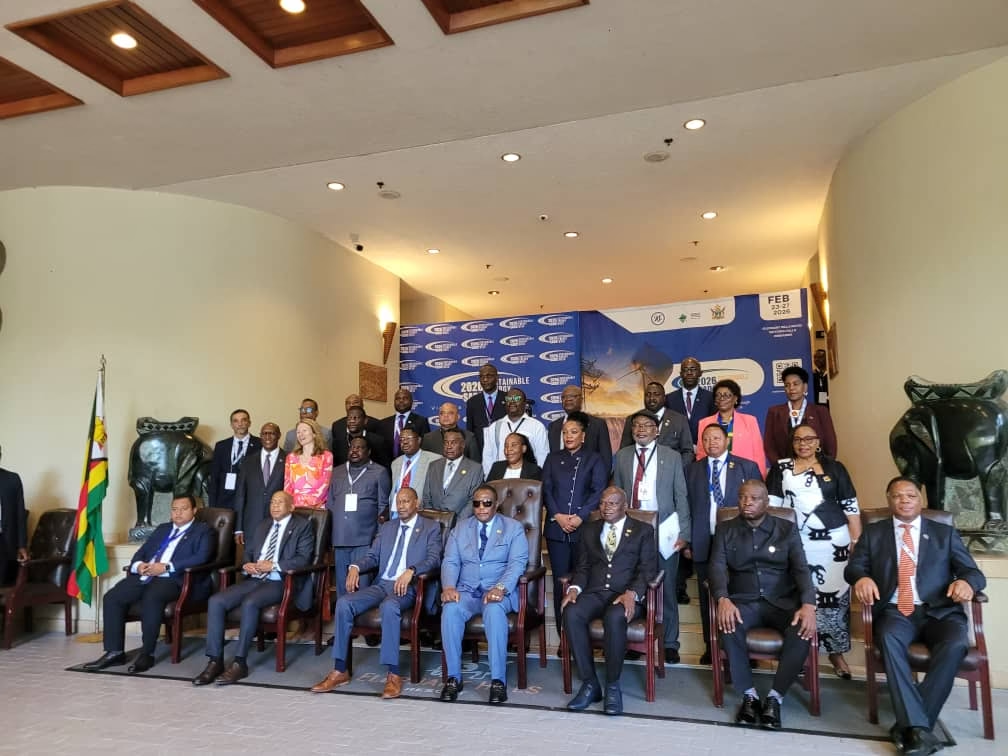
Officially opening the 2026 SADC Sustainable Energy Week at Elephant Hills Hotel on Tuesday, Vice President Chiwenga framed clean energy not as a future aspiration but as an immediate economic strategy critical to industrialisation, job creation and regional competitiveness.
Speaking on behalf of Emmerson Dambudzo Mnangagwa, Chiwenga situated the regional energy agenda within rapidly shifting global geopolitics marked by reconfigured supply chains, strategic minerals competition and the advance of the Fourth Industrial Revolution. He argued that Southern Africa must shape, rather than observe, the global energy transition.
The high-level gathering, convened under the Southern African Development Community, brought together policymakers, financiers, industry leaders, development partners and academics, a convergence Chiwenga said signalled the region’s readiness to move from policy conversation to delivery.
While commending SADC’s institutional frameworks, including the Renewable Energy Strategy and Action Plan and the Southern African Power Pool, the Vice President was candid about structural constraints. Power deficits, ageing infrastructure, fragmented regulation and an estimated US$83 billion annual infrastructure financing gap continue to suppress growth in a region of more than 340 million people.
Chiwenga’s address placed Zimbabwe’s energy reform agenda firmly within this regional context. With national electricity access at about 62 percent and rural access barely above 20 percent, he outlined reforms under National Development Strategy 2 aimed at liberalising generation, enabling direct power purchase agreements, expanding private sector participation in transmission and distribution, and accelerating rural electrification with a focus on schools and clinics.
The Vice President also highlighted Zimbabwe’s resource endowment as a strategic advantage if matched with execution. Coal reserves, extensive water bodies and untapped solar and wind potential, alongside emerging waste-to-energy projects in Harare, were presented as opportunities for clean urban development, decentralised power generation and rural economic transformation.
Regionally, Chiwenga reaffirmed Zimbabwe’s commitment to cross-border energy integration through major hydro-electric initiatives including Batoka Gorge, Devil Gorge and Mupata Gorge, while supporting continental flagship projects such as the Inga Dam in the Democratic Republic of Congo. These, he said, are essential to transitioning Southern Africa from an energy-deficit region to an energy-surplus industrial hub.
At a continental level, the Vice President expressed concern that Africa, despite possessing nearly 60 percent of the world’s best renewable energy resources, continues to harness only a fraction of its potential. He argued that Africa must leapfrog carbon-intensive development pathways and directly adopt clean, modern energy systems, consistent with global climate commitments.
In this regard, Chiwenga pointed to the recent African Union-led Memorandum of Understanding on the peaceful application of nuclear science and technology as a strategic opening for Africa to build regulatory capacity, human capital and value chains in support of long-term energy security and industrialisation.
Beyond policy, the Vice President directed a clear message to financiers, regulators and knowledge institutions. Investment bankers were urged to mobilise capital into scalable, bankable projects, while policymakers were challenged to provide regulatory certainty and harmonised frameworks capable of unlocking large-scale financing. Academia and energy experts, he said, must drive innovation, skills transfer and local capacity development.
Chiwenga concluded by underscoring that Southern Africa already possesses the resources, market size and strategic geography required for transformation. What remains lacking, he stressed, is disciplined execution. Clean energy, he argued, is no longer a distant goal but a defining economic instrument for growth, resilience and sovereignty.
With those remarks, the Vice President formally declared the 2026 SADC Sustainable Energy Week open, setting a high bar for outcomes that extend beyond declarations to measurable regional impact.