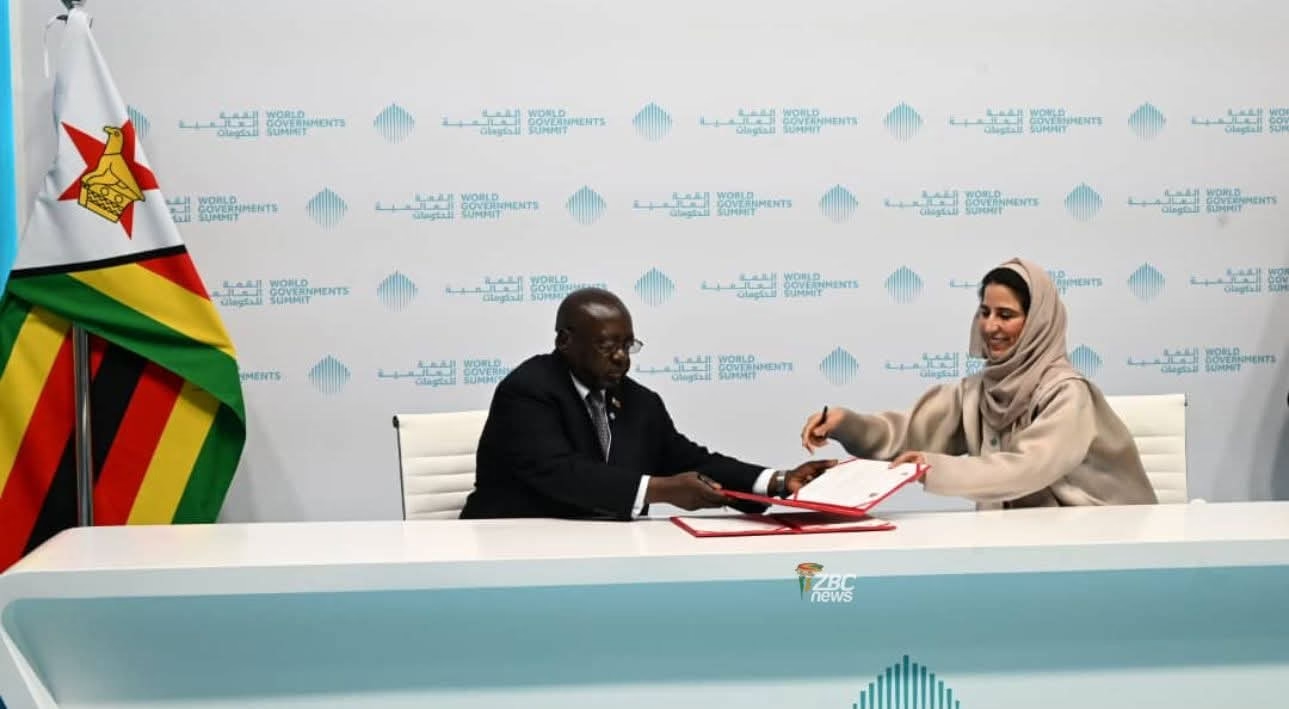
Zimbabwe and the United Arab Emirates have renewed their Memorandum of Understanding on governance and institutional cooperation, in a move that signals a deeper strategic shift toward strengthening state delivery systems, executive coordination and administrative performance frameworks.
The agreement, signed by Chief Secretary to the President and Cabinet Dr Martin Rushwaya and UAE Minister of State and Secretary General of the Ministry of Cabinet Affairs Honourable Maryam bint Ahmed Al Hammadi, positions governance capacity itself as a formal area of bilateral cooperation, not just a supporting pillar to trade and investment relations.
At an analytical level, the renewal reflects a growing recognition that economic transformation is not driven by policy announcements alone, but by the operational strength of institutions that implement those policies. By renewing the governance focused MoU, Zimbabwe is effectively treating institutional capability as development infrastructure, alongside energy, transport and industry.
The UAE model has increasingly attracted attention globally for its emphasis on delivery architecture, executive performance tracking and cross government coordination. Its governance system is built around structured performance management, rapid execution units and leadership development pipelines embedded within the state. Cooperation under this MoU potentially gives Zimbabwe structured exposure to these systems, methodologies and training ecosystems.
This matters in the context of Zimbabwe’s ongoing public sector reform and results based management agenda coordinated through the Office of the President and Cabinet. Institutional bottlenecks, slow implementation cycles and fragmented coordination have historically weakened policy impact across many developing administrations. A governance partnership that targets systems, not slogans, directly addresses this constraint.
The MoU is designed to advance joint initiatives that strengthen institutional capacity in governance. That typically includes executive training, policy delivery tools, performance measurement frameworks and administrative innovation platforms. If implemented with discipline, such cooperation can improve how ministries plan, sequence and execute programmes.
From a diplomatic standpoint, the renewal also indicates that Zimbabwe, UAE relations are evolving beyond transactional economics toward structural state collaboration. Instead of focusing only on capital flows and commercial deals, the partnership now includes how government itself is organised and how it performs. That marks a higher trust and longer horizon relationship model.
For Zimbabwe, the strategic value lies in adaptation, not imitation. Governance systems are context specific. The practical test will be how effectively UAE governance tools are localised into Zimbabwe’s legal, administrative and political environment. Institutional reform succeeds when models are translated, not copied.
There is also an accountability dimension. Governance cooperation raises expectations of measurable improvement. Stronger delivery systems imply clearer targets, tighter monitoring and more transparent performance evaluation across public institutions. That increases pressure for results, but also improves credibility when results are achieved.
In policy terms, the renewed MoU reframes governance from background function to front line development lever. It asserts that how the state works is as important as what the state plans.
The significance of the agreement will ultimately be judged not by the signing ceremony, but by whether citizens and investors experience a more coordinated, more responsive and more delivery focused public sector. That is where governance diplomacy either proves its value or remains paperwork.