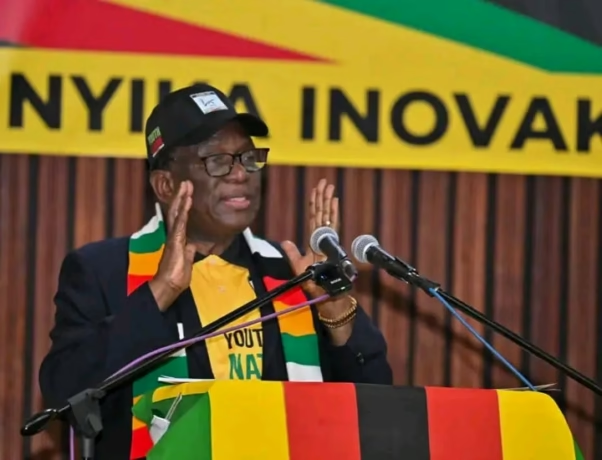
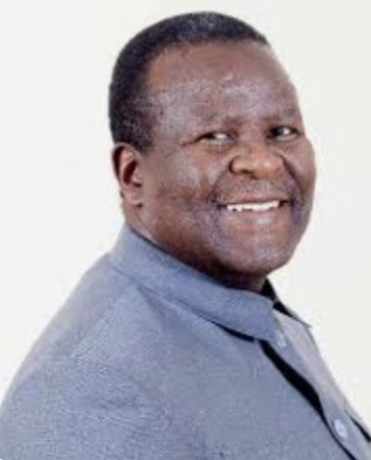
The International Day of Persons with Disabilities commemoration at St Giles Medical Rehabilitation Centre this year unfolded not as a routine calendar event, but as a carefully positioned statement on where Zimbabwe’s inclusion agenda is headed, toward systems, partnerships and accountable leadership.
Anchoring the occasion was Ms Patricia Murambinda, General Manager – Corporate Affairs, whose role as Guest of Honour gave the event a governance and institutional dimension that extended beyond symbolism. Her presence reflected a growing national understanding that disability inclusion is no longer a peripheral social issue, but a core development responsibility aligned with policy, ESG commitments and sustainable national growth.
St Giles, one of Zimbabwe’s most respected rehabilitation and inclusive education institutions, used the day to demonstrate how inclusion functions when it is embedded in structures rather than goodwill. Rehabilitation services, assistive technologies, special needs education and community reintegration were presented as essential components of national social infrastructure, fully aligned with Government policy on inclusion and social protection.
The event also enjoyed strong cultural resonance with the presence of music superstar Chipo Muchemwa, whose participation brought public visibility and social solidarity to the occasion. Her engagement underscored the importance of using cultural influence to normalise disability inclusion, amplify awareness and strengthen community ownership of national development goals.
Government support for disability inclusion was clearly evident throughout the commemoration. Zimbabwe’s National Disability Policy, which prioritises access to health, education, rehabilitation and economic participation, remains the guiding framework, with institutions like St Giles translating policy intent into practical outcomes. The Centre’s work reflects the broader Government thrust to ensure that no citizen is excluded from development pathways.
By hosting a Guest of Honour with a corporate affairs and governance portfolio, St Giles highlighted the increasingly strategic role of the private sector in supporting national inclusion objectives. Disability inclusion is now firmly situated within ESG and CSR leadership, where it intersects with workforce planning, infrastructure design, procurement systems and community investment strategies.
This alignment reinforces the Second Republic’s development philosophy, where public institutions, corporates and civil society are expected to work collaboratively rather than in silos. The participation of local authorities, development partners, educators and community leaders demonstrated a shared commitment to coordinated service delivery and inclusive growth.
St Giles Special School, in particular, continues to stand as a model of inclusive education in action. By nurturing academic excellence, independence and confidence among learners with disabilities, the school illustrates the long-term social and economic dividends of sustained investment in inclusive systems.
The presence of national figures, corporate leadership and cultural icons sent a clear message: disability inclusion in Zimbabwe is evolving from advocacy to implementation. It is increasingly measured not by declarations, but by institutions that deliver results consistently and with integrity.
As Zimbabwe advances toward Vision 2030, St Giles remains a practical example of how policy, leadership and partnerships can converge to create inclusive outcomes. The International Day of Persons with Disabilities commemoration therefore served not only as a celebration, but as reaffirmation that inclusion is central to national development, supported by Government, strengthened by partnerships and sustained through accountable institutions.