Zimbabwe and Zambia have stepped decisively into a new phase of infrastructure-led cooperation following renewed commitments to fast-track the Batoka Gorge Hydro-Electric Scheme, a project increasingly emerging not merely as a power station, but as a strategic anchor for regional industrialisation, energy security and inclusive growth.
The two countries have jointly committed US$440 million in equity towards the project, with each government contributing US$220 million, a move that sends a strong signal of political will and financial seriousness at a time when large-scale infrastructure across Africa often stalls at the level of intent. This firm financial backing places Batoka among the most advanced bi-national energy initiatives on the continent, transforming it from a long-held aspiration into a concrete development instrument.
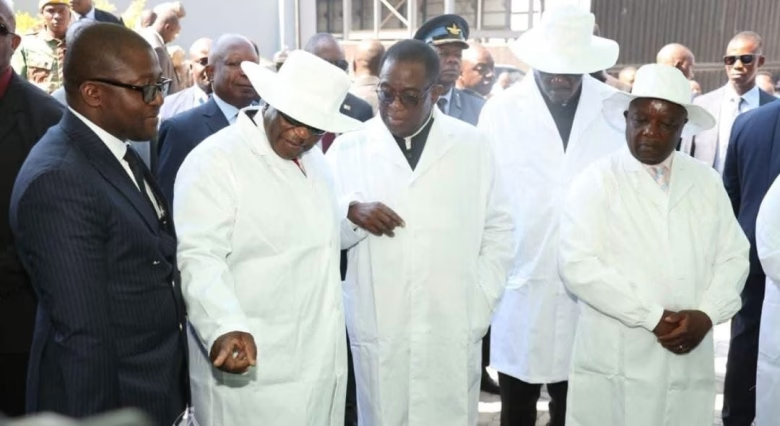
Momentum around the project was further consolidated this week when Zimbabwe’s Minister of Energy and Power Development, Honourable July Moyo, who also serves as Co-Chairperson of the Zambezi River Authority Council of Ministers, toured the proposed dam wall construction site in Victoria Falls. The visit was not symbolic; it was a practical inspection aimed at aligning political commitment with on-the-ground implementation realities and funding strategies.
Beyond the immediate financing pledge, what distinguishes Batoka from many regional power projects is the deliberate repositioning of the scheme as a vehicle for domestic value creation rather than a mere engineering undertaking. Minister Moyo underscored that the project is being structured to maximise the utilisation of locally available cement, steel, aggregates and technical skills from both Zimbabwe and Zambia, a move that seeks to entrench industrial spillovers into the broader economy rather than exporting economic value through externally dominated procurement models.
This local-resource-driven approach reflects a deeper policy shift in Zimbabwe’s development thinking, particularly under the National Development Strategy 2, where infrastructure is no longer viewed solely as a utility provider but as a catalyst for domestic production, job creation and industrial depth. In this framing, Batoka becomes not just a power generator but a driver of manufacturing demand, skills development and cross-border supply chain integration.
Equally significant is the project’s reorientation toward community-centred development, a historically weak link in mega-infrastructure projects across the region. Government has now made it explicit that communities in Hwange, Binga and surrounding districts will be direct beneficiaries through road construction, township development, employment creation and social infrastructure. This aligns closely with President Mnangagwa’s development mantra of leaving no one and no place behind, repositioning Batoka as a socio-economic development corridor rather than an isolated energy enclave.
Technically, project engineers have confirmed that the final dam design was optimised not only for power output but also for environmental sustainability and heritage preservation. By deliberately balancing generation capacity with ecological integrity, the project avoids compromising the Victoria Falls curtain and the outstanding universal value of the World Heritage Site, a critical consideration that strengthens Batoka’s global investment credibility while safeguarding one of Southern Africa’s most treasured natural assets.
From a regional perspective, Batoka represents a deeper evolution in Zimbabwe–Zambia cooperation, shifting from shared resource management toward shared economic destiny. In a region facing increasing energy deficits, industrial stagnation and climate-induced vulnerabilities, the scheme stands as a model of how transboundary resources can be transformed into engines of mutual prosperity rather than sources of conflict or underutilisation.
More broadly, Batoka’s acceleration signals Zimbabwe’s renewed confidence in deploying large-scale infrastructure as a lever for national revival. At a time when power shortages remain a binding constraint on industrial productivity, mining expansion and digital growth, the scheme positions itself as a foundational pillar for sustaining Vision 2030 ambitions.
As both governments now move toward mobilising additional funding beyond the initial US$440 million, Batoka enters a defining phase where vision must be matched with execution discipline. If delivered within its intended developmental logic, the Batoka Gorge Hydro-Electric Scheme will not only light homes and power industries, but also illuminate a new pathway for how Zimbabwe and the region conceive, finance and own their development future.