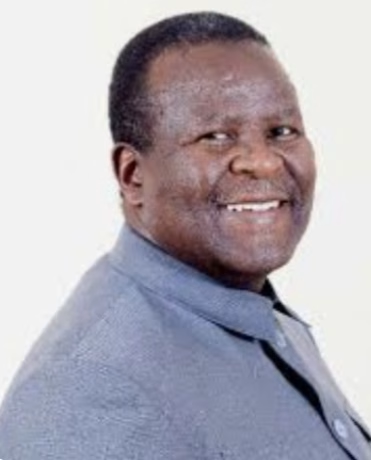
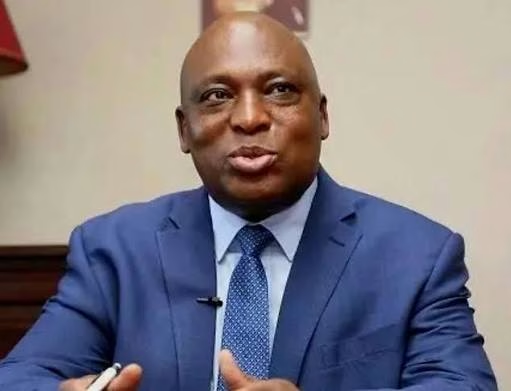
History often celebrates the thunder of founding moments while overlooking the hands that steady the structure long after the noise fades. In Zimbabwe’s national journey John Landa Nkomo belongs to this quieter lineage of builders. His life and work unfold in the long shadow of Father Zimbabwe Dr Joshua Mqabuko Nkomo yet they also reveal how that founding vision was protected translated and institutionalised during the fragile years of statehood.
Growing up under colonial rule in Tsholotsho John Landa Nkomo experienced the violence of dispossession at its most intimate level. Communities were uprooted identities fractured and African dignity deliberately diminished. These early encounters with injustice shaped a political ethic that rejected exclusion and domination. For him liberation was never simply the transfer of power but the restoration of humanity.
This worldview would later define his approach to governance and reconciliation.
His entry into politics through teaching and labour organisation placed him at the social base of the liberation struggle. While Father Zimbabwe mobilised the masses and articulated the national vision John Landa Nkomo absorbed its meaning among ordinary people. He witnessed how inequality survived even within liberation movements and understood that unity would be the most difficult inheritance of independence. This insight explains his later role as a political stabiliser rather than a power seeker.
After 1980 his influence became structural. In ministries responsible for labour social welfare and local government he advanced policies that anchored the state in social protection and civic order. These were not glamorous reforms but they were foundational. By institutionalising worker security local administration and public order he helped convert liberation ideals into lived governance. In this phase he functioned as a custodian of the Father Zimbabwe philosophy translating it from rhetoric into systems.
The defining test of his statesmanship came during Zimbabwe’s most volatile post independence years. Political conflict and unresolved historical grievances threatened to tear the nation apart. It was in this moment that John Landa Nkomo’s temperament proved decisive. He worked quietly within power structures to cool tensions and advance dialogue culminating in the unity framework that preserved the nation’s cohesion. This was not victory politics but survival politics and it reshaped Zimbabwe’s future.
As Vice President and later as a champion of national healing Nkomo framed peace as both a moral obligation and a political necessity. His belief that peace begins with the individual challenged a culture of blame and redirected responsibility toward collective self reflection. In this sense he extended the Father Zimbabwe legacy beyond liberation into ethical citizenship.
John Landa Nkomo’s historical importance lies in his role as a bridge. He connected the founding vision of Father Zimbabwe to the practical demands of governing a diverse and wounded nation. While others commanded attention he commanded trust. His legacy reminds Zimbabwe that the survival of the state depended not only on those who founded it but on those who quietly held it together when it was most vulnerable.