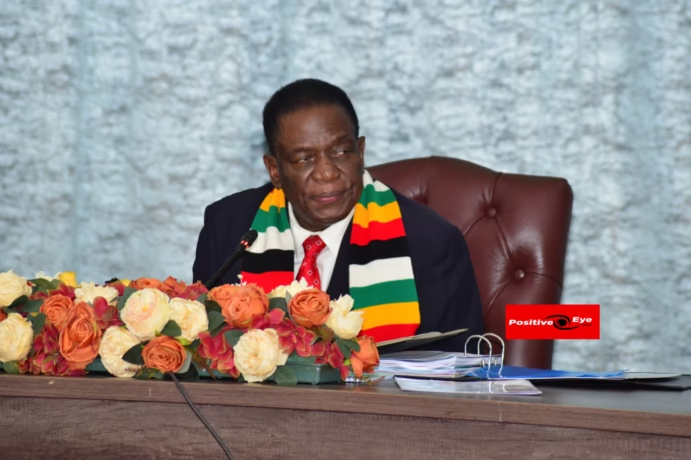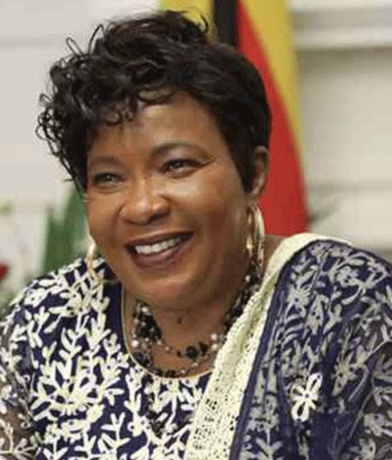
The call to strengthen the role of traditional leadership in Zimbabwe’s development trajectory came into sharper focus this week as the Deputy Minister of Local Government and Public Works responsible for Local Authorities and Traditional Leadership, Honourable Albert Tawanda Mavunga, reaffirmed Government’s commitment to restoring the dignity of chiefs while transforming their institutions into engines of rural development.

Addressing traditional leaders, Honourable Mavunga emphasised that the empowerment of chiefs goes beyond symbolic restoration. It represents a deliberate national strategy to correct colonial-era injustices that eroded traditional authority and undermined community structures. The Deputy Minister said Government’s ongoing efforts, including the provision of vehicles, decent housing, and improved infrastructure for chiefs, reflect its recognition of their central role in preserving culture, maintaining social order, and driving local development.
Yet, as developmental observers note, this empowerment raises a critical question: how effectively is traditional leadership being aligned with Zimbabwe’s Vision 2030, the blueprint for achieving an upper middle-income economy through inclusive and sustainable growth? The Government’s initiative, while commendable, must translate into tangible socio-economic outcomes within rural communities. It is not enough to restore dignity, empowerment must foster productivity, innovation, and resilience.
Honourable Mavunga underscored that Government values the contribution of traditional leaders in natural resource conservation and the preservation of sacred sites, areas that were once desecrated by the colonial regime. He noted that Government-funded cultural and environmental revival programmes, including rainmaking ceremonies such as Gora in Mashonaland West, symbolise a deeper effort to restore Zimbabwe’s spiritual and ecological balance. These initiatives, he said, form part of a holistic approach to sustainable development where cultural wisdom complements modern governance systems.
The Deputy Minister also commended traditional leaders for their developmental roles through Ward Assemblies and local structures, encouraging them to strengthen coordination with Government’s devolution agenda. He appealed to them to remain united in national development efforts and to work collectively in fighting the negative impact of sanctions, which continue to constrain economic growth. His message was clear, rural leadership is central to achieving Vision 2030, and unity of purpose is essential in that journey.
Analysts observe that this renewed engagement between Government and traditional leadership represents a paradigm shift from symbolic recognition to functional integration. Chiefs are increasingly viewed as developmental stakeholders, with influence over land use, community mobilisation, and environmental management. Their involvement in the implementation of devolution policies could enhance accountability, improve service delivery, and promote locally driven economic growth.
However, the long-term success of this empowerment programme will depend on measurable impact. Rural communities must begin to see improved livelihoods, better infrastructure, and expanded opportunities under traditional jurisdictions. The Deputy Minister’s remarks invite a broader national dialogue on how traditional institutions can evolve into drivers of inclusive growth, youth empowerment, and environmental stewardship.
As Zimbabwe progresses towards Vision 2030, the partnership between Government and traditional leadership will remain pivotal. The message from Honourable Mavunga’s address is one of shared responsibility, that tradition, when harnessed with purpose and supported by sound policy, can become a cornerstone of sustainable national transformation.