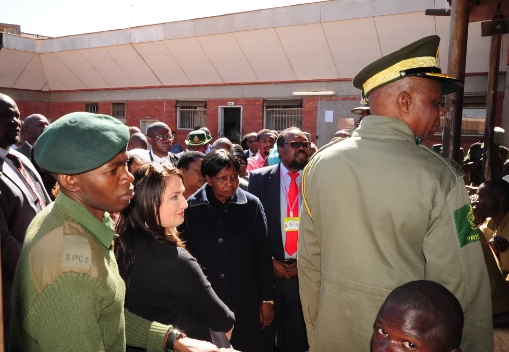
When the Joint Parliamentary Committee on Justice and Human Rights toured Zimbabwe’s prisons, they did not just encounter concrete walls and locked doors, they walked into stories of endurance, silence and forgotten humanity. Beneath the steel bars and cracked ceilings, there is a world where survival has become a daily act of faith, and where the promise of justice feels like a distant echo.
From Gwanda to Chikurubi, the report reveals a pattern that reads less like statistics and more like a cry. Cells built for 60 now hold 210 souls, and at Chikurubi, over 2,600 inmates share space meant for just over 1,100. Men and women sleep shoulder to shoulder on cold floors, some wrapped in thin blankets shared between two. There are no lines of comfort, only commas of endurance, small pauses in a life sentence of waiting.
At Marondera Prison, rain leaks through rotten roofs while inmates use buckets for toilets. In Harare, water runs dry for days, leaving hundreds without a single drop to wash. The kitchens tell another story, cooking pots dented with years of neglect, firewood stacked where electric stoves should stand. Dinner is served at three or four in the afternoon, because darkness comes early when there is no power.
The report finds pain but also glimpses of resilience. At Connemara Open Prison, inmates plant maize and learn carpentry, welding and tailoring, not just to pass time but to reclaim dignity. There, prisoners can listen to the radio, study for exams and even take short home visits. It is a correctional island that proves what is possible when rehabilitation replaces retribution.
Yet, beyond those few lights, the shadows remain long. Prisons across the country are haunted by drug shortages. Those with chronic illnesses depend on relatives for medication, while psychiatric patients wait months for treatment that never comes. One nurse often serves hundreds, with no fridge to store medicine and no gloves to protect her hands.
The committee’s report captures the silent heartbreak of long remand, men and women who have not been convicted but live behind bars for years, forgotten by the system. One official described them as “the prisoners of time.” Their crime, often, is poverty, an inability to afford bail, a lawyer or transport to court.
Still, there are patches of hope. Hurungwe Prison, with its vast farmland, feeds itself and nearby facilities, proving that prisons can become engines of productivity rather than drains of despair. Marondera Female Prison, the only open female correctional institution in Southern Africa, offers women a chance to rebuild. They garden, sew, study, and dream of life after confinement. But stigma and lack of starter packs upon release often drag them back into the cycle they fought to escape.
The report is not just a catalogue of hardship, it is a plea for compassion, modernisation and policy reform. It calls for digitised inmate records, humane remand laws and prisons that respect motherhood and disability. It demands that judges return to the cells they sentence people to, that health ministries equip clinics and that education be restored as a path to redemption.
Behind the statistics lies a deeper truth, a nation’s character is reflected in how it treats those it confines. Zimbabwe’s prisons may be old, cracked and overcrowded, but within them are human beings still capable of dreaming, learning and transforming.
The Parliamentary Committees did not just expose the broken, they challenged the country to reimagine justice, because prisons should not be places where hope dies quietly, they should be where it begins again.