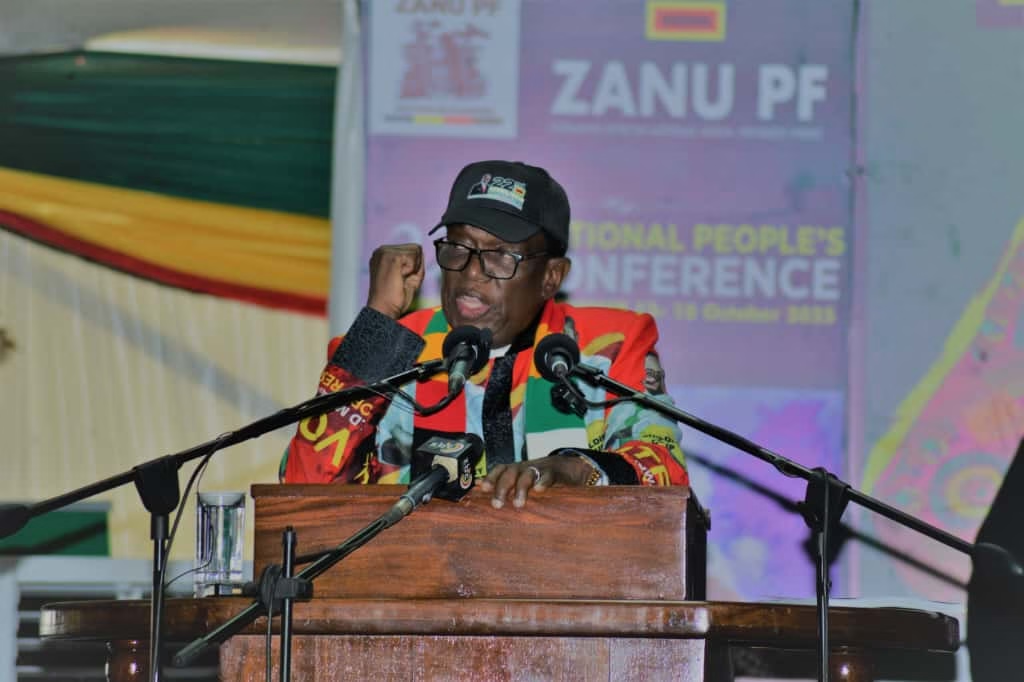
The ruling party, ZANU PF, convened its 22nd National People’s Conference in Mutare, Manicaland Province, where President Emmerson Dambudzo Mnangagwa reaffirmed the party’s central role in shaping Zimbabwe’s transformative journey towards Vision 2030. His keynote address captured the essence of continuity, discipline, and adaptation as the Party recalibrates its strategies for economic empowerment, industrialisation, and national unity.
President Mnangagwa, addressing thousands of delegates, invoked the enduring revolutionary spirit rooted in the liberation struggle, reminding the nation that ZANU PF remains the “custodian of the people’s revolution.” He saluted Manicaland Province for its historical contribution to the liberation war, citing the heroic legacy of figures such as Chief Tangwena, Chief Makoni, and Cde Herbert Chitepo, among others. The President framed the province not only as the cradle of the struggle but as an inspiration for modern-day nation-building through collective effort, discipline, and ideological clarity.
Anchored on the theme “Attainment of Vision 2030 through Economic Empowerment and Value Addition,” the conference, according to the President, comes at a crucial juncture when the nation is consolidating gains under the National Development Strategy 2 (NDS1). President Mnangagwa emphasised that the Party’s machinery must remain “well-oiled” to advance people-centred development, underscoring that ZANU PF is not merely a political entity but the “engine-room of national development.”
He reaffirmed the Government’s commitment to broad-based empowerment, rural industrialisation, and inclusive growth, insisting that “no one and no place will be left behind.” The President’s narrative aligned with his economic vision of systematically building the nation “brick by brick and stone upon stone,” describing Zimbabwe’s economic rise as steady and deliberate rather than a “big bang.” He pointed to significant progress in agriculture, mining, and manufacturing, highlighting record maize, wheat, and tobacco yields, growing mineral exports, and the expanding manufacturing sector as proof of a nation on an upward trajectory.
President Mnangagwa also lauded the diaspora community for contributing to the economy through remittances and investments, describing such acts as patriotic and central to nation-building. He stressed that rural development remains pivotal to his administration’s policy agenda, calling for the establishment of factories and industries in local communities to create employment and empower young people. The vision of transforming rural areas into productive, export-oriented zones was evident in his reference to Presidential Village Business Units and irrigation schemes that are reshaping local economies.
Education and innovation were also placed at the heart of the national transformation agenda. The President celebrated the success of the Heritage-Based Education 5.0 model, urging the Party to support youth innovators in commercialising their products and turning creative potential into enterprise. He said science education, particularly in rural schools, must be prioritised to accelerate industrialisation and technological progress.
In a strong moral and disciplinary appeal, President Mnangagwa warned against corruption, factionalism, tribalism, and indiscipline, describing these as cancers to both the Party and the nation. He reiterated his long-standing call, first made at the 2018 Esigodini Conference, for ZANU PF members to embody honesty, hard work, and transparency. “The Party should never be a haven for any of these vices,” he declared, stressing that integrity and discipline are non-negotiable in the pursuit of the national vision.
The President was equally emphatic about the dangers of misinformation and political opportunism, warning that Zimbabwe “is not governed on social media.” He reaffirmed that the country’s sovereignty and independence were bought through the blood of liberation fighters, asserting that his administration would remain vigilant in defending national dignity and unity.
At a time when political succession debates and external pressures often dominate public discourse, President Mnangagwa’s tone was one of continuity, stability, and focus. He urged Party members to strengthen grassroots mobilisation, expand membership, and maintain ZANU PF’s ideological dominance ahead of future elections. The President described the Party as “a mammoth revolutionary organisation that does not fit into anyone’s pocket,” emphasising that ZANU PF belongs to the people, not individuals or cliques.
The conference also spotlighted Zimbabwe’s growing resilience in the face of global shocks such as sanctions and climate change. The President paid tribute to regional and international allies for standing with Zimbabwe and reaffirmed his Government’s commitment to Pan-Africanism, unity, and South-South cooperation.
By officially tabling the Central Committee Report for debate and adoption, President Mnangagwa set the tone for the next phase of national and Party development. His message carried both ideological and practical dimensions — urging continuity in revolutionary values while adapting to the modern realities of technology, youth empowerment, and global competitiveness.
The 22nd National People’s Conference, therefore, became more than a routine gathering. It was a reaffirmation of identity, a renewal of purpose, and a clear call to action: to industrialise, to empower, and to preserve unity. It reinforced the national philosophy — “Nyika inovakwa, inotongwa, inonamatigwa nevene vayo / Ilizwe lakhiwa, libuswe, likhulekelwe ngabanikazi balo” — a philosophy that continues to define Zimbabwe’s march toward Vision 2030 under ZANU PF’s stewardship.