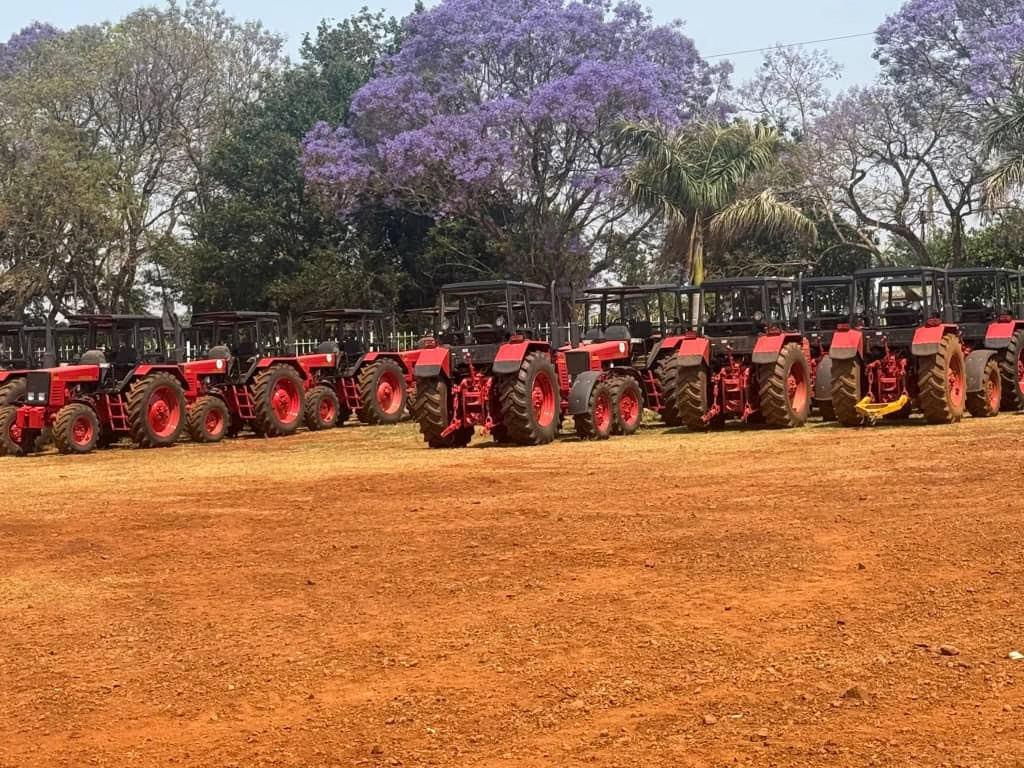
Zimbabwe’s agricultural journey has taken a decisive turn under the Second Republic, moving from survival farming to a strong and productive system that feeds the nation. What once seemed like a dream during the early days of the Land Reform Programme has now become a visible reality. Despite the heavy shadow of illegal Western sanctions, the country’s farmers are emerging as champions of food security, showing that resilience and vision can outgrow restriction.
The Land Reform Programme, which began with controversy and isolation, was the foundation of this transformation. At first, productivity fell and sanctions deepened, but the Second Republic under President Emmerson Mnangagwa has brought new energy to the sector. Through modernisation programmes like the Belarus Mechanisation Scheme, thousands of farmers have gained access to tractors, harvesters, and irrigation technology, tools that have replaced the hoe with machinery and hard labour with efficiency. The change is visible in fields once left idle, now turning golden with wheat, maize, and other crops that feed the nation and restore Zimbabwe’s agricultural pride.
For many farmers, the transformation is not only practical but emotional. “We want to thank the President for the tractors and harvesters. We can now produce enough food for our families,” said one farmer with visible pride. Another confidently declared, “By 2030, no farmer will be using a hoe.” These are not just words of gratitude, they echo a growing confidence that Zimbabwe’s farming community is stepping into a new era of empowerment.
The Zimbabwe Farmers Union (ZFU) Secretary General, Mr Paul Zakaria, highlighted how the mechanisation drive has become a shield against sanctions. “The high levels of production have played a pivotal role in countering the negative impact of sanctions. Thanks to the mechanisation programme introduced by the Second Republic, we can safely say we are now food secure,” he said. This reflects how the government’s vision of transforming agriculture into a fully mechanised, business-oriented industry is steadily materialising.
Permanent Secretary in the Ministry of Lands, Agriculture, Fisheries, Water and Rural Development, Professor Obert Jiri, said the current agricultural success story is built on persistence and innovation. He explained that while international funding was blocked, the government turned to its policy of engagement and re-engagement to bring in partners like Belarus. “There were prophets of doom who did not believe the land reform could succeed. We were blocked from accessing international funding, but through engagement and re-engagement, the President brought in the Belarus Mechanisation Programme. Despite sanctions, our agriculture is now modernised, and farmers are breaking records in various crops, including wheat,” he said.
This success story is not isolated. Across provinces, farmers are responding positively to the mechanisation and Pfumvudza/Intwasa programmes, producing record yields of wheat, maize, and horticultural crops. The results have been visible through improved food self-sufficiency, reduced import dependence, and revived rural economies. What was once a sector weakened by sanctions has turned into one of the strongest pillars of Zimbabwe’s economic recovery.
The regional recognition of October as Anti-Sanctions Month by the Southern African Development Community (SADC) adds political weight to Zimbabwe’s resilience. It symbolises the solidarity of the region against measures that sought to cripple its progress. But more importantly, it reflects how Zimbabwe has turned adversity into advantage. The government’s mechanisation strategy has not only strengthened the agricultural backbone but also restored dignity and independence to the land reform beneficiaries.
The Second Republic’s approach to agriculture blends vision, technology, and policy coherence. It proves that true transformation does not happen overnight but through consistent leadership and collective effort. From the fields of Mashonaland to the plains of Matabeleland, farmers are no longer victims of sanctions but victors of resilience. They are producing, feeding, and exporting, fulfilling the dream of restoring Zimbabwe’s place as the breadbasket of Southern Africa.
What began as a struggle for land has become a story of renewal. Under the Second Republic, the land is no longer a symbol of conflict but of productivity. With each harvest, Zimbabwe’s farmers are telling their own success story, one where sanctions failed to bury the seed of progress, and where hope has grown into food, dignity, and economic freedom.