The International Monetary Fund’s positive assessment of Zimbabwe’s economy marks a significant shift in the country’s engagement with global financial institutions and signals the potential for deeper integration into the international economic system. In its recent statement, the IMF commended Zimbabwe for undertaking policy reforms that have yielded tangible results, including stabilised economic conditions, growth in gold production, improved agricultural output, and the firm application of monetary discipline. Such recognition from a Bretton Woods institution does not only serve as a barometer of economic recovery but also as a vote of confidence in the trajectory the government has set under the Second Republic.
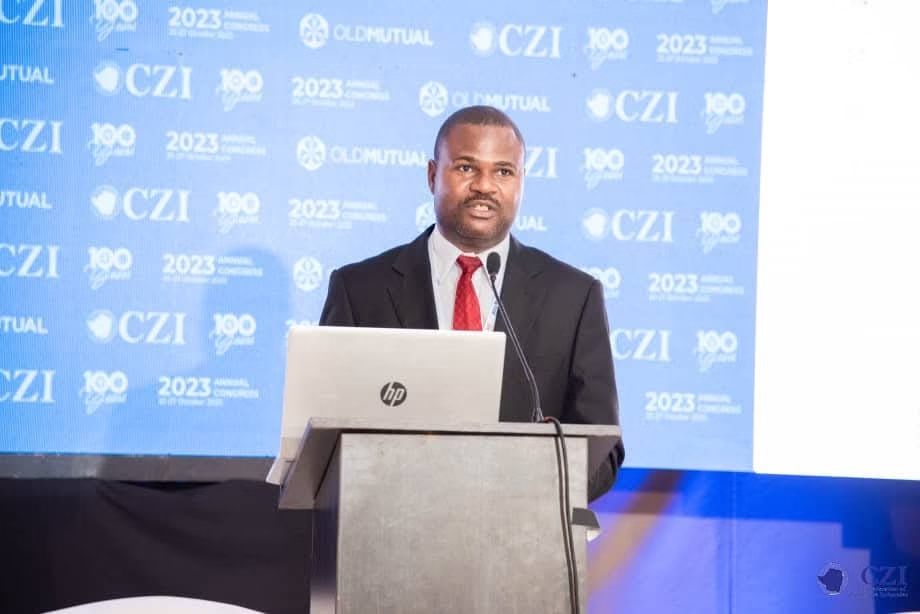
Analysts argue that this moment represents more than just an appraisal of economic performance. For Zimbabwe, whose relationship with global financial institutions has often been strained, the IMF’s endorsement speaks to the success of the re-engagement drive that has become central to the nation’s diplomatic and economic strategy. Chief Economist of the Confederation of Zimbabwe Industries, Dr Cornelius Dube, underscored that such recognition restores investor confidence, particularly as Zimbabwe positions itself as a competitive destination for global capital. He noted that industry and commerce stand to benefit from this renewed trust, as international partnerships remain key to unlocking opportunities for sustained growth.
The IMF’s acknowledgement of progress also highlights the strategic link between policy consistency and credibility. Since the days of the Transitional Stabilisation Programme and the implementation of the National Development Strategy One (NDS1), authorities have emphasised reforms that prioritise fiscal discipline, export growth, and agricultural resilience. The anticipation of the upcoming National Development Strategy Two (NDS2) is therefore being closely watched by both domestic stakeholders and external partners as the framework expected to consolidate the gains made so far. Economic analyst Tonderayi Mudhirizi noted that the IMF’s stance reflects a recognition of government’s willingness to engage transparently with the global community, a development that could open channels for increased cooperation and financing.
Yet, the IMF’s optimism is tempered by caution. It has warned that sustaining momentum requires guarding against both domestic vulnerabilities and external shocks. Global factors such as commodity price fluctuations, climate change impacts on agriculture, and geopolitical shifts continue to pose risks to fragile economies like Zimbabwe’s. Locally, ensuring policy continuity, strengthening institutional frameworks, and safeguarding currency stability remain central to building durable resilience. The IMF’s message is therefore twofold: progress has been made, but commitment to reform must deepen if Zimbabwe is to achieve its full potential.
Zimbabwe’s decision to revise its growth forecast from 2 percent last year to 6.6 percent this year provides a compelling narrative of recovery and ambition. Such projections, backed by external validation, will likely influence how investors, financial institutions, and trading partners view the country. However, whether this trajectory can translate into inclusive growth that touches ordinary citizens remains the ultimate measure of success. As farmers, miners, and manufacturers continue to drive output, the challenge lies in ensuring that prosperity is not only recorded in statistics but felt across communities.
The IMF’s endorsement of Zimbabwe’s reform path is thus more than just a diplomatic nod; it is a reminder of the opportunities that come with aligning national policy with global standards. It reinforces the fact that re-engagement is not a slogan but a tangible process with measurable gains. For Zimbabwe, the task ahead is to transform international goodwill into concrete benefits for its people by maintaining reform momentum, deepening trust with partners, and positioning the economy to withstand shocks while capitalising on opportunities. The IMF may have pointed to a trajectory of growth, but the responsibility of sustaining that path lies squarely in the nation’s hands.