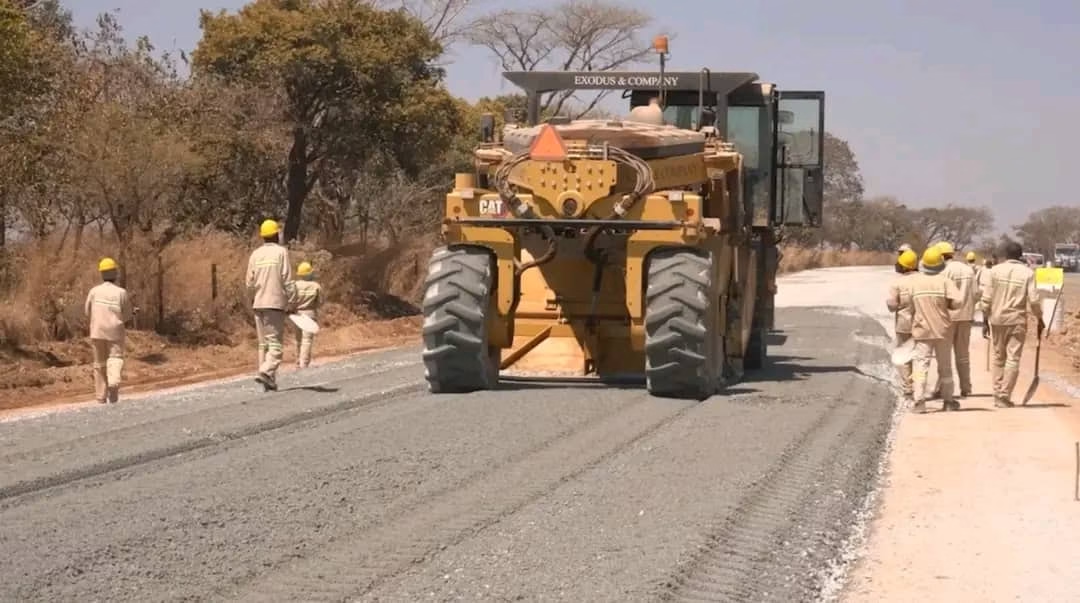
The ongoing dualisation of the Harare–Mazowe Road, part of the ambitious Harare–Angwa–Kanyemba Highway Project, is fast becoming more than a construction exercise. It is emerging as a strategic corridor of economic transformation that promises to reshape not only Mazowe district but the wider Mashonaland Central province.
Along the stretch from Boulevard Road Roundabout to Blue Ridge, hundreds of workers and fleets of heavy machinery are working tirelessly to deliver a modern dual carriageway. For motorists, the immediate gains will be safer, quicker, and more convenient travel. For the province and the nation, however, the long-term dividends lie in enhanced trade, agriculture, mining, and investment opportunities.
Local voices capture this optimism. One motorist expressed gratitude to President Mnangagwa’s administration, noting that the project will reduce road carnage and ease travel. Another described the development as “a wonderful thing” for the whole province, while a Mazowe resident pointed out that improved infrastructure would attract farmers, miners, and new businesses into the area.
Mazowe Acting District Development Coordinator, Mr. Joseph Edwards, echoed these sentiments with a broader economic perspective. He noted that “some investors follow the road,” emphasising that the dualised highway is set to become a lifeline for agriculture-driven value addition and broader industrialisation in the district. His remarks reflect a widely accepted development principle: infrastructure is the skeleton upon which economic growth is built.
The dualisation aligns with the government’s inclusive growth policy of leaving no community behind. While the immediate focus is the Mazowe stretch, the long-term vision stretches to Concession and eventually all the way to Kanyemba in Mbire district. Such reach will integrate remote areas into mainstream economic activity, providing farmers, miners, and entrepreneurs with reliable access to markets and inputs.
From an analytical standpoint, the Harare, Mazowe dualisation project is more than just a road, it is a signal of state-led infrastructure transformation as a driver of Zimbabwe’s Vision 2030. By reducing transport costs, stimulating rural industrialisation, and attracting private investment, the road project is positioned as a practical enabler of national development.
As bulldozers continue their work and tar is laid kilometre by kilometre, the highway is quietly stitching together a future of greater connectivity and opportunity. For Mashonaland Central, the dual carriageway promises to be a turning point, transforming Mazowe from a transit district into a hub of agriculture, mining, and commerce.
Bulawayo Road Rehabilitation Gains Momentum as Second Republic Prioritises Urban Infrastructure
Major road rehabilitation projects are transforming Bulawayo’s transport network, as Government accelerates efforts to modernise infrastructure under the Second Republic’s development drive. From the central business district to surrounding residential areas, roadworks are in full swing, bringing a sense of relief and renewed optimism to residents, motorists and commuters who have long endured deteriorating conditions.
“We are happy that the roads are finally being fixed. Driving was becoming dangerous, especially during the rainy season,” said one motorist. Another added, “If this pace continues, traffic flow will definitely improve. We just hope the rehabilitation covers all the bad spots in the city.”
The Bulawayo City Council says rehabilitation in the city centre has reached advanced stages, with detours created to ease traffic. “We have completed most of the works along George Silundika Avenue, now at 98 percent. Currently, teams are working on Lobengula Street, after which focus will shift to Herbert Chitepo. Looking ahead, next year’s plans will extend these works to feeder roads in residential areas,” explained Engineer Howard Sibanda of the Council’s Road Work
s Department.
The Government has reaffirmed its commitment to improving Bulawayo’s road network, with some projects implemented under the Emergency Road Rehabilitation Programme (ERRP). “The progress we have witnessed so far is encouraging. Some of the roads fall under the ERRP, with most at 30 percent complete. We are ensuring resources are channelled towards delivering lasting solutions to Bulawayo’s road challenges,” said Mr Paul Nyoni, Permanent Secretary in the Office of the Minister of State for Provincial Affairs and Devolution.
The rehabilitation initiative is expected to continue into 2026, in line with the Second Republic’s broader infrastructure modernisation agenda, which seeks to improve service delivery, boost economic activity, and restore urban centres to their former glory.