By Aldridge Dzvene
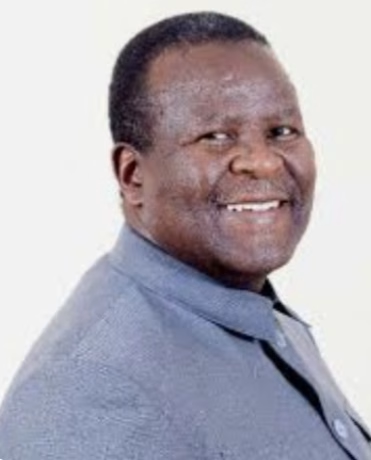
The recent disbursement of the Presidential Empowerment Fund in Harare marks a critical point in Zimbabwe’s socio-economic recovery efforts. With bold statements from Presidential Advisor, Dr. Tungwarara, delivered on behalf of President Mnangagwa, the initiative has reawakened key national conversations around accountability, transparency, and the enduring fight against corruption.
But beyond speeches and disbursements, the real test lies in execution and ethical stewardship, will this fund break the historical pattern of politicised and unaccounted for empowerment efforts, or fall prey to the same systemic gaps?
Historically, empowerment funds in Zimbabwe have suffered reputational damage due to allegations of favoritism, manipulation, and weak oversight. Beneficiaries were often connected individuals or ghost recipients. Monitoring mechanisms were either non-existent or toothless. As a result, the public grew cynical, empowerment became synonymous with elite capture rather than mass upliftment.
What makes this current fund notable is the deliberate language around clean governance. Dr. Tungwarara’s call to “account, not falter” and to “build legacies, not leisure” signals an ideological pivot. Empowerment is being reframed not as aid or reward, but as a contract with national accountability. Yet, words must walk.
Transparency is not a secondary value in public finance, it is the oxygen of public trust. In the current fund model, the government proposes provincial committees and evaluation structures to monitor usage. This is a step in the right direction. However, unless the monitoring process is independent, participatory, and public-facing, it risks falling into a familiar trap, symbolic compliance without substantive control. Transparency must be proactive, not reactive. Beneficiaries’ names, amounts received, and measurable targets must be public information. Communities must know who was funded, for what purpose, and what milestones are expected. Without this, the system invites manipulation, and citizens remain spectators instead of stakeholders.
Corruption doesn’t always wear a suit or occupy an office. Sometimes it shows up quietly, a bribe for access to the form, a family member who cuts the queue, a pastor who converts a business grant into a car. These forms of everyday corruption are often normalized, yet they are precisely what dilute national programs.
What’s encouraging is that the tone from leadership suggests a shift. “If you misuse these funds, you are stealing from the next person,” Dr. Tungwarara stated. This points to a collective ethic, where funds are not private blessings but national capital. To fight corruption, there must be consequences. Not just political embarrassment, but legal action. Public reports of misused funds must trigger investigations. Without enforcement, rhetoric means little.
Empowerment is a powerful tool, but only when matched by integrity. The nation watches not just for results, but for principles. If Zimbabwe is to empower with purpose, it must also account with courage.