As Zimbabwe prepares to close the chapter on the National Development Strategy 1 (NDS1) and turn the page to NDS2, the 10th anniversary of the Zimbabwe Gender Commission (ZGC) has arrived not just as a milestone, but as a moment of reckoning. It is a reminder that while significant ground has been covered in promoting gender equality since the Commission’s establishment in 2014, the gaps that remain require more than policy rhetoric, they demand a deep structural recalibration across institutions, attitudes, and systems.
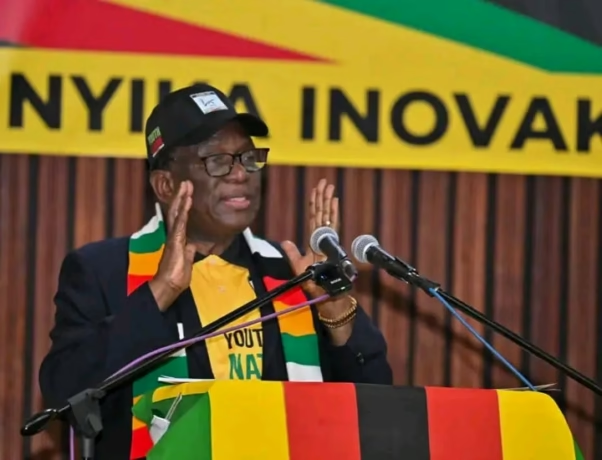
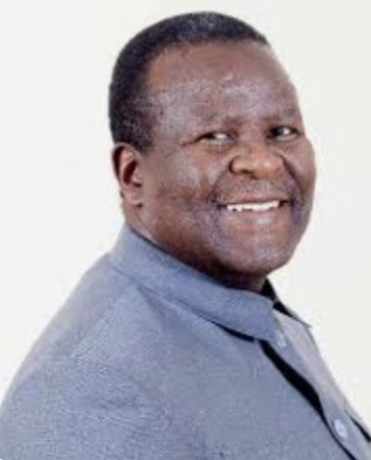
The provincial gender forum held in Gweru this week, as part of the Commission’s national commemorations, came at a critical juncture. With NDS2 on the horizon, the forum evolved into a space of reflection, dialogue, and reimagination. Commissioner Obert Machalaga, standing in for Chairperson Margaret Mukahanana-Sangarwe, underscored the urgency of mainstreaming gender across the national agenda. His call to embed gender equality at the heart of the next development strategy was not merely a ceremonial pronouncement, it was a strategic demand to center the lived realities of women and marginalized groups in the policy discourse.
What made the Gweru dialogue particularly significant was its focus on drawing lessons from the last decade while simultaneously engaging citizens on future priorities. Gender equality is no longer just a goal; it is a benchmark for development effectiveness, and its absence compromises the integrity of national progress. In this context, the Commission’s commitment to gathering nationwide input is a timely move toward participatory governance. But it also places the burden of delivery squarely on the state and its partners to move beyond consultative postures and into tangible reforms.
Honourable Owen Ncube, the Minister of State for Midlands Provincial Affairs and Devolution, highlighted the achievements of the Second Republic under President Emmerson Mnangagwa, particularly its push for gender-responsive socio-economic programmes. His emphasis on inclusive access to productive resources, financial services, and decision-making platforms speaks to a state vision that has the right policy ingredients. Yet, implementation continues to be hampered by systemic bottlenecks, patriarchal cultural norms, uneven access to education, and gendered poverty that perpetuates inequality across generations.
On the ground, the exhibition mounted by the National Association of Non-Governmental Organisations (NANGO) offered a compelling narrative of what is possible when policy meets grassroots innovation. Women-led enterprises, youth entrepreneurship, and community empowerment initiatives showcased during the expo are proof that gender equality is not an abstract idea, but a lived economy of effort and resilience. These are the spaces where the real work of nation-building is taking place, and they deserve not only recognition but sustained financial and institutional support.
The Zimbabwe Gender Commission’s 10-year journey has been one of visibility-building and norm-shifting. It has introduced a lexicon of accountability into the gender discourse and carved out a constitutional space for advocacy. Yet, the next decade will test its influence not just in raising awareness but in ensuring enforcement. Legal frameworks must be matched with political will, and declarations must be backed by budgets. The NDS2 era must be one where gender equality is not peripheral but integral, where every ministry, province, and sector is held to account for gender outcomes.
As Zimbabwe marches toward Vision 2030, the choice is clear. Gender equality must move from aspiration to action, from celebration to consolidation. The Commission’s 10th anniversary is both a testament to what has been achieved and a challenge to do more. It is a call for society, at every level, to be deliberate about dismantling barriers and building a Zimbabwe that is fair, inclusive, and just, for all.