By Aldridge Dzvene | Positive Eye News
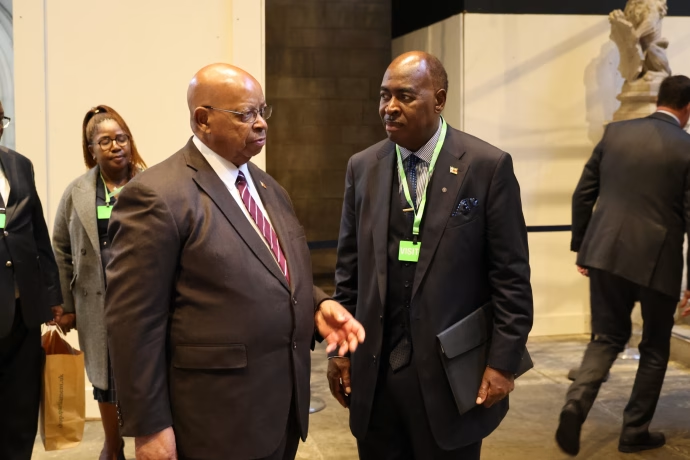
In a compelling demonstration of Zimbabwe’s growing intellectual influence in global parliamentary discourse, Speaker of the National Assembly Advocate Jacob Francis Mudenda delivered a powerful intervention at the Second Parliamentary Conference on Interfaith Dialogue held from 19 to 21 June 2025 in Rome, Italy. The high-level conference, convened by the Inter-Parliamentary Union (IPU), brought together lawmakers from around the world under the theme “Parliamentarians in Dialogue with Religion and Belief: Strengthening Trust and Embracing Hope for Our Common Future.” Speaker Mudenda’s presentation stood out as both bold and deeply reflective, mapping new ethical ground on how technology, particularly Artificial Intelligence, can be mobilized to support interfaith understanding, religious inclusivity, and global peacebuilding.
Far from a ceremonial contribution, Speaker Mudenda’s speech offered a rigorous analysis of the legislative responsibility in a world increasingly marked by religious polarization, distrust, and the erosion of empathy. He posited that Parliamentarians must not only legislate but also lead moral conversations that echo the deep yearnings of humanity across faiths. His call was for a dynamic, empathetic engagement with religious systems, warning that superficial or uninformed approaches risk producing legislative frameworks that fall short in protecting fundamental rights and freedoms, particularly the right to worship with dignity. He stressed that poor legislative insight in matters of belief can diminish parliamentary oversight, weaken the representative mandate, and fracture public trust, a commodity he rightly argued is the currency of democracy.
To navigate these intricacies, Hon Mudenda introduced a forward-thinking proposition: the deliberate use of Artificial Intelligence in facilitating interfaith dialogue. He described AI as a transformative tool capable of breaking down communication barriers through advanced language translation, enabling broader access to diverse religious texts, and assisting in predictive analytics to map the evolving landscape of belief systems. His emphasis, however, was not on the technology alone but on its governance, urging that any deployment of AI in this sensitive realm must be guided by ethical principles that center the human experience. Parliamentarians, he cautioned, must become guardians of responsible AI, ensuring it enhances rather than distorts the spiritual and moral tapestries of communities.
At the heart of Speaker Mudenda’s remarks was a deeply philosophical appeal to hope, hope as an active, moral force in legislative practice. Drawing inspiration from the late Pope Francis, Mudenda underscored that hope is not naïve optimism but a determined quest for peace amid war, faith amid doubt, and justice amid division. He invoked the late pontiff’s declaration that “hope does not disappoint,” challenging Parliamentarians to become, in his words, “Pilgrims of Hope.” That pilgrimage, he explained, requires lawmakers to cultivate trust through listening, empathy, and a fearless pursuit of peace even in the most divided contexts.
His insights did not fall into abstraction. They were reinforced in the final Rome Communiqué, adopted unanimously at the conclusion of the conference. The Communiqué distilled the consensus of global legislators on the need to earn and preserve public trust through inclusive and informed dialogue with religious communities. It reinforced the urgency of protecting human dignity, not just as a legal requirement but as a sacred moral commitment, particularly where freedom of worship and belief are concerned. Furthermore, it affirmed Speaker Mudenda’s AI thesis, recognizing digital technology as a vital enabler of interfaith engagement, while also embracing the need for ethical boundaries that prevent technological abuse.
There is also need for collaborative action among Parliamentarians that transcends religious and political divides, which emphasize that sustainable peace will not be achieved through diplomacy alone but through the legislative courage to create frameworks that protect, include, and inspire. The Communiqué echoed Mudenda’s central concern, that in an age of rising extremism and global instability, it is Parliamentarians who must provide the moral clarity and structural support for interfaith collaboration to thrive.
Closing remarks by IPU President Dr. Tulia Ackson and IPU Honorary President Senator Pier Ferdinando Casini echoed a similar spirit. Both leaders praised the depth of the discussions and commended the delegates for their active pursuit of peace through dialogue. They acknowledged Italy’s gracious hosting of the conference and reiterated the importance of Parliamentary Diplomacy in shaping a more peaceful, inclusive world.
What emerged from Rome was not just a declaration but a renewed commitment, a global consensus that faith, technology, and ethics are not opposing forces but interlinked spheres through which humanity can reimagine its future. Speaker Mudenda’s contribution did not merely reflect Zimbabwe’s legislative ethos; it projected a continental vision, a vision where Africa does not just participate in global dialogue but shapes its moral and technological direction. In a world teetering on the edge of division, his voice reminded the world that trust, hope, and ethical leadership are the pillars upon which a common future must rest.