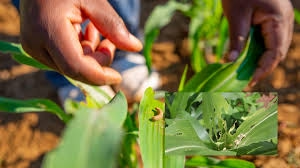
A quiet revolution is taking root in Zimbabwe’s agricultural sector, and it begins not in the fields but with the seeds themselves. With the gazetting of Statutory Instrument 61 of 2025, the government has drawn a new line of defense against one of the country’s most persistent agricultural adversaries: the fall armyworm.

This latest regulation requires all certified maize seed to be treated with a recommended and effective seed dressing chemical containing a combination of a diamide and a neonicotinoid, or an equivalent compound proven to work against the pest. By embedding pest management into the earliest stages of the planting process, Zimbabwe is betting on a smarter, more sustainable approach to combating crop devastation.
For years, the fall armyworm has been a scourge in maize-producing areas, threatening food security and impacting the livelihoods of smallholder farmers, who form the backbone of Zimbabwe’s agricultural economy. Many farmers have found themselves caught in a reactive cycle, scrambling to buy pesticides and spraying equipment only after damage is visible.
This new regulation disrupts that cycle by mandating that certified maize seed carries its built-in shield against the pest. It’s a proactive approach that could transform the pest-control landscape, shifting the fight from the field to the seedbed.
Analytically, the move is a game-changer in terms of agricultural quality control and market regulation. By stipulating that all seed dressing chemicals must be registered with the Ministry of Lands, Agriculture, Fisheries, Water and Rural Development, and that any non-compliant seed lots cannot be sold or distributed as certified maize seed, the government is reinforcing trust in Zimbabwe’s seed supply chain.
This is no small matter. Inconsistent seed quality and variable pest control measures have long undermined productivity, especially among smallholders who depend on reliable inputs to survive. The regulation’s insistence on a combination of diamide and neonicotinoid chemicals (or equivalent) provides a science-based standard to protect both farmers and consumers.
This new statutory instrument aligns with Zimbabwe’s broader agricultural ambitions. With food security a national priority, and with maize at the heart of the country’s staple diet, ensuring that farmers plant maize seed that is resilient against pests is a foundational step. By preventing infestations at the seed level, the country can reduce its reliance on emergency interventions, often costly and sometimes environmentally risky, and instead build a more sustainable, resilient maize sector.
The Road Ahead
Yet, as any seasoned farmer knows, regulation alone cannot guarantee success. Effective implementation, consistent enforcement, and robust education campaigns will be key to ensuring that farmers understand and embrace the new rules. Seed producers, too, must be ready to comply, ensuring that the treated seed reaches even the most remote farming communities.
Still, as the ink dries on Statutory Instrument 61 of 2025, one thing is clear: Zimbabwe is stepping into a new era of agricultural resilience, one where the fight against fall armyworm starts not with the sprayer but with the seed itself. It’s a bold move that holds the promise of transforming not just pest management but the entire outlook for maize farming in the country. And in a region where food security remains a daily challenge, that’s a step worth celebrating.