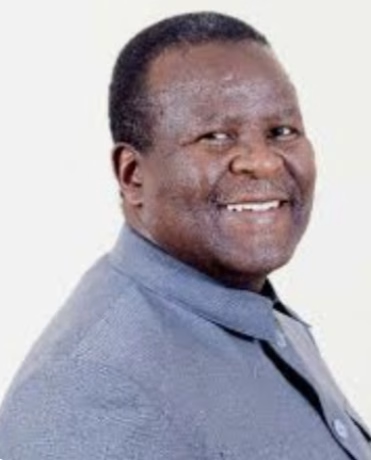
VICE President Kembo Mohadi is in Nairobi, Kenya for the 6th Session of the United Nations Environmental Assembly (UNEA-6) which opened on Monday and runs until tomorrow at the UN Environment Programme (UNEP) headquarters.
It is being held under the theme: “Effective, inclusive and sustainable multilateral actions to tackle climate change, biodiversity loss and pollution”.
Through its resolutions and calls to action, the assembly provides leadership and catalyses intergovernmental action on the environment.
As the world’s top decision-making body on the environment, UNEP aims to help restore harmony between humanity and nature, improving the lives of the world’s most vulnerable people.
UNEA-6 will focus on how multilateralism can help tackle the triple planetary crisis of climate change, nature and biodiversity loss, and pollution and waste. Backed by strong science, political resolve and engagement with society, the assembly will be an opportunity for world governments, civil society groups, the scientific community and the private sector to shape the global environmental policy.
As the planet’s only universal membership forum for the environment, UNEP provides a unique platform for courageous decisions and new ideas to chart a bold plan of collective environmental action.
In so doing, UNEA-6 will support the achievement of the sustainable development goals.
UNEA-6 was preceded by a meeting of the open-ended committee of permanent representatives, held from February 19-23, which helped lay the groundwork for the assembly.
The assembly held its first-ever day devoted to multilateral environmental agreements, some of which date back 50 years, which have helped protect endangered species, limit chemical pollution, and repair the hole in the ozone layer, among other things.
While their focus varies, the agreements are all founded on the idea that the world’s most-pressing environmental challenges transcend borders. To tackle crises such as climate change, nature and biodiversity loss and pollution and waste, countries must work together.
“With a diversity of perspectives come strength,” said Mr Leila Benali, the president of UNEA-6 and Minister of Energy Transition and Sustainable Development for Morocco.
“Let us be guided by the spirit of multilateralism”
Ministers of Environment and other leaders from more than 180 nations are in Nairobi, Kenya, in an attempt to find solutions to this triple planetary crisis.
UN research shows that this work is becoming increasingly urgent. Global temperatures hit record highs last year, while hundreds of thousands of species are facing extinction, and millions of people are losing their lives annually to pollution.
“The triple planetary crisis is still accelerating. We must do more. And we can only do more if we act as one,” said Mr Inger Andersen, Executive Director of UNEP.
Some agreements can trace their origins back to the dawn of the global environmental movement in the late 1960s and early 1970s.
That includes the Convention on Trade in Endangered Species and Wild Fauna, which since 1973 has helped to regulate the trade of more than 38 000 animals and plants.
Perhaps one of the best-known agreements is the Montreal Protocol, the first treaty to achieve universal ratification.
Forged in 1987, it is helping to mend and repair what was a potentially cataclysmic hole in the ozone layer.
Another series of accords, the Basel, Rotterdam and Stockholm conventions, have helped to rein in pollution, including from hazardous waste.
At the same time, other international bodies are providing policymakers with cutting-edge science on climate change and biodiversity loss, informing a bevy of global pacts and national laws and policies.
Herald