ZIMBABWE and Botswana will forge ahead with eliminating passport requirements for citizens travelling between the two countries in line with regional and continental aspirations of facilitating the free movement of people across borders.
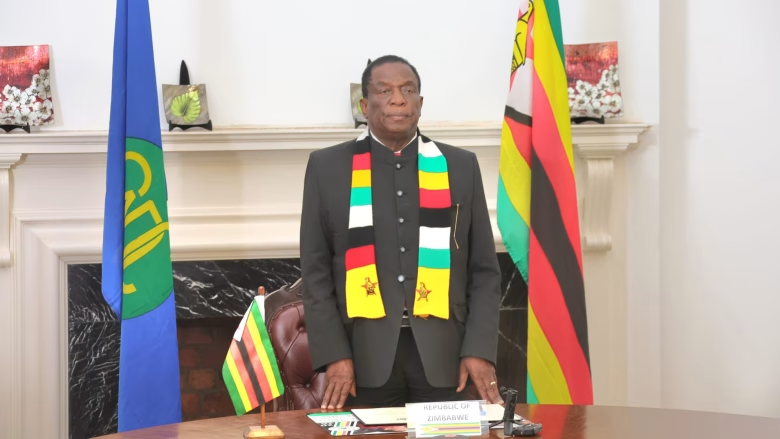
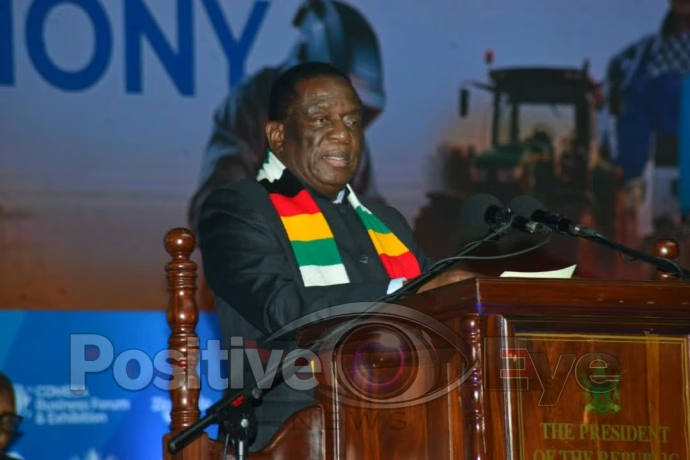
Addressing a Press briefing after the Fourth Session of the Zimbabwe-Botswana Bi-National Commission Summit here yesterday, both President Mnangagwa and his counterpart President Mokgweetsi Masisi reaffirmed their commitment to facilitating seamless movement of people and goods across the shared borders, boosting economic activity and strengthening regional integration.
President Mnangagwa said passport requirements were vestiges of a fraught colonial past that was no longer fit for purpose in a fast-integrating region.
On his part, President Masisi dismissed the notion that the removal of passport requirements would lead to an influx of illegal immigrants into the neighbouring country, saying those views were driven by unjustified prejudice.
It is envisaged that once passport requirements have been removed, travellers would only require their respective national identity documents to travel between the two countries.
This initiative aligns with broader efforts within the Southern African Development Community and the African Union (AU) to promote free movement of people on the continent.
“The history of our respective countries shows that we didn’t have passports to move from one country to another. Passports were brought by those who thought they were more civilised than us.
“We have decided that between Zimbabwe, Botswana, South Africa, and Mozambique in our region …we have a policy of integration. I don’t know what word you use in Setswana to say integration, but in Shona we say kubatana,” said President Mnangagwa.
President Masisi said consultations between Harare and Gaborone for rolling out the proposed initiative were ongoing.
“There is ongoing very positive consultation between the Governments of Botswana and Zimbabwe,” said President Masisi.
“There have been exchanges of what is required to enable that including issues like security vetting of the instruments; comparability of instruments used and many other things, just like we did with Namibia.”
Botswana and Namibia removed passport requirements for their citizens early last year, making the two the first countries in Southern Africa to implement such a system.
“As leaders we have expressed a desire to do this, not because we want it among ourselves only, but it’s a long-standing resolution and intention as pronounced not just by SADC but the AU. So we don’t claim to own or be the originators of these things. We are the deliverers of it,” said President Masisi.
He said the initiative would not lead to heightened illegal migration but using an ID to cross borders would make cross-border movement between the two countries more efficient.
“There is a break in logic here; the ID itself and the permission of it to become a travel document does not correlate with an influx (of illegal immigrants) because it is still a filter,” President Masisi said.
“What it does is that it provides a greater opportunity for people to travel legally. There is still a border that they have to cross. It doesn’t mean they have to have an ID to skip a border; they still become illegal even if they have an ID. You are still an illegal immigrant if you have a valid passport that was not stamped at the border. So we must separate these.”
He said fears of an influx of illegal migrants were misplaced.
Botswana, he said, had a long history of accepting Zimbabweans into their country since the days of the liberation struggle when refugees fleeing the war flocked into the neighbouring country.
“I think people get caught up in this emotional association that is not logical and certainly not necessarily true. This is where xenophobia begins.
“When you, my brothers and sisters, develop an attitude usually without real explanation, you will break relations. Not so long ago when Zimbabwe was fighting for its liberation, we readily accepted them and opened our doors to refugees. Now they are not coming as refugees,” said President Masisi.
Herald