The International Monetary Fund (IMF) has commended Zimbabwe’s 2024 national budget, saying the fiscal policy and resource-generating measures will give impetus to economic growth for the attainment of national objectives.
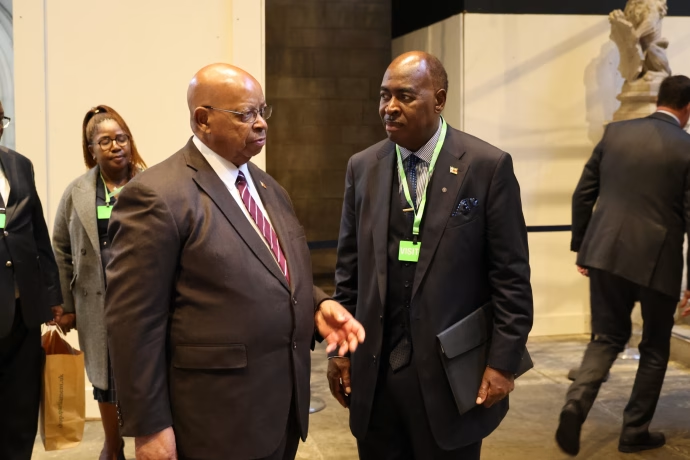
IMF country representative Mr Carlos Caceres said the central Government’s decision to assume the Reserve Bank of Zimbabwe’s liability was commendable as that would free the bank to concentrate on its mandate and help the country move towards firming its economy.
Mr Caceres said this on Monday night during a Star FM programme, “Muriro on Monday News and Current Affairs”.
He said authorities took a step in the right direction by relieving the Reserve Bank from foreign-currency liabilities.
“The budget presents a wide range of comprehensive measures, particularly in terms of tax policy measures and revenue raising administration measures. This is something that my colleagues, particularly the technical colleagues from the fiscal affairs department of the IMF, are analysing and we are going to have a comprehensive answer when the Article 14 is here early next year,” he said.
Mr Caceres said the IMF noted that Treasury had assumed US$1,8 billion that was in the RBZ’s books as a liability which will free the central bank to focus on its core mandate.
“Overally that is a very important step, that is a bold step. I would even say a positive step but a very comprehensive and detailed plan to ensure that all the liabilities of the central bank are included in the books of the central Government,” he said.
While fiscal and monetary authorities were on a positive economic trajectory, said Mr Caceres, it was critical that the RBZ slowed down on quasi-fiscal operations like creating money as that was inflationary.
“One of the main culprits behind the macro-economic stability that we have been living in Zimbabwe is really the excessive money printing by the central bank to service some of these quasi-fiscal operations,” he said.
Parliament’s portfolio committee chairperson on Budget, Finance and Investment Promotion Cde Clemency Chiduwa, who was part of the panel, said quasi-fiscal operations were necessary given that Zimbabwe ought to survive under the yoke of illegal sanctions.
Some of the quasi-fiscal operations IMF raised came after the United States imposed illegal sanctions under the Zimbabwe Democracy and Economic Recovery Act which preclude IMF and other Bretton Woods institutions from extending loans to Zimbabwe.
“We need to understand the background. There is an issue of sanctions, the reality on the ground is that our relations with IMF worsened when Zidera was promulgated by the US government. In it there was a clear provision that says IMF must not support Zimbabwe where lines of credit are supposed to be extended to Zimbabwe.
“IMF is a leader and once something is said it sends signals to the market. Signals were made and the signals were sent and all multilateral agencies did not want to deal with Zimbabwe,” said Cde Chiduwa, who is former Finance and Economic Development deputy minister.
He said quasi-fiscal operations were done to meet obligations in areas such as health, agriculture, among others for the country to survive.
“We needed funding for health, agriculture, forex support and this was done as extraordinary measures meant for the country to survive, we ended up borrowing expensive lines of credit from Afreximbank and other institutions and these were meant for us to remain afloat. But given that we are stabilising, there is need to refocus and focus on its mandate. But going back, the measures taken by the RBZ were necessary,” said Cde Chiduwa.
“So, going forward, I think it is very critical for IMF to assist Zimbabwe. When a member nation is in distress, you don’t say rescue yourself so that we can be together.
“This is the time for IMF to come to the table and rescue the situation, we need IMF to continue playing its part, if you check countries like Greece these are some of the countries that are top tailing in terms of indebtedness. The country with the highest debt in the world is the United States, with a debt of US$34 trillion and I think IMF can still assist Zimbabwe,” said Cde Chiduwa.
Herald