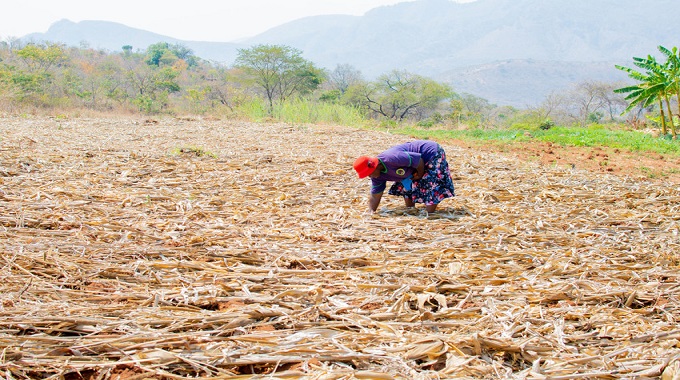
SMALLHOLDER farmers have prepared more than nine million Pfumvudza/Intwasa plots in preparation for the 2023/2024 summer cropping season.
This represents a threefold increase in the number of plots prepared for the conservation agriculture-based programme since its launch during the 2020/2021 summer cropping season.
However, Government has set a target of 11 million plots this year to stave off the effects of the El Niño weather phenomenon.
Pfumvudza seeks to enhance food security at household level by facilitating production of more food on less land, with smallholder growers engaging in sustainable farming practices.
Experts consider conservation agriculture to be particularly effective during drought years.
Permanent Secretary in the Ministry of Lands, Agriculture, Fisheries, Water and Rural Development Professor Obert Jiri told The Sunday Mail that farmers are busy holing and mulching their plots.
“Our extension officers are also on the ground pushing the climate-proofing agenda under the Pfumvudza programme.
“In the 2020/2021 season, we did about 2,9 million plots for Pfumvudza; the following season — 2021/2022 — we did 4,9 million plots and this year, as we speak, we have done more than nine million plots.
“By the end of November, we believe farmers must have prepared 11 million plots.”
It was critical, Professor Jiri said, for smallholder farmers to practise conservation agriculture since the country was likely to experience unseasonably low rainfall.
“If each household does Pfumvudza on at least one plot, we know that we will be food self-sufficient at the household level,” he continued.
“If they do two plots, it means they will be able to get more than they need; and if they do three, it means they are now into commercial production.”
Agricultural extension officers, he added, have been provided with the requisite equipment to discharge their duties effectively.
“The ministry has capacitated extension workers physically through giving them motorbikes and laptops for the supervisors, and we are going to give laptops to the actual extension officers as well.
“We have given the extension officers tablets so that they go digital.
“We are not going to stop capacitating our extension officers because they are the ground force, the foot soldiers.”
Prof Jiri said extension officers have been directed to attend to every household involved in food production this season and assess their plots to ensure they produce optimally.
Agricultural Advisory and Rural Development Services director for training and information Mr Sibangilizwe Dlodlo said training of farmers under the Pfumvudza/Intwasa programme was progressing well.
“It is quite evident that the 2023/2024 agricultural season promises to be the most challenging one,” he said.
“To equip farmers, we are making progress in farmers’ training on climate-smart methods to adapt, mitigate and act responsibly.
“The late start to the season may have serious implications for the season.”
Mr Dlodlo said farmers are being encouraged to cultivate seed varieties suited to their regions.
“Those in agro-ecological regions 4 and 5 should plant traditional grains, which are more tolerant to drought conditions and take a shorter time to reach physiological maturity,” he added.
“Farmers in the first three zones are not limited in terms of the choice of crops to grow, but they should be sure to select fast-maturing varieties.”
He said the El Niño phenomenon may also result in flooding.
“Late rains also often come with heavy and infrequent downpours, which increase runoff and reduce rainfall effectiveness, potentially negatively affecting rainfall distribution . . .
“Drier areas also experience very high temperatures, which make the little rain even more ineffective for good crop yields.”
He reiterated the need for farmers to mulch their crops to conserve moisture.
Zimbabwe Commercial Farmers Union president Dr Shadreck Makombe said farmers should prepare for the El Niño weather phenomenon.
“With the El Niño phenomenon upon us, farmers need to have enough time to prepare their land for Pfumvudza, one of the safest ways of crop production,” he said.
“However, we also urge farmers to practise rainwater harvesting throughout the season for any probable mid-season dry spell so that they can supplement by irrigating their crops since they are small plots, which are manageable.”
Sunday Mail