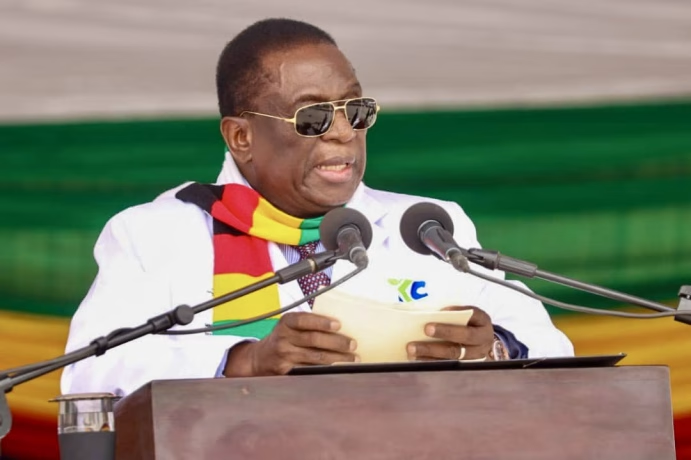
THE flip-side of the punitive economic sanctions imposed on Zimbabwe by Western nations is the country’s prevailing culture of self-reliance that is evidenced by the attainment of food self-sufficiency for three years running, President Mnangagwa has said.
In a speech read on his behalf by Vice President Kembo Mohadi at the Zimbabwe Institute of Strategic Thinking (ZIST) annual conference in Nyanga yesterday, President Mnangagwa said food self-sufficiency was at the top of priorities of the Second Republic.
He said: “Zimbabwe has attained food self-sufficiency in the past three years and that is the reason why the country was worried about the Russia-Ukraine conflict which could have affected food supplies.
“When we came into office as the Second Republic, we took time to sit down and asked ourselves what exactly the people of Zimbabwe needed. Vision 2030 is what the nation wants. At the heart of the Vision 2030 is the issue of food self-sufficiency. We achieved food self-sufficiency three years ago and we are happy with that achievement.
“We have not been importing grain for the past three years and I think this also has to do with the sanctions we have been reeling under for more than two decades now, they helped us to learn to think outside the box and work for our own survival.”
President Mnangagwa said Government was always open to constructive criticism.
“We do not want to see antagonistic criticism. What we want is constructive criticism.
“As Government, we take note and appreciate that there are other institutions such as ZIST, who are prepared to critically review and audit national programmes and policies,” he said.
“Let us move together. We need to engage so that we build the confidence to work together. It should not be them and us, but it should be us altogether moving in one direction. In fact, Vision 2030, as a blueprint, is not for Government alone. It is all you people here who can assist in achieving what we have set for ourselves to achieve.
“There is an East African saying which relates to Harambee. It means let us move together. Bring all the stakeholders together so that whatever achievement we make we do so as a nation. I must express Government’s appreciation for such initiatives which provide platforms to speak about strategies to speed up processes to achieve national policies.”
President Mnangagwa commended ZIST and the like-minded for brainstorming on options and solutions that could help the country improve its economy.
“What I have seen already and heard at this conference is valuable and worthwhile,” he said.
“For my generation, opportunities were not there. We had to create them until we managed to win the war of liberation.
“It is in the same vein that you gathered here, with the same idea of cross pollination of ideas. You will win the third war of liberation, which is that of economic emancipation.”
President Mnangagwa said colonialism was now wearing a new face.
“When (Harold) McMillan, the former Prime Minister of United Kingdom, pronounced that there were winds of change blowing from North to South in Africa, he meant the days of colonialism were coming to an end around the 1960s,” he said.
“Let me hasten to say colonialism hasn’t gone. Let me give you a background to it about our erstwhile friends who live in those ivory towers north of us.
“Before colonialism, there was slavery. All the countries in Europe built whatever they have using forced labour from Africa. When slavery was abolished, still they wanted our resources.
“This time around they no longer wanted the human resources, but minerals and other resources. This is when they partitioned Africa and ushered in colonialism. Without Africa, Europe will not survive.
“It will gravitate to a Third World. They sat down to think about what to do to remain where they are after colonialism ended. They came up with institutions that ensure Africa remains poor. The Bretton Woods institutions were created so that each country in Africa can go and borrow money.
“If you go and get money from the Bretton Woods institutions, make sure you are going to remain shackled for the rest of your life. Most of the time when you ask for aid, you are told how and where to use it and they put in place systems that ensure that you will always place the debt (clearance) as a priority in your budgeting.”
With the ultimate aim of providing a platform for dialogue and search for solutions to the country’s economic challenges, the ZIST annual conference is being attended by Cabinet Ministers, senior Government officials, financial experts, heads of parastatals, corporate directors, educationists and policy makers from of diverse professional backgrounds.
It is meant to create champions of corporate excellence in strategic institutions, as well as enable participants to discover and learn best practices from leading and fast growing companies.
Herald