HWANGE Power Station’s Unit 7, which has a capacity to generate 300MW but is undergoing maintenance, will be back online in the next three weeks.
In addition, negotiations are underway to increase electricity imports while the rehabilitation of Units 1 to 6 at Hwange Power Station is being speeded up to boost electricity supplies and bring to an end the ongoing load-shedding regime.
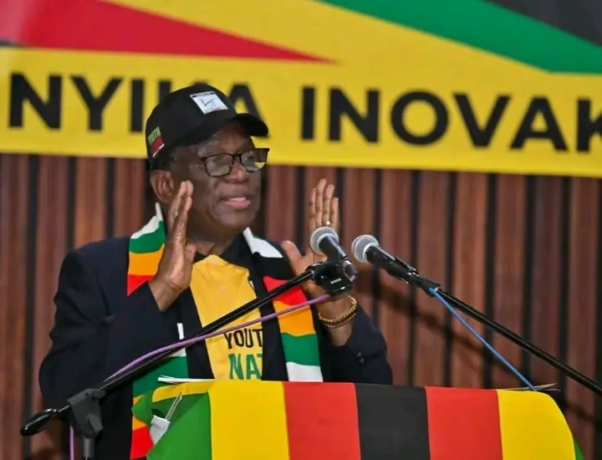
This was said by the Minister of Energy and Power Development, Edgar Moyo, during a tour of Hwange Power Station yesterday.
Minister Moyo assured stakeholders that swift measures were being taken to restore normal power supplies and support key economic sectors.
The power cuts being experienced across the country have been caused by reduced domestic power generation due to low water levels at Lake Kariba, which has severely crippled hydro-power generation, and the switching off of Hwange’s Unit 7 for maintenance purposes.
To ensure long-term supply stability, Government is pushing for the retooling of aging Units 1 to 6 at Hwange Power Station and rolling out new technologies, which include introducing a floating solar system at Lake Kariba and bringing on stream several independent power producers.
Electricity generation dropped to about 1 300MW recently against a demand of 1 800MW following the scheduled switching off of Unit 7 for Class C maintenance and reduced capacity at Kariba South Hydropower Station, which is now producing an average of 300MW.
This has left the country largely dependent on Hwange Power Station and imports from regional producers.
“There is a need to deploy new technology for units 1 to 6 and our capacity to generate will be increased and we will be able to supply sufficient power to the nation,” said Minister Moyo.
“We are doing about 1 300MW against a peak demand of 1 850MW. So, we are having that deficit, which has been occasioned by the outage of Unit 7, and to mitigate that, some imports are being done.
“Very soon in about two to three weeks, one unit is going to come back to service and that is going to reduce our power deficit, and we should see an improvement in the power supply going into the end of this month although intermittently we should expect breakdowns.”
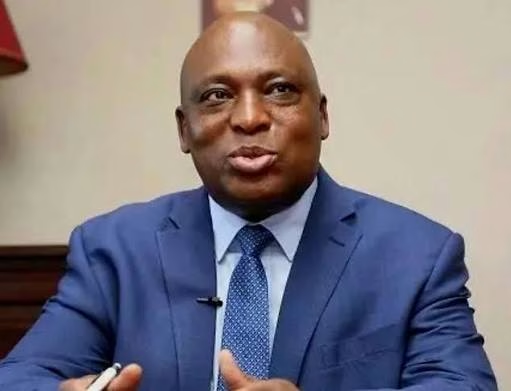
Zesa executive chairman, Dr Sydney Gata, who accompanied Minister Moyo, said the adoption of new technology was imperative in boosting power generation efficiency and improving service delivery.
“From the onset, I need to emphasise a fundamental parameter that has affected power supply in Zimbabwe more than any other factor. It is the fact that our biggest power station Kariba, rated at 1 050MW, producing the
cheapest and most reliable capacity, has run short of water to such an extent that we are running on an average of 300MW against 1 050MW capacity and so effectively we lost 750MW.
“If we don’t realise this, we may not appreciate the circumstances that we are under. There are moves now to accelerate alternative technology, principally PV solar and there is a lot of investment waiting in the pipeline.
“I am pleased to say measures recently taken by the minister are beginning to release that capacity so progressively load shedding will come to an end forever because we have limitless solar in the country,” said Dr Gata.
Meanwhile, Minister Moyo said the familiarisation visit to the giant thermal station was an eye-opener as he was able to appreciate the power generation matrix, as well as the modern technology used in Units 7 and 8.
The 2x300MW units were built at a cost of about US$1,5 billion with support from China and officially commissioned by President Mnangagwa in August.
Minister Moyo said besides new technology absorption, work is underway to steadily increase tariffs with a vision of capacitating the power utility to provide sustainable service.
He said Cabinet this week adopted some principles to move steadily towards cost-reflective tariffs, which producers in the sector have long lobbied for.
Minister Moyo also said he was pleased by the work ethic at Zimbabwe Power Company and urged Zesa to diversify its energy generation mix.
“So, we would like to move our tariff of course without curtailing producers, miners, farmers and manufacturers but move steadily so that the utility is stable and able to carry out its maintenance and power generation,” he said.
“As Government, we have come up with a roadmap to energy self-sufficiency and we want to get to where we have energy security and to a point where people will say ‘raise tariffs so that we get service’.
“This is the opportune time and we need to up our game in terms of power generation. We also need to ensure that access to power is universal and people can benefit from other technologies.”
Through diversifying the energy generation pool and harnessing modern technologies such as the floating solar system at Kariba, Zimbabwe could break even and be energy-sufficient.
“Last week I was in India and we spoke to International Solar Alliance and they are going to send a team next year in January or February so that they can assist us in the deployment of that technology,” said Minister Moyo.
Herald
Positive Eye News