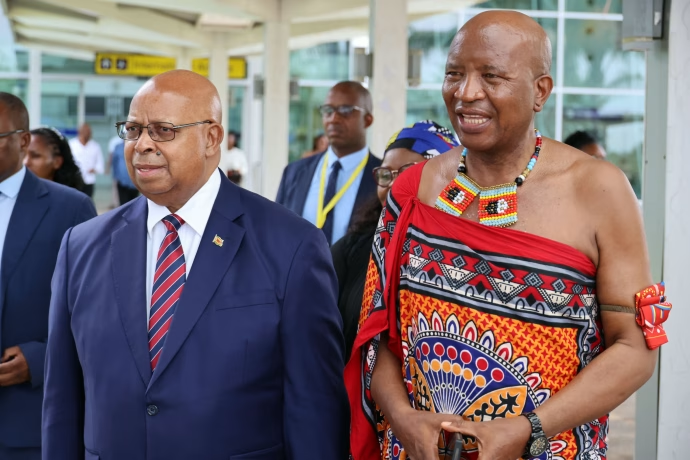
Inspired by neighbourly tenets of candidness, fairness and trust where action overrides words, Zimbabwe and South Africa are more than neighbours, for the countries share a rich history of cooperation and cultural ties, which makes Beitbridge more than just a port, but an enabler of bilateral relations cemented in the common desire for independence and economic emancipation.
This was highlighted by President Mnangagwa in his weekly column in The Sunday Mail, following a joint tour of Beitbridge Border Post with South African President Cyril Ramaphosa on Thursday last week.
The idea of the joint tour was proposed when the two leaders met on the sidelines of the 78th session of the United Nations General Assembly in New York last month.
The President also had the opportunity to meet the United Kingdom’s Minister for Development and Africa, Mr Andrew Mitchel, underlining a new vision against a backdrop of a decades-long “costly diplomatic standoff”.
“The second development was again mooted on the sidelines of the United Nations General Assembly. President Cyril Ramaphosa of South Africa intimated that he would visit the Musina Border upon his return from UNGA. South Africa, he added, planned to revamp and upgrade its border facilities and services at this crucial port of entry, which we share, and itself the busiest port on the African continent,” said President Mnangagwa.
South Africa envisaged a Border Management Authority, which would see the integration of port services for more efficiency, a vision shared with Zimbabwe, as the two countries are working on establishing a one-stop border post.
Said the President: “The purpose of that joint tour was to ensure we lay the infrastructural basis for seamless port operations to promote efficient movement of people, goods and services. This critical goal rides on our excellent historical and bilateral relations, and on our ever strengthening trade and investment ties.
“South Africa is much more than a neighbour; it is Zimbabwe’s largest trading partner, numerous people-to-people social and cultural affinities quite apart.”
Such is the nature of neighbourliness, which, if given a chance, would help in the realisation of collective dreams. What is crucial, for the greater good to be the ultimate winner, is openness.
As Friedrich Nietzsche points out: “We fear our neighbour’s hostile mood because we are afraid that this mood will lead him to penetrate our secrets”.
The sister countries have nothing to hide from each other, as they are historically and culturally connected. The liberation movements of the two countries tap into a common chalice enthused by the desire for independence and freedom. Beyond sharing geographical proximity, Zimbabwe and South Africa are top trading partners.
Furthermore, President Mnangagwa noted, Zimbabwe is South Africa’s gateway to the North, which makes the two neighbours’ relations “comprehensive and strategic”.
“Against this important consideration, our infrastructures have been lagging behind the ever-growing demand, and were not quite talking to each other by way of operating systems and procedures,” he said.
Having gained Independence in 1980, Zimbabweans remained steadfast in their support of the liberation struggle in South Africa against the heinous apartheid system until South Africans elected a democratic Government in 1994.
With the apartheid system bent on thwarting cooperation aimed at heightening the aspirations of blacks, the peoples of South Africa and Zimbabwe maintained unofficial relations between 1980 and 1994 through the Trade Offices in Harare and Johannesburg.
From April 29, 1994, bilateral relations between the two countries took a new dimension meant to push forward shared goals by fostering win-win outcomes.
Presidents and ministers of the two Southern African countries have been shuttling across the Limpopo in an effort to find each other, for decades now.
Many Zimbabweans have found a home in South Africa. Through marriage and cultural links, therefore, Zimbabweans and South Africans have become one people.
Considering infrastructural inadequacies against rising demand, President Mnangagwa emphasised that Zimbabwe was the first to respond to the mismatch through the modernisation of Beitbridge Border Post.
“Today, it is an exemplar of a modern and efficient port infrastructure and operating system. We were able to share our experiences in developing the Beitbridge Port with our South African brothers and sisters. It was a very happy and fulfilling day for both countries,” he said.
With the country angling for an upper-middle income status by 2030, as enshrined in National Development Strategy 1, the construction of another bridge across the Limpopo River, the transformation of Tende-Runde into an expansive water body, and the extension of the runway at Beitbridge to accommodate bigger aircraft will not only bolster people and vehicular linkages, but will revive the manufacturing, mining and agricultural sectors of the Zimbabwean economy as well.
The light beckons ahead as the two principals share a common vision of mutual benefit underlined by trust, openness and support beyond politicking.
The fight against neo-colonialism remains an uphill task, acerbated by the rise of puppetry and the politics of subterfuge, which have become a bane on pan-Africanism and nationalism.
President Mnangagwa nailed it: “A lot looks very bright for our country and our SADC sub-region. We remain determined to make Zimbabwe the model of a land-linked country and a sub-regional transport hub”.
Herald