By Aldridge Dzvene
HARARE – Zimbabwe has entered a defining week of regional economic diplomacy as the Common Market for Eastern and Southern Africa (COMESA) business engagements begin in Harare, setting the stage for the 19th COMESA Business Forum on Tuesday and the 25th Heads of State and Government Summit on Thursday, where His Excellency Dr Emmerson Dambudzo Mnangagwa, President and First Secretary of ZANU PF, is expected to assume the bloc’s rotating chairmanship for the 2026–2027 term.
Running under the theme “One Market, One Future: Advancing Inclusive Industrialisation, Investment and Regional Integration in COMESA,” the engagements bring together government representatives, business leaders, investors, development finance institutions and regional organisations to consider how the region can translate its collective economic potential into stronger trade, industrial growth and investment.
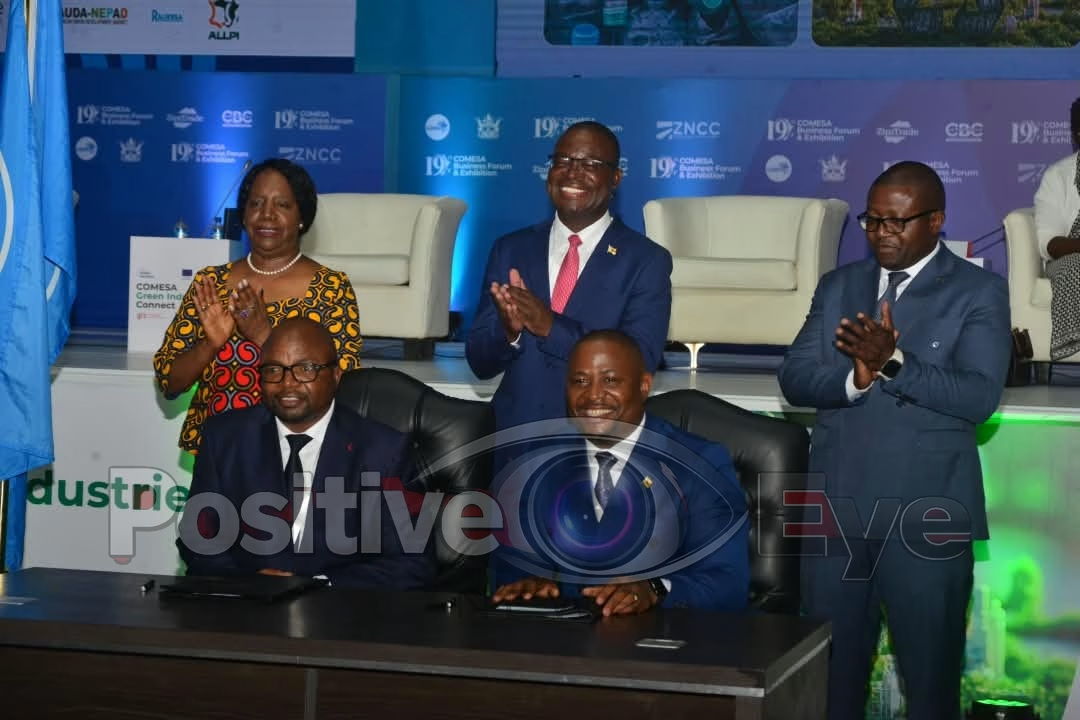
The programme began on Monday, 19 October, with the COMESA Green Industries Connect and the opening of the Multi-Sectoral International Exhibition at the Harare International Conference Centre. The Business Forum follows on Tuesday, 20 October, while foreign affairs ministers are scheduled to meet on Wednesday ahead of the Heads of State and Government Summit on Thursday, 22 October.
For Zimbabwe, the significance extends beyond hosting a high-level regional gathering. The forthcoming chairmanship offers an opportunity to influence the regional integration agenda, strengthen commercial relationships and position domestic enterprises to access a wider regional market. The central challenge is to ensure that diplomatic visibility translates into investment, industrial expansion, stronger exports and employment opportunities.
This economic imperative was underscored at the opening of the COMESA Green Industries Connect, where Minister of Industry and Commerce Hon. N. M. Ndhlovu called for regional industrialisation commitments to move beyond policy declarations towards investments, modernised production facilities, viable enterprises and measurable employment outcomes.
The Minister’s remarks introduced a practical dimension to the summit week, linking regional integration with the transformation of how businesses produce, process and trade goods. Zimbabwe’s incoming chairmanship, he indicated, presents an opportunity to work with member states, the COMESA Secretariat and the private sector to strengthen industrial capacity while promoting more efficient and environmentally responsible production.
One of the most notable proposals was the establishment of a COMESA Circular Economy Fund to support viable businesses investing in cleaner production, energy-efficient equipment, recycling infrastructure and the conversion of waste into productive inputs. The proposal, presented by the Minister for consideration by COMESA, remains an initiative requiring further development rather than an established regional financing facility.
Its potential significance lies in addressing a persistent constraint on industrial development: the gap between identifying commercially promising opportunities and securing the finance, technology and infrastructure needed to implement them. If carefully designed and adequately financed, such a facility could help eligible enterprises modernise equipment, develop recycling capacity and improve resource efficiency while creating new commercial opportunities.
The proposal also reflects a broader economic argument. Waste management need not remain solely an environmental obligation. When collection systems, recycling facilities, manufacturers and markets are effectively connected, discarded materials can become inputs for new products, supporting businesses and employment across the production chain.
For COMESA, the opportunity would be to develop cooperation that enables such businesses to operate beyond individual national markets. However, the success of any proposed fund would depend on its financing model, transparent eligibility criteria, commercially viable projects and measurable industrial and environmental benefits.
The Minister also placed sustainable industrialisation within Zimbabwe’s broader development framework, referencing Vision 2030, the National Development Strategy 2, the Zimbabwe National Industrial Development Policy 2 and the Local Content Strategy. These frameworks emphasise domestic value addition, stronger local production, expanded exports and employment creation.
His argument was that environmental sustainability and industrial growth should not be treated as competing priorities. More efficient use of energy, water and raw materials can lower production costs, improve reliability and strengthen competitiveness. For manufacturers operating in demanding markets, resource efficiency can therefore become an economic advantage rather than simply an environmental consideration.
Zimbabwe is working with the Climate Technology Centre and Network on a National Decarbonisation Roadmap for the cement sector, according to the Minister. He also identified opportunities in iron and steel, mineral processing and other manufacturing industries, where improvements in energy efficiency, renewable energy and water recycling could support more competitive production.
These initiatives illustrate the kind of practical industrial policy that could feature more prominently during Zimbabwe’s COMESA chairmanship. The objective is not simply to increase the number of factories or the volume of production, but to strengthen the capacity of industries to manufacture competitively, use resources efficiently and supply markets consistently.
The Minister cited Zimbabwe’s shipment of locally processed lithium sulphate to China as an illustration of the opportunities created by moving further up the value chain. The example reinforces the importance of mineral beneficiation and processing in retaining more economic value within producing economies.
For the wider COMESA region, the same principle applies to agriculture, leather, textiles, energy and other industries. Countries can achieve stronger industrial linkages by processing raw materials, manufacturing intermediate goods and developing complementary production capabilities. Rather than relying exclusively on exports of unprocessed commodities or imports of finished products, regional cooperation can help build more connected manufacturing systems.
This is particularly relevant to the emerging electric mobility industry. The Minister urged COMESA countries to look beyond importing finished electric vehicles and consider opportunities in vehicle assembly, charging infrastructure, battery technologies, maintenance services and the manufacture of related components.
Such ambitions would require reliable electricity, suitable infrastructure, technical skills, supportive policies and safe systems for collecting and recycling batteries at the end of their useful lives. No single country necessarily needs to develop every component of the value chain independently. Regional partnerships could allow member states to combine mineral resources, engineering capabilities, manufacturing capacity and market access to attract investment and develop specialised industries.
The same logic underpins the proposed expansion of circular production. The Minister identified the need for stronger regional value chains in recycling and resource recovery, supported by effective waste collection, infrastructure, standards, financing and reliable markets. He also called for small and medium-sized enterprises, women and young entrepreneurs to participate meaningfully in the businesses and jobs emerging from the transition.
The policy foundations already exist in several regional initiatives. According to the Minister, the COMESA Industrialisation Strategy and Action Plan identifies priority sectors including agro-processing, leather, textiles, energy and mineral beneficiation. He also referred to commitments made by COMESA ministers responsible for industry and investment at their 8 September 2026 meeting, including support for an inclusive transition to a circular economy and the promotion of green and circular businesses.
The immediate task, therefore, is implementation. Regional strategies must be reflected in national programmes, supported by clear institutional responsibilities and adequate resources, with monitoring mechanisms capable of measuring delivery. The test is whether these commitments produce actual investment, upgraded industrial facilities, stronger enterprises and new jobs.
Trade facilitation will be equally important. The Minister called for greater alignment of green standards, cooperation on product testing and improved conformity assessment to reduce unnecessary compliance costs and ease the movement of qualifying products across borders.
This is a critical link between industrial policy and regional integration. A manufacturer may invest in modern machinery and produce goods that meet market demand, but its competitiveness can still be undermined by duplicated inspections, inconsistent standards, expensive logistics and unpredictable border procedures. More coordinated regional systems could reduce these burdens while enabling businesses to serve larger markets.
The COMESA Free Trade Area offers qualifying goods preferential access to participating markets, subject to applicable rules of origin and other requirements. For Zimbabwean businesses, the commercial opportunity lies in matching this market access with production capacity, competitive pricing, consistent quality and dependable delivery. Preferential access creates an opening, but businesses must still be equipped to compete.
The 19th COMESA Business Forum consequently assumes importance as a meeting point between policy priorities and commercial realities. Discussions on regional value chains, investment financing, digital transformation, artificial intelligence and industrial competitiveness can help identify barriers affecting enterprises and the reforms required to address them.
The private sector must remain central to this process. Governments have a responsibility to provide predictable policies, appropriate regulation and enabling infrastructure, while businesses must invest in productive capacity, innovation, cleaner technologies and regional partnerships. Financial institutions, development partners, universities and research institutions also have roles in mobilising capital, developing financing instruments and supporting technological advancement.
For smaller enterprises in particular, access to finance can determine whether a promising commercial opportunity becomes a viable business. Limited working capital, expensive borrowing and insufficient trade finance can prevent firms from purchasing equipment, fulfilling large orders or establishing distribution networks beyond their home markets. Financing mechanisms that support commercially sound projects could help more businesses participate in regional value chains.
Digital transformation offers another route towards more efficient trade. Electronic documentation, interoperable customs systems, digital payments and data-driven logistics can reduce transaction costs and improve the movement of goods and information. Artificial intelligence and other emerging technologies may also support production planning, logistics and customer services, provided businesses have access to connectivity, skills and appropriate infrastructure.
The Multi-Sectoral International Exhibition, running from 19 to 21 October, provides an additional platform for enterprises to showcase products, services, innovations and investment opportunities. Its commercial value will depend on whether the visibility generated leads to buyer relationships, distribution arrangements, investment discussions and supply contracts.
For participating Zimbabwean businesses, preparation is essential. Companies seeking regional partners need to demonstrate what they produce, their pricing, available production capacity, applicable standards and plans for expansion. The exhibition creates an opportunity to establish relationships, but converting those relationships into business will require follow-through and commercially credible proposals.
The forthcoming Heads of State and Government Summit will provide the broader political framework for these priorities. Regional leaders are expected to consider integration and industrial development, while the programme includes the launch of the COMESA Medium-Term Strategic Plan for 2026–2030. The plan is intended to guide regional priorities in areas including industrialisation, value addition, intra-regional trade, infrastructure connectivity, digital transformation and citizen welfare.
For His Excellency Dr Emmerson Dambudzo Mnangagwa, President and First Secretary of ZANU PF, the anticipated chairmanship would place Zimbabwe at the centre of these discussions during the 2026–2027 term. It offers an opportunity to build consensus around practical reforms that connect regional cooperation with production, investment and trade.
However, chairmanship alone cannot resolve the region’s structural economic challenges. Progress will depend on sustained cooperation among governments, customs authorities, regulators, financial institutions and private enterprises. Agreed measures must be implemented consistently if they are to reduce business costs and improve the conditions under which regional companies operate.
Zimbabwe also has a domestic responsibility to prepare its enterprises to take advantage of the opportunities being discussed in Harare. This requires stronger production capacity, improved standards, market intelligence, reliable infrastructure and closer collaboration between businesses and trade-support institutions. Government policy can establish the enabling environment, but firms must also invest in quality, efficiency and innovation.
For farmers and agro-processors, regional integration could widen access to buyers and create incentives for investment in storage, transport and processing. For manufacturers, a larger market can improve the prospects of scaling production. For recycling businesses and emerging green industries, regional cooperation could help establish supply chains and markets that may be difficult to sustain at a smaller national scale.
The central issue is whether the COMESA engagements can connect these opportunities to practical mechanisms for delivery. The proposed Circular Economy Fund, stronger regional standards, investment partnerships and industrial value chains offer possible avenues, but each requires clear implementation arrangements, financing and accountability.
As the proceedings move towards the Heads of State and Government Summit, Zimbabwe faces two connected tasks: helping advance regional economic integration and ensuring that its own businesses are ready to benefit from it. Strong regional agreements will have limited effect if enterprises cannot supply competitive goods, while domestic production gains can be constrained if cross-border trade remains costly and unpredictable.
The success of the forthcoming chairmanship will therefore be measured less by the prominence of the proceedings than by the economic changes that follow. More efficient trade, investment in productive capacity, stronger regional manufacturing, viable enterprises and sustainable employment would provide tangible evidence of progress.
Ultimately, “One Market, One Future” must mean more than a shared ambition expressed at a regional summit. It must translate into markets that businesses can access, industries that can compete, resources that generate greater local value and opportunities that reach citizens. As Zimbabwe prepares to assume COMESA’s rotating chairmanship, the challenge is to turn the region’s industrial and commercial potential into measurable economic results.