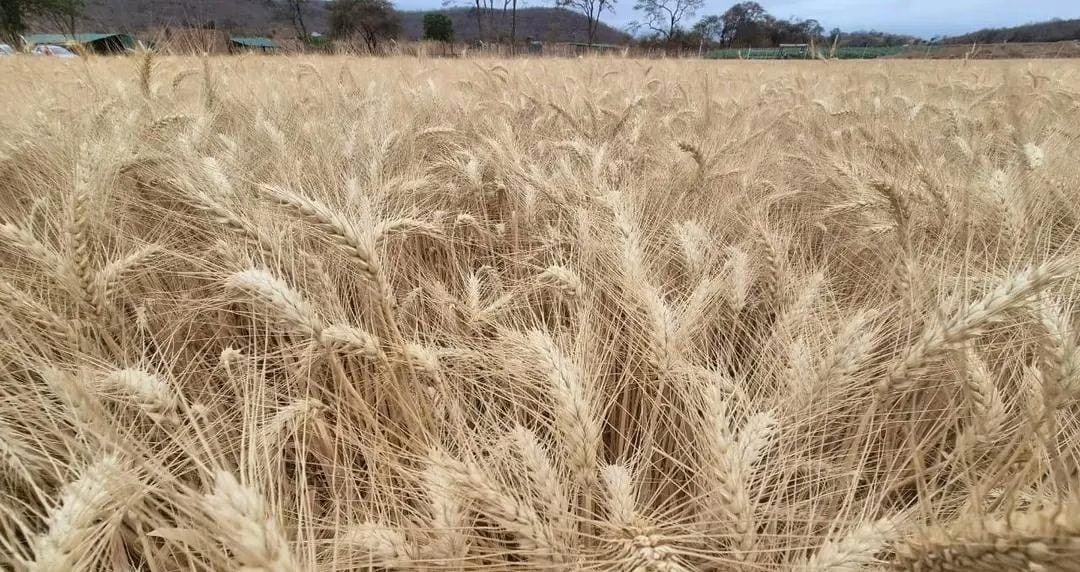
The harvesting of nearly 900 hectares of wheat in Mashonaland Central since September is more than a seasonal agricultural milestone. It provides an indication of how Zimbabwe’s food-security strategy is increasingly being anchored on irrigation, domestic production and the ability of farmers to produce strategic crops beyond the traditional summer agricultural cycle.
Wheat occupies a particularly important position in the national food system because of its direct connection to bread, flour and a wide range of processed foods consumed daily. Consequently, every additional hectare placed under productive wheat cultivation has implications beyond the farm gate, particularly for the availability and cost of basic food products.
The significance of the Mashonaland Central harvest lies partly in what it says about irrigation. Winter wheat production depends heavily on reliable water supplies, making irrigation infrastructure one of the most important determinants of whether Zimbabwe can consistently expand domestic wheat production. The province’s output therefore reinforces the argument that investment in dams, irrigation schemes, water conveyancing infrastructure and efficient irrigation technologies should be treated as food-security infrastructure rather than simply agricultural assets.
Zimbabwe’s exposure to imported wheat has historically meant that developments in international commodity markets can eventually find their way into domestic food prices. International prices, freight costs, exchange-rate movements and supply disruptions can all affect the cost of imported grain and, ultimately, the price structure of products such as bread and flour.
Increasing domestic production changes that equation. It does not eliminate the need for imports or remove Zimbabwe from international markets, but it gives the country greater capacity to absorb external shocks. A stronger domestic wheat sector can therefore function as a strategic economic buffer, particularly when global grain markets become volatile.
The Mashonaland Central harvest also brings into focus the economics of agricultural production. Putting more land under wheat is only meaningful if farmers can access affordable finance, fertiliser, chemicals, machinery, electricity and irrigation services while receiving viable returns from their crop. High production costs can undermine the very food-security gains that increased hectarage is intended to deliver.
This makes the next phase particularly important. Zimbabwe’s objective should not simply be to celebrate hectares harvested, but to build a productive and commercially sustainable wheat value chain. That requires stronger coordination between farmers, financial institutions, input suppliers, millers, processors and markets.
There is also a wider rural-development dimension. Higher wheat output can stimulate demand for agricultural services, transport, storage, mechanisation and processing, creating economic activity beyond the farms themselves. If supported by appropriate infrastructure and market linkages, agricultural production can therefore become a broader engine of rural economic development.
The strategic question now is whether Zimbabwe can turn provincial successes into a sustained national wheat-production system. The answer will depend less on expanding hectarage alone and more on whether government and the private sector can make wheat production consistently profitable, irrigated and market-secure.
The policy takeaway is clear: Zimbabwe should treat irrigation and wheat production as strategic food-security infrastructure, not short-term agricultural programmes. This means prioritising investment in irrigation rehabilitation and expansion, reducing the cost of productive inputs, improving access to affordable agricultural finance and establishing predictable market arrangements that give farmers confidence to plant at scale.
If these measures are sustained, the Mashonaland Central harvest can become more than a good season. It can form part of a structural shift towards lower import dependence, stronger rural production and greater resilience to global food and price shocks. If they are not, Zimbabwe risks repeatedly celebrating individual harvests without building the production system required to sustain national food security.