By Aldridge Dzvene
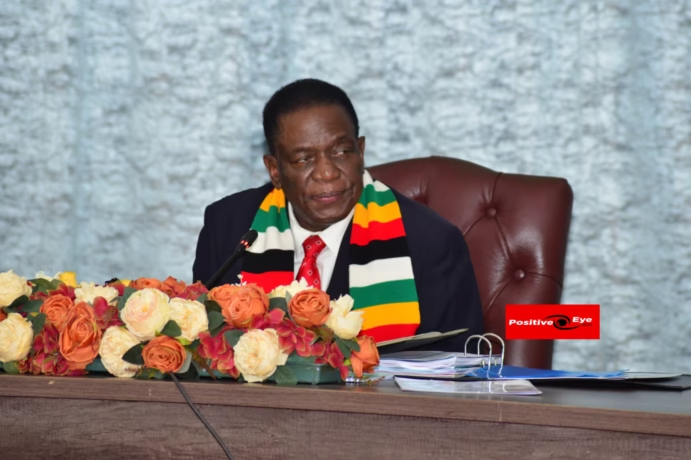
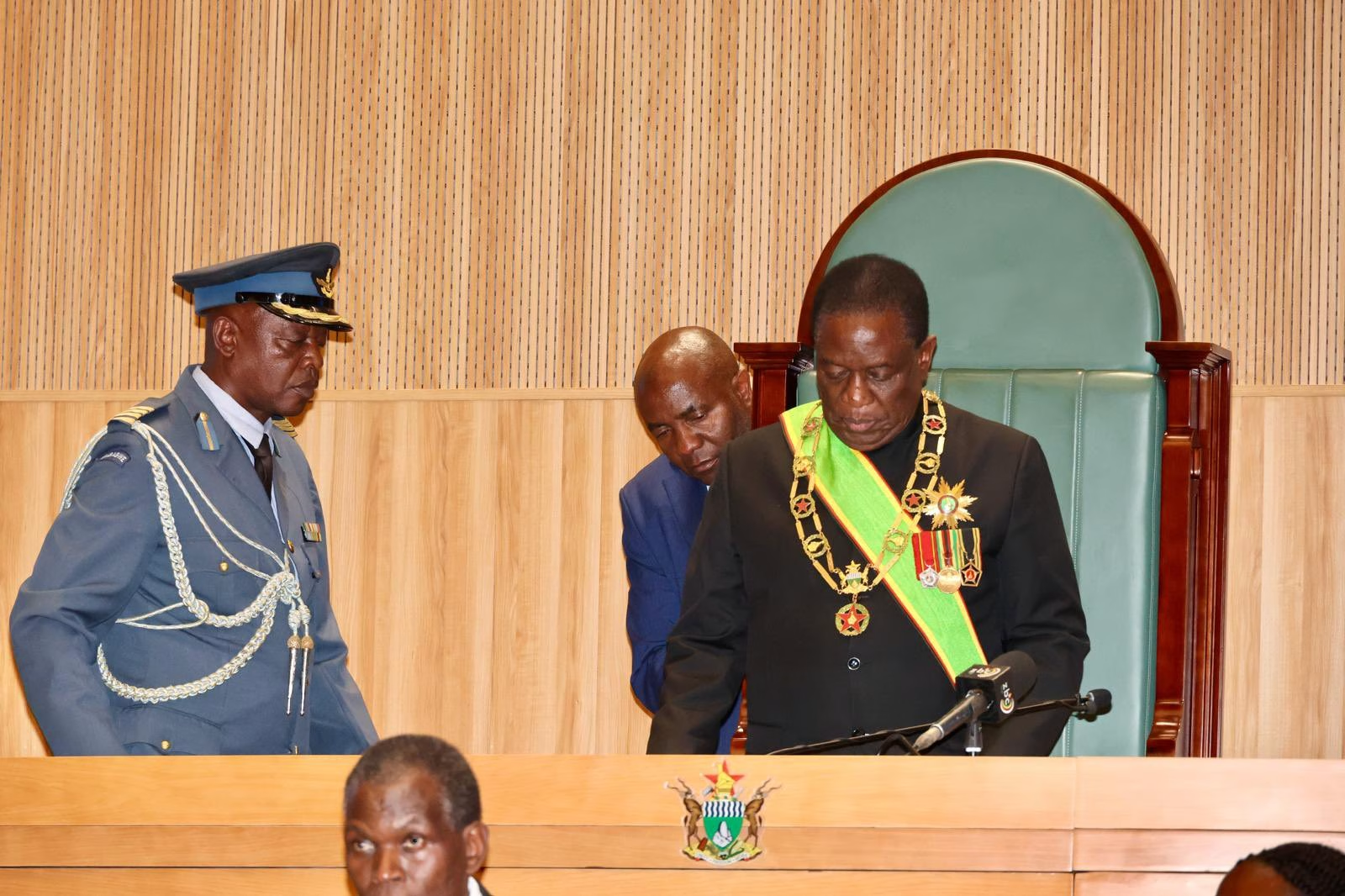
HARARE — His Excellency Dr Emmerson Dambudzo Mnangagwa, President and First Secretary of ZANU PF, has opened the Fourth Session of the Tenth Parliament with a State of the Nation Address that effectively places legislation, economic consolidation and accelerated implementation at the centre of Zimbabwe’s final stretch towards Vision 2030.
Addressing Parliament at the New Parliament Building on 29 September 2026, His Excellency Dr Emmerson Dambudzo Mnangagwa presented a wide-ranging account of the country’s economic and social trajectory while outlining the legislative programme that will occupy the Fourth Session. The address was therefore more than an assessment of national conditions. It was a presidential roadmap connecting economic stability, production, infrastructure, investment, social services, institutional reform and international engagement to the broader development agenda of the Second Republic.
The timing of the address gives the programme particular significance. With less than four years remaining to 2030, the national development conversation is increasingly moving from the establishment of policy direction to the consolidation of measurable outcomes. His Excellency Dr Emmerson Dambudzo Mnangagwa acknowledged this trajectory while maintaining that significant work remains to be done, framing the Fourth Session as an opportunity to scale up transformational results across sectors and levels of society.
At the centre of the economic narrative was the Government’s assertion that macro-economic stability has been consolidated over a considerable period. His Excellency Dr Emmerson Dambudzo Mnangagwa reported that inflation had remained in single digits since January 2026, while foreign currency inflows reached US$10.7 billion during the first half of the year and were projected to approach US$20 billion by year-end. Against this backdrop, the reported 8.3 percent GDP growth, supported significantly by a 27.9 percent expansion in agriculture, places the country’s economic performance within the broader question of whether stability can now be converted into deeper productive capacity and sustained improvements in livelihoods.
That distinction is important because the speech did not present stability as the destination. Rather, His Excellency Dr Emmerson Dambudzo Mnangagwa linked macro-economic gains to investment, industrialisation, value addition and production. The emphasis on improving the financial sector institutional framework, reviewing licences and regulatory requirements across 13 sectors, and creating conditions for provincial industrialisation points to an economic strategy in which the next stage of growth is expected to be driven increasingly by productive activity rather than stability alone.
Mining occupies a central position within that strategy. His Excellency Dr Emmerson Dambudzo Mnangagwa described the sector as a key anchor of economic development while highlighting systematic mineral exploration, bankable investment projects, lithium sulphate production, iron and steel development and expansion in gold and platinum group metals. The significance of this approach lies in the movement from extraction towards beneficiation, because the deeper economic opportunity is not simply the value of minerals leaving Zimbabwe, but the industrial ecosystems that can be created around processing, manufacturing, engineering, logistics, technology and local supply chains.
The agricultural component of the address presented a similar emphasis on resilience and productive capacity. Following the reported strong performance of the sector in 2026, His Excellency Dr Emmerson Dambudzo Mnangagwa warned of an expected period of below-normal rainfall in the SADC region and outlined a six-pillar resilience plan incorporating an enhanced strategic grain reserve, climate-smart production, integrated financing, livestock drought mitigation, coordination, early warning and capacity building. The message is significant because agricultural policy is being positioned not simply around production in a favourable season, but around the ability of the national food system to absorb climatic shocks and maintain production.
The President’s infrastructure agenda further demonstrates the relationship between development policy and the physical architecture of the economy. His Excellency Dr Emmerson Dambudzo Mnangagwa identified major sections of the Harare-Beitbridge, Harare-Kanyemba, Harare-Nyamapanda, Bulawayo-Victoria Falls, Harare-Chirundu and Kwekwe-Nkayi-Lupane roads for construction or completion during the Fourth Session, alongside the Mabvuku Interchange, airport upgrades and railway rehabilitation. These projects are significant not only because of their domestic connectivity, but because they form part of a wider attempt to strengthen Zimbabwe’s position within regional trade and transport corridors.
The railway programme adds another dimension to that strategy. The proposed 311-kilometre Kafue-Lion’s Den railway link between Zimbabwe and Zambia, together with the rehabilitation of the 614-kilometre Chicualacuala-Plumtree line, places rail infrastructure within a regional economic framework. For an economy seeking to increase exports, attract investment and deepen regional trade, transport infrastructure becomes an instrument of competitiveness rather than simply a public works programme.
Energy is equally central to this equation. His Excellency Dr Emmerson Dambudzo Mnangagwa pointed to improvements in electricity availability through Kariba and Hwange, independent power producers, captive power plants, net-metering, rooftop solar and rural electrification. The significance of this development extends across virtually every productive sector because sustained industrialisation, mining expansion, agricultural processing and digital economic activity all depend upon reliable energy. The policy challenge therefore shifts towards maintaining supply while simultaneously preparing for rising demand as production expands.
The legislative programme announced by His Excellency Dr Emmerson Dambudzo Mnangagwa gives the Fourth Session another layer of significance. Following the enactment of Constitutional Amendment Act No. 3, Parliament is expected to consider consequential amendments to the Electoral Act and Constitutional Court Act, as well as legislation establishing a new Delimitation Commission. These measures illustrate an important feature of parliamentary governance: constitutional reform does not end with an amendment to the Constitution, because the principles established at constitutional level must subsequently be translated into functioning legislation and institutions.
The proposed legislation on justice, including the Child Justice Bill, Whistle Blowers and Witness Protection Bill and Legal Aid Bill, similarly broadens the scope of the session beyond economic reform. The programme also extends into public administration, foreign affairs, water management, agriculture, environmental protection, education, healthcare, transport, policing, drug control, trafficking in persons, defence and veterans of the armed liberation struggle. Collectively, these Bills point towards an attempt to update the legal architecture supporting a rapidly changing economy and society.
Healthcare provides another illustration of the breadth of the legislative agenda. His Excellency Dr Emmerson Dambudzo Mnangagwa announced the National Healthcare Provision Bill alongside legislation dealing with medicines and allied substances, medical research, food safety and mental health. Considered together, these measures indicate that the legislative programme is addressing not merely individual sectors but the regulatory systems underpinning public service delivery, institutional accountability and access to essential services.
The proposed Foreign Affairs and International Trade Bill is equally important within the economic dimension of the address. His Excellency Dr Emmerson Dambudzo Mnangagwa said the Bill would formally place trade and investment promotion within the statutory mandate of Zimbabwe’s diplomatic missions while strengthening coordination across Government in projecting “Brand Zimbabwe”. This places economic diplomacy within the country’s wider investment and export strategy, particularly as Zimbabwe prepares to assume the COMESA chairmanship and take up its United Nations Security Council non-permanent seat for the 2027 to 2028 term.
The President’s remarks on citizen engagement also point towards an evolving relationship between Government and citizens. The proposed centralised Citizen Engagement Platform is intended to capture citizens’ views on policy, reform and public-sector performance. Its significance will ultimately depend on how information gathered through such a mechanism feeds into policy development, institutional responsiveness and corrective action, but its inclusion in the State of the Nation Address demonstrates the growing importance being attached to structured engagement between citizens and the state.
From a parliamentary perspective, the Fourth Session therefore presents a substantial workload that extends beyond the formal passage of legislation. Parliament’s role will include examining the detail of proposed Bills, considering their constitutional implications, scrutinising Government expenditure and programmes, representing constituencies and following up on implementation. The President’s address establishes the executive’s priorities, while the parliamentary process provides the constitutional space through which those priorities are debated, refined and translated into law.
This distinction is essential to understanding the significance of the State of the Nation Address. A presidential address sets out the direction of Government and provides the national development narrative, but the subsequent parliamentary process determines how much of that agenda becomes legislation, how the legislation is scrutinised and how implementation is subjected to oversight. The Fourth Session consequently represents an important link between the policy direction articulated by His Excellency Dr Emmerson Dambudzo Mnangagwa and the institutional machinery required to deliver it.
The address also reinforced the Second Republic’s emphasis on development occurring across the whole country. From roads and electricity to agriculture, mining, tourism, healthcare, skills development and property formalisation, the speech repeatedly returned to the objective of ensuring that development reaches both urban and rural communities. The emphasis on leaving no one and no place behind therefore runs through the economic, social and infrastructure components of the programme rather than appearing merely as a political slogan.
The international dimension strengthens this narrative. Zimbabwe’s forthcoming role on the United Nations Security Council, the assumption of the COMESA chairmanship and preparations for international sporting and economic events provide additional platforms through which the country can promote its interests, investment opportunities and development priorities. His Excellency Dr Emmerson Dambudzo Mnangagwa’s reference to Zimbabwe’s philosophy of being “A Friend to All and an Enemy to None” consequently places foreign engagement within a broader strategy of international cooperation and economic diplomacy.
Ultimately, the 2026 State of the Nation Address can be read as a statement of consolidation and acceleration. His Excellency Dr Emmerson Dambudzo Mnangagwa presented the economic gains, infrastructure projects and institutional reforms of the Second Republic as foundations upon which the country must now build, while simultaneously acknowledging that significant work remains before the 2030 objective is reached.
For the Fourth Session of the Tenth Parliament, the significance of the address will therefore be measured not only by the number of Bills introduced or passed, but by the quality of the legislative architecture created around the country’s development programme. The effectiveness of parliamentary scrutiny, the implementation of enacted laws, the sustainability of public investment and the ability of institutions to translate policy into tangible outcomes will determine how the programme outlined in the President’s address ultimately manifests across the country.
His Excellency Dr Emmerson Dambudzo Mnangagwa has set out the direction with considerable breadth, linking economic stability to production, production to industrialisation, industrialisation to infrastructure and infrastructure to national development. The Fourth Session now becomes the parliamentary phase of that programme, with legislation and oversight providing the bridge between presidential policy direction and implementation on the ground.
As Zimbabwe moves towards 2030, the central development question is consequently becoming increasingly precise: how effectively can the policies, investments and reforms outlined by the Second Republic be institutionalised, implemented and sustained so that the transformation described from the floor of Parliament becomes an enduring economic and social reality?