Zimplats delivered a sterling performance for the year ended 30 June 2026, with revenue surging 57% to US$1.3 billion from US$826.6 million in FY2025 on the back of broad-based strength in precious and base metal prices, improved mining and milling volumes, and significant gains in safety.
In his letter, Chairman Professor Fholisani Sydney Mufamadi said despite a challenging operating environment, the Company delivered a strong performance, reflecting the dedication of management and employees and strategic oversight of the Board, and was particularly encouraged by continued improvement in safety with zero fatalities recorded for the second consecutive year.
Chief Executive Officer Alex Mhembere said safety remains the foundation of sustainable performance, with the Company progressing its safety journey through strategic initiatives to strengthen employee engagement, risk awareness and a safety-first culture.
During FY2026, lost-time injuries reduced to four from 13 in the prior year, resulting in the lost-time injury frequency rate improving 68% to 0.22 per million man-hours worked from 0.68. Total injuries declined to 10 from 19, improving the total injury frequency rate by 46% to 0.54. Most importantly, operations closed the year with 4.75 million cumulative fatality-free shifts, up from 2.44 million in FY2025, marking an important milestone. The Company retained its OHS ISO 45001:2018 certification following third-party surveillance.
Operationally, performance strengthened across the mining value chain. Mined ore volumes increased 9% to 8.4 million tonnes from 7.7 million tonnes, driven by improved availability of trackless mobile machinery across underground operations and increased open-pit contribution from South Pit Mine, which produced 461,000 tonnes compared to 220,000 tonnes in FY2025. By mine, South Pit delivered 0.5 million tonnes, Ngwarati 0.7 million tonnes following successful ramp-up of pillar reclamation using fleets redeployed from the now-depleted Rukodzi Mine, Mupfuti 1.6 million tonnes in line with planned tapering towards depletion in FY2030, Bimha 3.2 million tonnes up 10%, and Mupani 2.4 million tonnes up 20% as it continues to ramp up to replace Rukodzi, Ngwarati and part of Mupfuti.
Ore milled increased 8% to 8.0 million tonnes from 7.5 million tonnes in line with improved ore supply, though 6E head grade retraced 2% to 3.29g/t from 3.37g/t due to higher volumes of lower-grade open-pit ore and dilution from traversing geological structures. Concentrator 6E recovery was stable at 77.6%. As a result, 6E in concentrate production improved 5% to 660,000 ounces from 628,000 ounces, while 6E production in final matte was unchanged at 606,300 ounces, as circa 24,000 ounces of concentrate accumulated in stock following smelter maintenance in the second half. Concentrates smelted rose 9% to 225,046 tonnes from 205,643 tonnes after commissioning of the smelter expansion in FY2025, with 6E production in converter matte up 5% to 606,300 ounces.
Sales volumes decreased 2% to 598,369 ounces from 613,336 ounces due to material in transit at year-end, but gross revenue per 6E ounce surged 61% to US$2,171 from US$1,349. Consequently revenue grew 57% to US$1.3 billion. Cost of sales increased 20% to US$860.9 million from US$720.3 million due to higher mining and milling volumes, increased labour costs following full restoration of employee earnings and higher engineering maintenance costs, with cash operating cost per 6E ounce up 23% to US$1,102 from US$898. Despite cost pressures, gross profit improved four-fold to US$437.9 million from US$106.3 million, with gross margin expanding to 34% from 13%.
Profit before tax increased 484% to US$387.5 million from US$66.4 million largely due to improved metal prices, while income tax rose 328% to US$110.8 million. Profit after tax increased 583% to US$276.7 million from US$40.5 million. Net cash generated from operating activities increased to US$180.5 million from US$127.2 million on higher sales proceeds, with loan repayments of US$69.3 million made during the year and closing cash at US$58.3 million compared to US$99.3 million in FY2025.
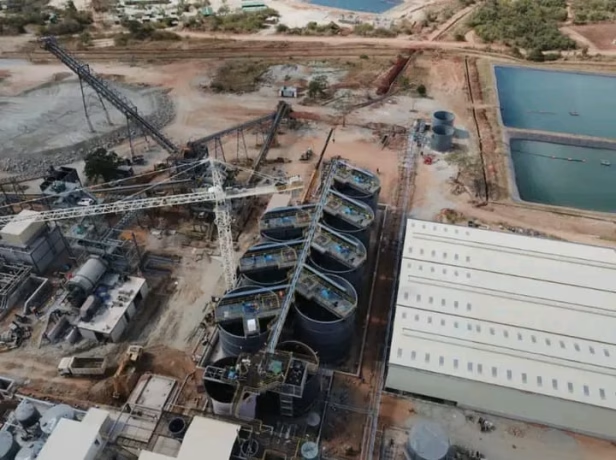
Capital expenditure decreased 4% to US$153.5 million from US$160.7 million as major projects tapered. Expansion capex fell 73% to US$12 million from US$44.8 million, while stay-in-business capex increased to US$122.2 million from US$90.8 million driven by the 45MW Phase 2A solar project and replacement of the trackless mobile machinery fleet. The Company invested US$55.2 million in replacing TMM fleet and support equipment to enhance reliability. The Selous Metallurgical Complex tailings storage facility extension achieved technical completion of Phase 1 at US$25 million within budget, with Phase 2 progressing to US$8 million spent, bringing cumulative spend to US$33 million against a US$43 million budget, supporting concentrator operations through to FY2049.
On energy transition, following successful commissioning of the 35MW solar plant in FY2025, Zimplats commenced Phase 2A 45MW project, which remains on track for commissioning in H1 FY2027 and will bring total installed solar to 80MW. Cumulative expenditure reached US$45 million against a US$54 million budget. This forms part of the broader 185MW solar portfolio aimed at diversifying energy, enhancing security, mitigating cost risks and reducing carbon footprint.
The development of Mupani Mine, which will replace depleted Rukodzi and Ngwarati mines, progressed according to plan and remains on schedule to achieve full-scale production of 3.6Mtpa by FY2029, with spend of US$19.3 million in FY2026, down 23% in line with planned scope.
On environment, Zimplats retained ISO 14001:2015 Environmental Management System and ISO 9001:2015 Quality Management System certifications and commenced alignment for ISO 14001:2026. Water stewardship improved, with 68% of water recycled and reused from 65% in FY2025, contributing to a 1% reduction in freshwater abstraction to 7,443 megalitres and a 6% improvement in freshwater consumption to 0.91 kilolitres per tonne milled. Carbon intensity improved 6% to 0.047 tonnes CO2 per tonne milled due to renewable contribution, while energy consumption improved 2% to 0.45 gigajoules per tonne. Sulphur dioxide emissions increased 35% to 40,038 tonnes due to higher smelting capacity and elevated sulphur in third-party toll concentrates. Progressive rehabilitation covered 17.2 hectares, up 39% from 12.4 hectares, including 9.6 hectares of open-pit and 7.5 hectares of tailings surface revegetated.
On people, headcount increased 3.5% to 4,296 employees from 4,150, with contractor employees up 4% to 3,649, in line with recovery from low PGM prices and project requirements, while labour turnover remained stable at 5%. The Company restored salaries fully and implemented inflation-linked adjustments, strengthening its employee value proposition despite critical skills attrition, and launched a Men’s Forum as a sub-committee of the Gender Forum on 5 May 2026 to address male-specific issues including mental health, suicide, infidelity and gambling. Health programmes were expanded with on-site laboratory investigations, point-of-care diagnostics, mental health first aiders, counselling, and surveillance of epidemic-prone diseases including malaria, with no outbreaks of waterborne or respiratory diseases reported.
Social investment totalled US$0.6 million from US$0.5 million, spanning community wellbeing, education and local enterprise development, including the ninth year of the Albinism Awareness Initiative across six provinces, support for 11 community granaries, training of 58 farmers at Gwebi Agricultural College, provision of furniture to Chingondo Primary School, drilling of a borehole for Tyrone Horticultural Project benefiting 27 households, and repairs to Chegutu Phase 4 road. Spend through local enterprise development suppliers rose to US$76 million from US$50 million, with local suppliers accounting for more than 53% of Company spend, supporting 22 enterprises, six women or youth-led, and 3,315 jobs.
On taxation, Zimplats maintained full compliance and met its obligations, with continued engagement fostering transparency.
Looking ahead, Zimplats said it remains focused on achieving zero harm, advancing mine replacement projects to ensure sustainable ore generation, completing the second phase of the solar power project, and prioritising stay-in-business capital to maintain asset integrity, improve reliability and support production targets.